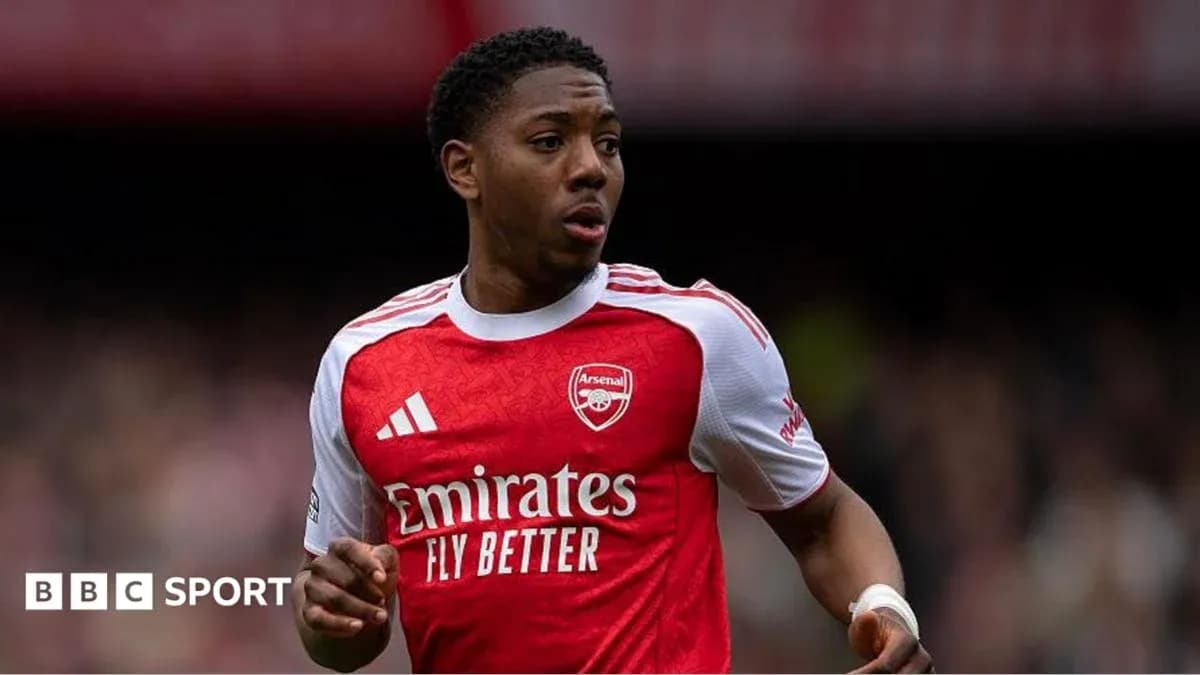
Myles Lewis-Skelly: From Emergency Full-Back to Arsenal's Future Star
Myles Lewis-Skelly has never taken the easy road into Arsenal’s first team. He has had to force doors open.
At 19, with barely a full season behind him, he already feels like one of those players supporters talk about differently. Not just as a prospect, but as a marker of what the club wants to be.
From emergency full-back to England history-maker
His breakthrough in 2024-25 came out of chaos. Injuries shredded Mikel Arteta’s options, the squad bent under the strain, and a teenager from Hale End was shoved in at left-back – a role that was never supposed to be his.
He didn’t just cope. He surged.
Within months, Lewis-Skelly had turned a stopgap assignment into a statement. He became one of the standout young full-backs in the Premier League, driving Arsenal’s build-up with the composure of a seasoned midfielder masquerading on the flank.
That is, of course, exactly what he was.
He came through Hale End as a midfielder and has never been shy about saying that is his position. Even while defending the back post and tracking wingers, you could see the midfielder’s brain at work: drifting inside to invert, slipping out of pressure in tight spaces, exploding away from challenges. His ball protection, his balance, his ability to break a press – they already rank with some of the best in the division.
The rewards came quickly. In March 2025, he stepped onto the Wembley pitch for England and into the record books. Against Albania, he became the youngest man to score on his England debut, opening a 2-0 win under the arch. A few months later, Arsenal handed him a new five-year contract. The club knew what it had.
Yet even for a prodigy, the climb is never straight.
Squeezed out by experience
Last season bit back.
Riccardo Calafiori, the £42m signing from 2024, returned to full fitness. The Italian’s swaggering, unpredictable surges from the back are central to how Arsenal attack. Arteta then added another left-sided defender, bringing in Piero Hincapie from Bayer Leverkusen on loan, a deal that has now become permanent.
Two established internationals. Both older. Both trusted. Suddenly, the teenager who had lit up the previous campaign found the path ahead crowded.
Arteta admitted he had been “tough” on Lewis-Skelly. The minutes dried up. The story threatened to stall.
Then the season’s strain began to show elsewhere. Martin Zubimendi’s form dipped as the run-in approached. With four league games left, Arsenal needed fresh legs and fresh ideas in midfield.
The door creaked open again.
Lewis-Skelly stepped into the centre of the pitch against Fulham and played as if he had been waiting his whole life for that exact moment. Sharp on the turn, calm under pressure, aggressive in his pressing – this was Hale End’s midfielder finally operating where he had always believed he belonged.
He kept his place. From that Fulham match on, he started all but one of the remaining fixtures as Arsenal surged to the Premier League title and reached the Champions League final, losing to Paris St-Germain. On the biggest stages, with the season on the line, Arteta trusted a 19-year-old academy graduate in the heart of his team.
The message was clear: this was no longer just a useful full-back. This was a midfielder Arsenal could build around.
“Pure profit” and a brutal reality
Modern football does not allow romance to stand alone. It measures as much in balance sheets as in banners.
As an academy product, any transfer fee for Lewis-Skelly would register as “pure profit” in Arsenal’s accounts. The phrase has become a cold shorthand in the game, a reminder that homegrown players are not only symbols but assets.
Supporters hate that language. Especially when it is applied to one of their own, a kid who has grown up in their colours and now lifts their trophies.
Lewis-Skelly knows the conversation is happening. When Arsenal celebrated the title at Selhurst Park on the final day of last season, he posted a picture with the Premier League trophy and captioned it, pointedly: “pure profit”.
A joke. A jab. A nod to the debate swirling around him.
Arsenal want to operate sustainably, and the market demands trading. After spending around £250m on new players last summer, the club cannot ignore the need to sell, even with room still left in their financial plans.
At one stage, they were prepared to listen to offers for Lewis-Skelly. On paper, it made sense. On the pitch, his performances in central midfield at the end of the campaign complicated the equation. Those games did not just keep Arsenal’s title charge on track; they may have forced a rethink over his status this summer.
Guimaraes incoming, competition everywhere
There is another layer to the story.
Arsenal are closing in on the signing of Newcastle captain Bruno Guimaraes in a deal that could rise to £80m. A midfielder of that calibre does not arrive to sit quietly on the bench. He arrives to start, to shape games, to lead.
For Lewis-Skelly, it is both a threat and a challenge. Guimaraes in the building means another elite body in the zone he wants to call home. A barrier, perhaps. But also a benchmark.
What keeps the door ajar is timing.
The World Cup’s late finish has left a string of Arsenal’s midfielders behind in their preparations. Captain Martin Odegaard, England’s Declan Rice and Eberechi Eze, plus Zubimendi and Mikel Merino – both fresh from winning the tournament with Spain – have yet to fully rejoin the squad.
Lewis-Skelly has been working while they rest. He has started and impressed in pre-season friendlies against Girona and Real Betis, using every minute to underline that he is not just a placeholder until the stars return.
Against Betis, Arteta stationed him at the base of midfield. Deepest-lying, most responsible, the pivot everything spun around. He looked at ease. He carried the ball upfield when Arsenal needed someone to break lines. He read danger, tidied loose phases, and then, when Calafiori surged forward on one of his trademark runs, Lewis-Skelly simply slid across, filling in at left-back without fuss.
The understanding between the two was obvious.
“We just speak in the last few days about this connection that we have – we don’t need to speak,” Calafiori said afterwards. “I really like to play with him, a really good player.”
Those are the kinds of relationships that matter to a manager. They are also the kinds of details that can tilt selection battles.
Nine days to make a statement
The clock is ticking towards the first piece of silverware on offer. The Community Shield against Manchester City is just nine days away. For some, it is a glorified friendly. For Lewis-Skelly, it could be something else entirely.
With senior midfielders still playing catch-up on fitness, he stands in prime position to stake a claim. This is his window: a stretch where rhythm, sharpness and trust might count more than reputation.
He has already shown that he can step into a crisis and thrive. He has already proved that he can shift from emergency full-back to England goalscorer to title-winning midfielder in the space of a year.
Now comes the next question.
With a superstar signing on the way, a stacked midfield returning from World Cup duty and a club wrestling with its own financial realities, can Myles Lewis-Skelly turn a temporary opportunity into a permanent place at the heart of Arsenal’s future?