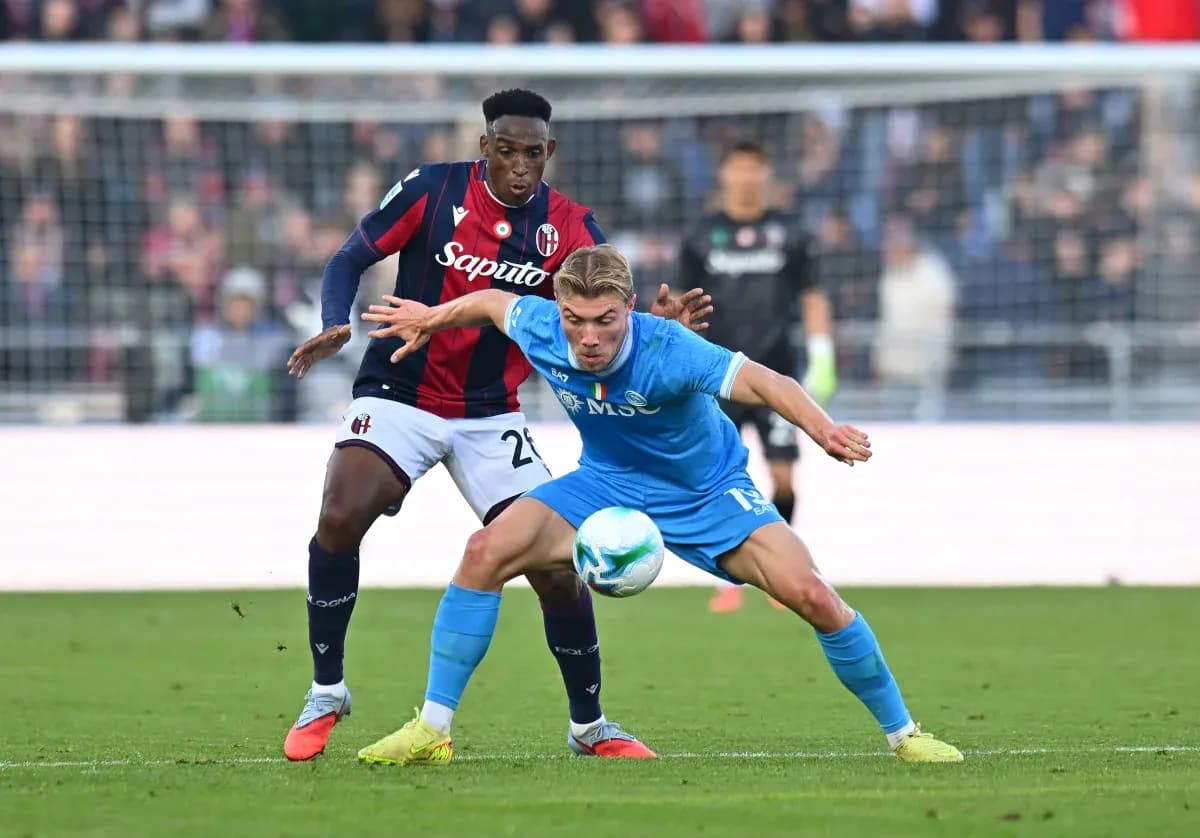
Napoli vs Bologna: Tactical Analysis of Serie A Showdown
Under the lights of Stadio Diego Armando Maradona, this was billed as a late‑season stress test of Napoli’s title credentials and Bologna’s European ambitions. Heading into this game, Napoli sat 2nd in Serie A on 70 points with a goal difference of 18 (54 scored, 36 conceded), a side defined by control and structure under Antonio Conte. Bologna arrived in Naples in 8th on 52 points, with a far slimmer cushion of 2 in goal difference (45 for, 43 against), but with an away record that hinted at danger: 9 wins on their travels from 18, and 29 away goals, more than Napoli had managed away from home.
By full time, the table’s numbers had been given a narrative. Bologna’s 3-2 win did not just upset the evening; it exposed the fault lines in Napoli’s carefully engineered 3-4-2-1.
I. The Big Picture: Systems and Season DNA
Conte leaned on his most-used structure: Napoli’s 3-4-2-1, a shape they had deployed 21 times in the league. V. Milinkovic-Savic anchored a back three of G. Di Lorenzo, A. Rrahmani and A. Buongiorno, with a hard‑working midfield band of four – M. Politano and M. Gutierrez wide, S. Lobotka and S. McTominay inside – feeding the narrow front trio of Giovane, Alisson Santos and R. Hojlund.
The structure mirrored their season profile: at home Napoli had scored 32 goals in 18 matches, an average of 1.8, while conceding 18 at exactly 1.0 per game. Their minute distribution painted them as fast starters and strong re‑starters – 20.75% of their goals in both 0‑15 and 46‑60, with another 18.87% between 31‑45. This is a side that usually imposes itself early and around half-time.
Vincenzo Italiano, though, broke from Bologna’s default 4-2-3-1 and rolled out a 4-3-3, betting on verticality and wide aggression. M. Pessina started in goal behind a back four of Joao Mario, E. Fauske Helland, J. Lucumi and J. Miranda. The midfield trio – T. Pobega, R. Freuler and L. Ferguson – sat behind a high, aggressive front line of R. Orsolini, S. Castro and F. Bernardeschi.
Bologna’s season data foreshadowed their approach. On their travels they had averaged 1.6 goals per game (29 in 18), with a pronounced attacking surge between 46‑60 (22.22% of goals) and a strong presence late (20.00% in both 31‑45 and 76‑90). But they were also vulnerable: overall they conceded 1.2 goals per match, with a defensive soft spot between 46‑60 (23.26% of goals conceded) and 61‑75 (20.93%).
II. Tactical Voids: Absences and Discipline
The absentees gave this fixture its first twist. Napoli were without three headline names: David Neres (ankle injury), K. De Bruyne (eye injury) and R. Lukaku (hip injury). De Bruyne’s absence stripped Conte of his most natural between‑the‑lines conductor; Neres’ injury removed a one‑v‑one winger who could have stretched Bologna’s full-backs; Lukaku’s hip issue meant no late‑game battering ram to change the dynamic in the box.
Conte’s response was to push creativity into the boots of Politano and Giovane, with McTominay asked to be both the late-arriving scorer and a secondary playmaker. The burden of depth running and hold‑up fell squarely on Hojlund.
Bologna’s missing quartet – K. Bonifazi (inactive), N. Cambiaghi (muscle injury), N. Casale (calf injury) and M. Vitik (ankle injury) – trimmed Italiano’s defensive and wide options. The absence of Cambiaghi, who had combined 3 goals, 4 assists and a red card in his season, removed an unpredictable transitional threat but also one of their most fouled players. Italiano compensated by pushing Orsolini and Bernardeschi higher, trusting Lucumi and E. Fauske Helland to cope with Napoli’s central surges.
Disciplinary profiles hinted at where the contest might fray. Napoli’s yellow cards spike between 61‑75 minutes (31.91%), precisely when Bologna’s own yellows also peak (27.27%), and Bologna’s red‑card pattern – spread across 16‑30, 46‑60, 61‑75, 76‑90 and 91‑105 – suggested a team that lives on the edge in the game’s most intense phases. The match’s late‑game chaos felt almost baked into the numbers.
III. Key Matchups: Hunter vs Shield, Engine Room vs Enforcer
The “Hunter vs Shield” duel was embodied by R. Hojlund against Bologna’s centre‑back pairing and their season-long defensive record. Hojlund came into the fixture with 10 league goals and 4 assists, from 42 shots (22 on target) and 50 fouls drawn. He is not just a finisher but a constant irritant, winning 107 of 299 duels. Facing a Bologna defence that had conceded 23 goals away from home at 1.3 per match, the expectation was that his movement between Lucumi and E. Fauske Helland would generate chances.
Yet Bologna’s “shield” was collective rather than individual. Freuler’s positioning in front of the back four cut off the vertical lanes that usually feed Hojlund’s runs. Pobega and Ferguson alternated stepping onto Lobotka and McTominay, disrupting Napoli’s rhythm at source. The result was a Napoli attack that often had to build wider and slower, allowing Bologna’s back line to set and clear.
In the “Engine Room”, McTominay and Lobotka faced Freuler and Ferguson in a duel that defined the game’s flow. McTominay’s season numbers – 9 goals, 3 assists, 28 tackles and 13 blocked shots – show a midfielder who drives into the box but also protects his defence. Here, his double duty became triple: with De Bruyne missing, he was also asked to link play. That stretch diluted his edge.
On the other side, Ferguson’s shuttling and Freuler’s metronomic passing gave Bologna a stable platform for transitions. Every time Napoli’s wide midfielders, Politano and Gutierrez, pushed high, Bologna tried to spring Orsolini into the half‑space behind them. Orsolini’s profile – 9 goals, 1 assist, 64 shots and 26 key passes – made him Bologna’s primary “hunter”, and his presence repeatedly dragged Napoli’s back three into uncomfortable lateral sprints.
IV. Statistical Prognosis and What the Scoreline Tells Us
Heading into this game, Napoli’s defensive timing profile showed vulnerability mirroring their attacking strengths: 21.62% of their goals conceded came in both 0‑15 and 46‑60, with another 18.92% in 76‑90. Bologna, conversely, are most dangerous in 46‑60 (22.22%) and maintain threat late. The intersection was clear: if Bologna could survive Napoli’s early storm, the middle hour of the match would tilt their way.
That is exactly how the 3-2 played out. Napoli’s structural dominance and home scoring average of 1.8 suggested they would find goals – and they did, twice – but Bologna’s away attacking average of 1.6 and their multi‑phase goal distribution always hinted they could out‑punch Napoli in the game’s broken phases.
Without xG data, the expected‑goals story has to be inferred from shot and chance profiles. Napoli, a side with 13 clean sheets overall and only 2 home defeats before this, do not usually concede three at home. Bologna, with 11 clean sheets and only 5 away losses, are better travellers than their raw goal difference suggests. This result feels less like a freak and more like the meeting point of two curves: Napoli’s slight defensive looseness in key windows and Bologna’s capacity to surge exactly then.
Following this result, the narrative is twofold. For Napoli, the 3-4-2-1 remains a powerful framework, but the absence of a true creative 10 like De Bruyne and the lack of a plan‑B striker like Lukaku left them short of variety when chasing. For Bologna, Italiano’s 4-3-3 in Naples showcased a side whose away identity – fast, vertical, and willing to live on the disciplinary edge – can bloody the nose of the league’s elite.
In the end, the numbers had warned us: this was never a safe home banker. It was a collision of well‑defined identities, and on this night in Naples, Bologna’s travelling punch landed hardest.