Real Madrid vs Oviedo: Tactical Showdown at Estadio Santiago Bernabéu
Under the Madrid lights, this was a meeting of opposites: second-placed Real Madrid, chasing perfection at Estadio Santiago Bernabéu, against bottom side Oviedo, fighting to stay afloat. Heading into this game, the standings told a stark story. Real Madrid sat 2nd in La Liga with 80 points from 36 matches, a formidable overall goal difference of +39 built on 72 goals scored and 33 conceded. At home they had been ruthless: 15 wins from 18, scoring 41 and conceding just 14. Oviedo arrived as 20th, marooned on 29 points, their overall goal difference a bruising -30 from 26 goals for and 56 against. On their travels they had lost 12 of 18, conceding 39 and scoring 17.
The final 2-0 scoreline felt almost inevitable given those seasonal profiles, but the way the squads were shaped by absences gave this fixture its tactical flavour. Real Madrid’s missing list was long and high profile: D. Ceballos (coach’s decision), Eder Militao and A. Guler (muscle injuries), D. Huijsen (lacking match fitness), A. Lunin (illness), F. Mendy (muscle injury), Rodrygo (knee injury) and F. Valverde (head injury) were all ruled out. That stripped Alvaro Arbeloa of two of his most creative midfielders in Guler and Valverde, a key ball-playing centre-back in Militao, and a major attacking outlet in Rodrygo.
Yet Arbeloa’s response was not caution, but control. He leaned into a familiar 4-4-2, the formation Real Madrid had used more than any other this season, and trusted the club’s depth. T. Courtois anchored the side behind a back four of T. Alexander-Arnold, R. Asencio, D. Alaba and A. Carreras. In midfield, F. Mastantuono, E. Camavinga, A. Tchouameni and B. Diaz formed a box that promised both progression and counter-pressing, while G. Garcia joined Vinicius Junior as a front two.
Oviedo, by contrast, came to the Bernabéu shorn of ballast. L. Dendoncker and O. Ejaria (injuries), B. Domingues (knee injury), and the suspended J. Lopez and K. Sibo (both red cards) removed experience and defensive steel from Guillermo Almada Alves Jorge’s options. Without those figures, he pivoted from the 4-2-3-1 that had been his default this season to a more aggressive 4-3-3, perhaps a recognition that mere containment had not been enough in a campaign that had yielded only 6 wins in 36 and an overall scoring rate of just 0.7 goals per game.
The disciplinary backdrop to this fixture added another layer. Real Madrid’s season-long yellow-card distribution showed a tendency to accumulate bookings as games wore on, with a clear peak between 61-75 minutes, where 22.06% of their yellows had arrived. Oviedo’s own yellow pattern was similarly back-loaded, with 23.38% between 61-75 and 16.88% from 76-90. Red cards told an even more volatile story for the visitors: 40.00% of their reds had come in the 76-90 minute window, a sign of late-game desperation and fatigue. In a match where Real Madrid were likely to dominate territory and tempo, those numbers hinted that any Oviedo resistance might fray badly in the final quarter.
Tactical Duel
On the tactical board, the game’s central duel was written clearly: the “Hunter vs Shield” confrontation between Real Madrid’s elite attack and Oviedo’s fragile defence. Overall, Real Madrid had averaged 2.0 goals per game this season, rising to 2.3 at home, while conceding just 0.9 overall and 0.8 at home. Oviedo, on their travels, had leaked 2.2 goals per game and scored only 0.9. That differential alone framed the contest: a high-volume, high-efficiency home attack against a visiting back line accustomed to suffering.
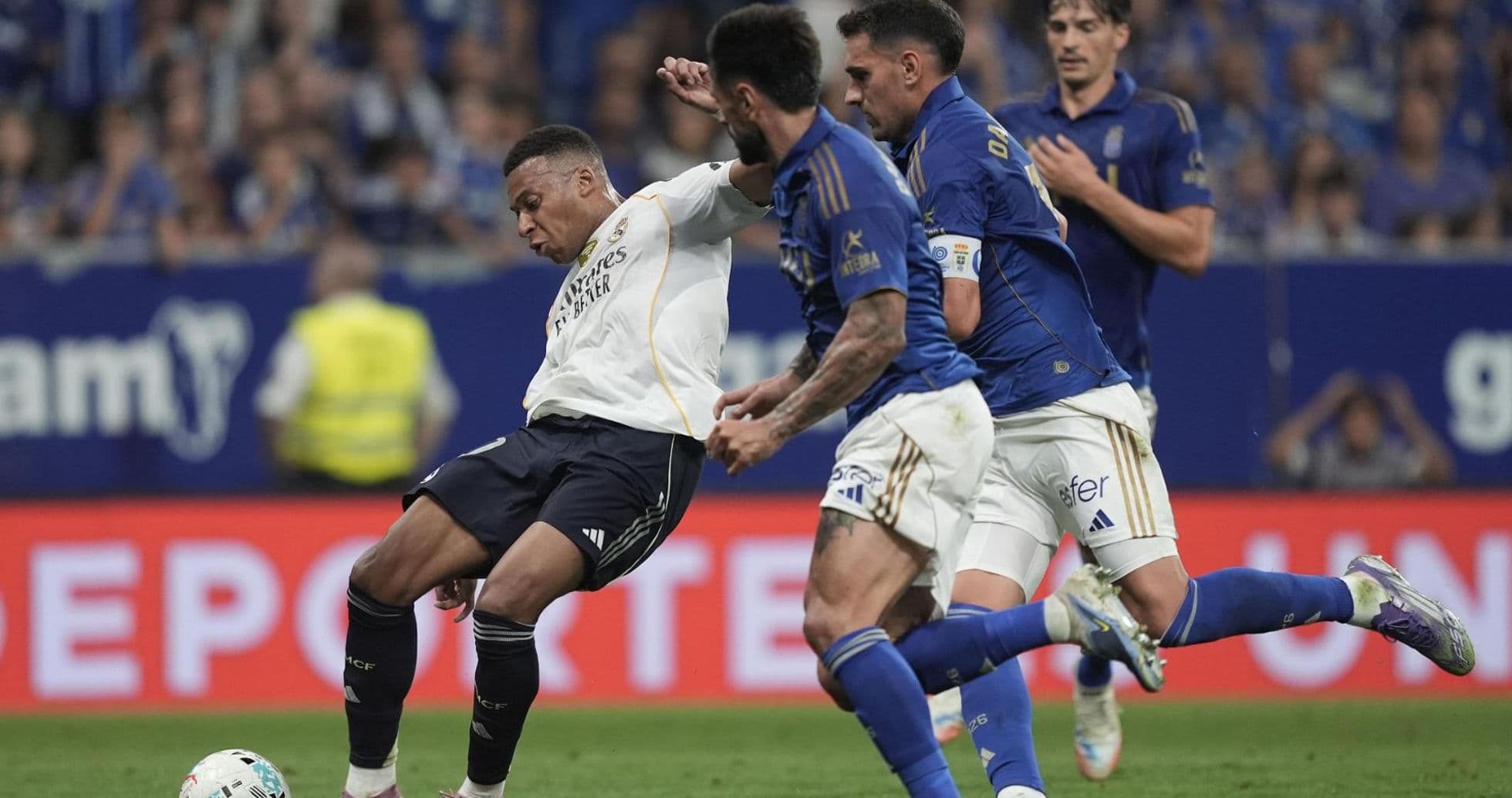
Within that, Kylian Mbappé, even starting on the bench, loomed as the ultimate “hunter”. With 24 league goals and 5 assists in 29 appearances, he had generated 102 shots, 61 on target, and drawn 32 fouls. His penalty record was outstanding but not perfect: 8 scored and 1 missed, a reminder that even his ruthlessness has a human edge. Arbeloa could deploy him as a late-game weapon if the match tightened, targeting a defence that had already shown a propensity for red cards and lapses under pressure.
Vinicius Junior, in the XI from the start, offered a different kind of menace. His 15 goals and 5 assists in 35 appearances, supported by 190 dribble attempts and 81 fouls drawn, made him the constant agitator of back fours. Against Oviedo’s right side of N. Vidal and E. Bailly, the Brazilian’s ability to receive wide, drive inside and combine with B. Diaz and overlapping A. Carreras was always likely to stretch the visitors into uncomfortable shapes. With Real Madrid’s home scoring average at 2.3 and Oviedo conceding 2.2 away, Vinicius was perfectly placed to turn statistical probability into scoreboard reality.
Engine Room
In the “Engine Room”, Real Madrid’s trio of Camavinga, Tchouameni and Mastantuono had the advantage over Oviedo’s N. Fonseca, S. Colombatto and A. Reina. Oviedo’s overall average of 1.6 goals conceded per game, combined with 19 matches where they failed to score, suggested a midfield more used to firefighting than dictating. Here, their 4-3-3 risked being pinned back into a 4-5-1, with F. Viñas – Oviedo’s top scorer with 9 goals and also La Liga’s leading red-card recipient with 2 dismissals – left isolated. His duel numbers (484 duels, 254 won) showed willingness to battle, but in a match where his side were likely to see little of the ball, that physical edge always carried the risk of disciplinary trouble.
From a statistical prognosis standpoint, everything pointed towards Real Madrid control. Their 13 clean sheets overall, split as 6 at home and 7 away, underlined a defensive structure capable of suffocating an attack as limited as Oviedo’s. The visitors’ 10 clean sheets – 9 at home but only 1 away – highlighted how much less secure they were once they left Asturias. With Real Madrid perfect from the spot this season (12 penalties taken, 12 scored, 100.00% conversion and no misses), any penalty award would tilt the odds even further in the hosts’ favour.
The 2-0 final score felt like a measured expression of that imbalance rather than a full-throttle rout. Real Madrid’s seasonal xG profile – implied by their consistent goal output and chance creation from the likes of Mbappé and Vinicius – suggested they would generate enough opportunities to win comfortably, while Oviedo’s anaemic scoring record made a Courtois clean sheet more likely than not. In narrative terms, this was less an upset or a drama than a confirmation: the Bernabéu remains a fortress, Real Madrid’s depth allows them to absorb a long injury list without losing identity, and Oviedo’s survival fight continues to be waged against unforgiving numbers.