Neymar's Triumphant Return to Brazil's World Cup Squad
The roar started long before he appeared.
In the heavy, humid air of Miami Gardens, every glimpse of Neymar – a close-up on the giant screens, a shot of him stretching on the touchline, even his name on the teamsheet – sent a ripple through the stands that swelled into hysteria. Brazil’s forgotten prodigal son was back in yellow. That alone felt like an event.
Almost three years had passed since he last played for his country. Three years of rehab rooms, doubts, and the slow fade from centre stage. This World Cup has arrived with Brazil built around new idols, with Vinicius Jnr now the face on the billboards. Neymar, at 34, is no longer the axis of the team. On Wednesday night in Miami, he didn’t need to be.
He just needed to walk back into the light.
A superstar steps back into the frame
Carlo Ancelotti had said it in a cramped press room earlier in the week: “Neymar needs no ulterior motivation. Everyone loves him here.” He barely needed to make the case. The city did it for him.
Miami Stadium is ringed by four giant screens, vast slabs of light that could probably be picked out from orbit. When Neymar’s name flashed up before this Group C finale, the noise felt like it might reach the International Space Station. If Commander Sergey Kud-Sverchkov had been listening in, he might have heard what Brazil still thinks of its No 10.
On the pitch, the new Brazil went about their business with a cold edge. Vinicius Jnr punished a self-destructing Scotland twice in the first half, twisting the knife with the swagger of a man who knows this is his era now. Matheus Cunha slid in a third. The match, and top spot in Group C, were essentially sealed.
Yet every lull in play, every pause between attacks, the crowd’s attention drifted back to the touchline. To the man in the bib.
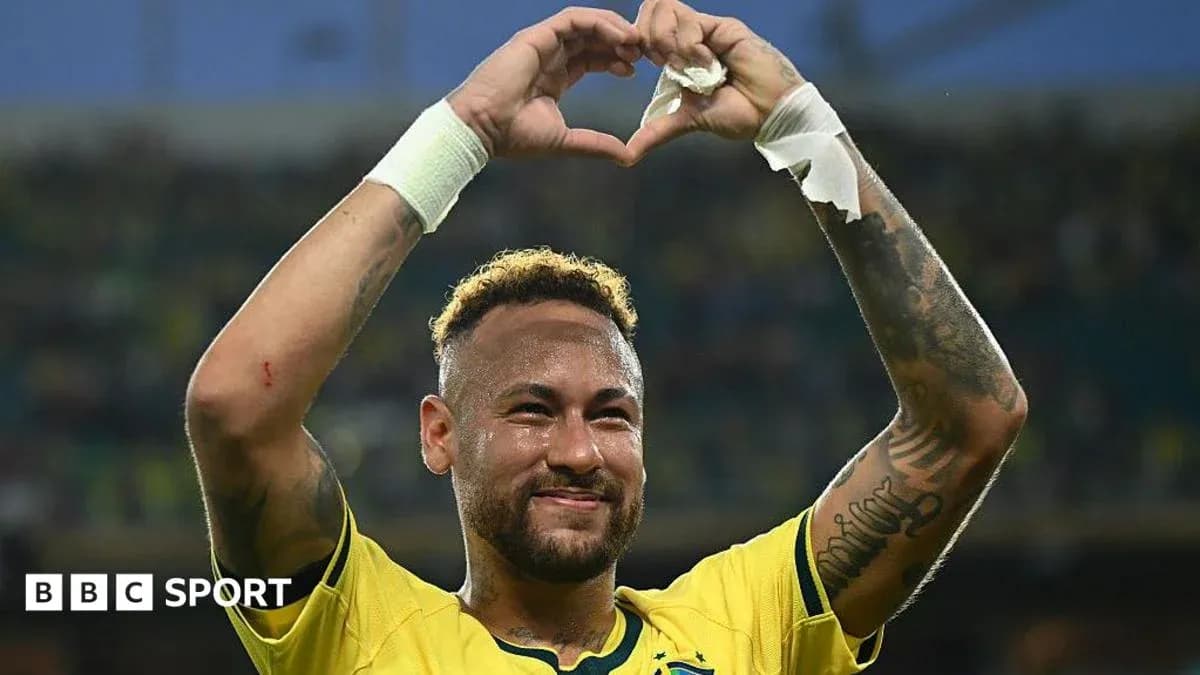
When Neymar finally peeled it off, the place erupted. He took the short walk to the sideline, exchanged a few words, and trotted on to replace Cunha on 76 minutes. It was a simple substitution. It felt like a coronation.
Twenty minutes, 24 touches, and a reminder
Ancelotti did not dress it up after the win.
“He had the opportunity to play, because I think he deserved to play,” the Brazil manager said. “He trained and worked hard to recover, with professionalism. For this World Cup, I think that he can help the team with his qualities. I think he played well, the few minutes he was on the pitch.
“Neymar needs no motivation to wear the colours of Brazil. Neymar is still the same, and at 34, he has the same passion he had as a kid.”
The numbers from his cameo were modest but telling. Twenty minutes. Twenty-four touches. A shot on target. Cunha, whom he replaced, had only 14 more touches across his entire shift.
The damage to Scotland had already been done by then, but Neymar’s presence shifted the mood. The old rhythm flickered. He dropped off the front, demanded the ball, probed, teased. Not the relentless force of his peak years, but enough to hint there is still something left in that right foot, still a spark in those quick, darting steps.
And, truthfully, the details barely mattered. The moment was the point.
A nation still searching for its next great chapter
Post-match, the giant screens found him again. Neymar walked over to the Brazil fans, a slow lap of gratitude, then stopped to embrace his young daughter at the front of the stand. Cameras zoomed in. The crowd drank it in.
A hero, battered by injuries and doubts, had returned to the World Cup stage at a time when Brazil crave greatness with almost feral hunger.
The five-time world champions have not lifted the game’s biggest prize since 2002. Their last major trophy came in 2019, when they claimed a ninth Copa America. For a nation raised on Pelé, Ronaldo, Ronaldinho and the mythology of the yellow shirt, that gap feels like an eternity.
Ancelotti’s Brazil have not always convinced. Results against the elite have underlined that: no wins over Argentina, Ecuador, Bolivia, Japan, Tunisia, France or, most recently, Morocco. Too often the performances have flickered rather than burned.
Against Scotland, something different appeared. There were spells of pure swagger, the old Brazil rhythm, but this time with a ruthless streak baked in. They punished mistakes. They did not let up. They looked like a team that understands how thin the margins are in modern tournament football.
The fans who spilled out into the Miami night did so with a spring in their step. Their team topped Group C. Their attack looked sharp. And the player many had feared they might never see at this level again had taken his place in the story.
The weight of history, the pull of the future
Outside the ground, the debate about where Neymar fits into Brazil’s pantheon was already in full swing.
“Pele is the best player of all time. No comparison,” one supporter said. “He won three World Cups for Brazil.
“Neymar will be among the best ones. He could be in the same level as Ronaldo or Ronaldinho if he wins the World Cup.
“I was in 2016 at Maracana, when he was the guy who scored the decider at the Olympics, and that was a title that Brazil never had before, but the World Cup is the title that we need, and we’re going for the six stars.
“I think he’s able to open up the field and bring out jogo bonito, as they say.
“They have to respect who he is and who he once was, because if you don’t, he’ll make you pay, that’s for sure.”
That is the tension Brazil now lives with. This is Vinicius Jnr’s team, with a supporting cast of hungry, emerging stars. Yet Neymar still carries a unique weight, the bridge between the ghosts of 2014 and the promise of something better.
In Miami, for 20 hot, breathless minutes, that bridge held firm. The question now is not whether Brazil still loves Neymar. The noise answered that.
It is whether this World Cup finally gives him – and them – the ending they have been chasing since 2002.