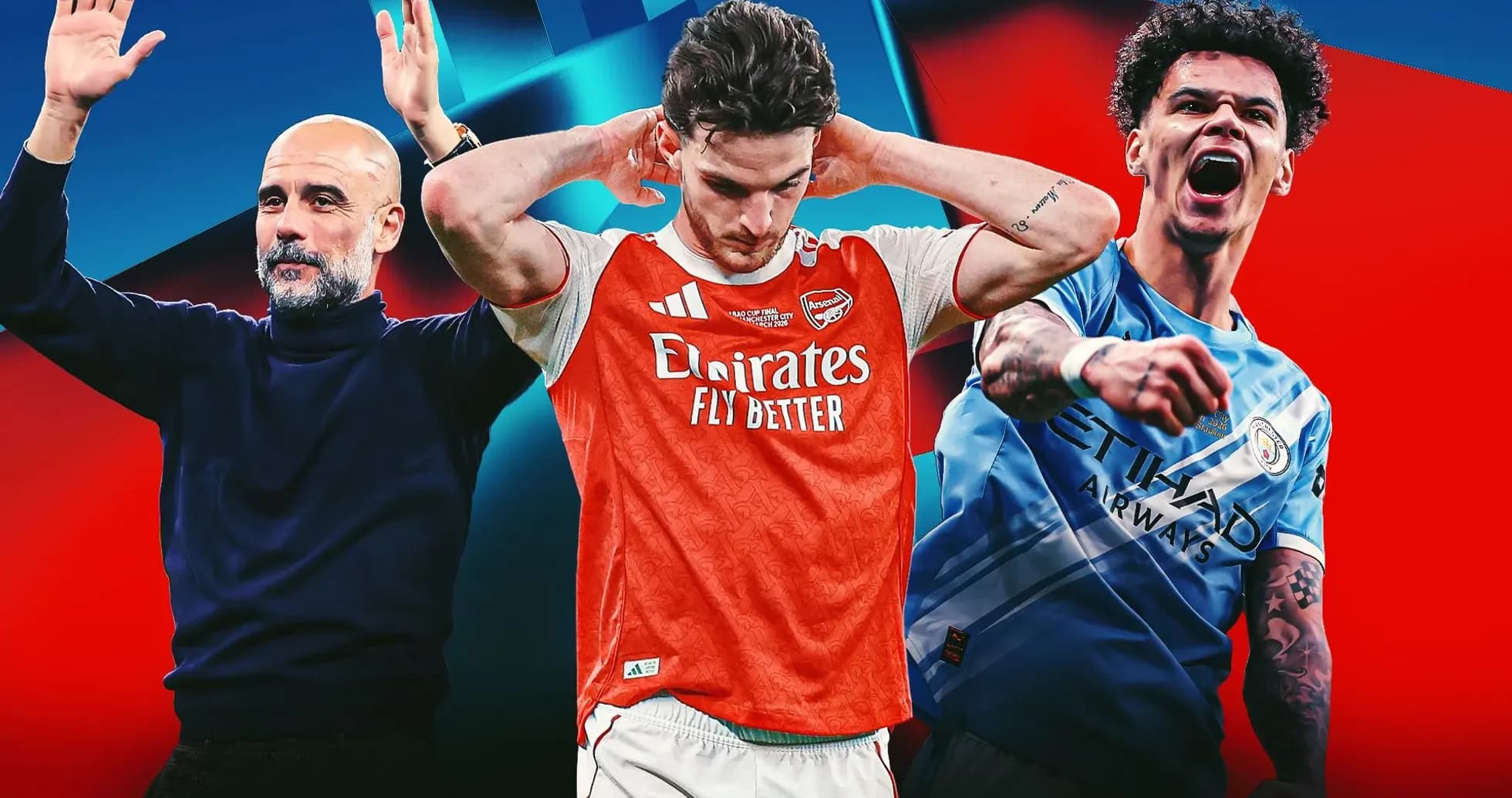
Nico O’Reilly Shines as Manchester City Triumphs at Wembley
At Wembley, Manchester City’s past and future stood side by side.
High in the stands, a vast tifo honoured Dennis Tueart, the acrobat of 1976, the man whose bicycle kick against Newcastle became a piece of club folklore and, for 35 long years, their last domestic cup triumph. Down on the pitch, another local boy was writing his own entry into that story.
Nico O’Reilly, born in Collyhurst, raised on City, “0161” inked into his skin, turned a final that had been drifting into a tactical arm-wrestle into a coronation. The kid who once turned down Manchester United to stay true to his colours has now given his club a Wembley memory to sit alongside Tueart’s.
O’Reilly’s Wembley weekend
What a three‑day stretch it has been for him. Named in the England squad on Friday. Twenty‑first birthday on Saturday. On Sunday, he walked out at Wembley as a left-back and played like a marauding midfielder in his pomp.
Restored to the flank after a recent run in midfield, O’Reilly refused to let the positional switch blunt his instincts. When Kepa Arrizabalaga spilled a routine cross from Rayan Cherki, O’Reilly reacted quicker than anyone in red or blue, tearing into the six-yard box to slam in the loose ball. It was a poacher’s finish, the sort you usually associate with Erling Haaland, watching on as the local lad showed the centre-forward’s killer timing.
Barely four minutes later, O’Reilly was at it again. He slipped into the penalty area almost unnoticed, timing his run perfectly to meet a teasing cross from Matheus Nunes and glance a header into the far corner. In the space of a few heartbeats, the final was ripped away from Arsenal and handed to City.
From academy hopeful to England international and now a Wembley match-winner, O’Reilly has gone from feelgood subplot to central character in Guardiola’s new‑look side. On a day when City’s global stars did their jobs, it was the homegrown left-back who took centre stage.
Kepa’s Carabao curse
The Carabao Cup and Kepa Arrizabalaga have a strange, tortured relationship, and this final only deepened the scars.
This is the goalkeeper who refused to come off at Wembley in 2019, waving away Maurizio Sarri’s fury before losing a shootout to City. The same man who was brought on specifically for penalties in 2022, only to concede 11 straight Liverpool spot-kicks and then balloon his own into the night.
So when word leaked on Saturday that he would start for Arsenal, the narrative wrote itself. Redemption or disaster. Nothing in between.
He edged towards the latter early in the second half, charging out and clattering Jeremy Doku after completely misjudging a long ball over the top. Arsenal fans must have prayed that was his one wild moment.
It wasn’t. When Cherki floated in a straightforward cross from the right, Kepa misread the flight, flapped weakly and left the ball hanging in the six-yard box. O’Reilly did the rest. From that point, Arsenal’s belief seeped out of them. Kepa’s personal Carabao saga, already a catalogue of missteps, gained one final, brutal chapter. It is hard to imagine him being trusted in this fixture again.
At the other end, James Trafford – the man whose position was thrown into doubt by the arrival of Gianluigi Donnarumma – delivered the kind of performance that makes directors feel vindicated and managers sleep well.
His triple save in the first half, repelling efforts from Kai Havertz and Bukayo Saka in one frantic sequence, set the tone. Late on, with City already in control, he stayed sharp to deny Riccardo Calafiori and preserve his clean sheet. While Kepa unravelled, Trafford quietly built a final to remember.
Guardiola’s response
Pep Guardiola walked into this final under a rare cloud. A bruising March had seen City drop points against Nottingham Forest and West Ham, gifting Arsenal a surge in the title race, and lose twice to Real Madrid in Europe. For once, the questions around him were not about perfection, but about decline.
He answered them with a game plan that squeezed the air out of Arsenal.
Ruben Dias’s late withdrawal might have rattled a lesser coach. Guardiola barely blinked. He kept faith with Trafford as his cup goalkeeper. He doubled down on the Doku–Antoine Semenyo pairing that had misfired against Madrid. He parked sentiment, leaving Phil Foden on the bench until the 90th minute.
Every call landed.
Semenyo bullied Piero Hincapié all afternoon, his power and direct running pinning Arsenal’s left side back and forcing them into their own half. Cherki, signed for £34m and often tagged as a luxury talent, tormented Arsenal with more than just flicks and tricks. His work rate without the ball, his willingness to track and harry, underpinned City’s control. Even Guardiola, who shook his head when Cherki indulged in a bout of keepy-uppies mid-game, could only be delighted with the substance behind the show.
This was Guardiola’s fifth League Cup, a record for any manager in English football. While others have treated the competition as a distraction, he has used it as a proving ground and a habit-former. Win here, win there, and soon the squad forgets how to lose.
It was also the first trophy of the Guardiola era lifted without Txiki Begiristain present. His successor, Hugo Viana, watched on as three of his recruits – Semenyo, Cherki and Trafford – ran the final. The Donnarumma deal may have complicated Trafford’s future, and Tijjani Reijnders has yet to convince, but across two windows and £260m spent, Viana’s hit rate looks ominously high for City’s rivals.
Arsenal shrink on the big stage
For Mikel Arteta, this was supposed to be the night. A first trophy in almost six years. A chance to beat his mentor in a final. A chance to silence any lingering doubts about Arsenal’s ability to finish seasons as strongly as they start them.
It never came close.
Arsenal’s performance was anaemic, their attacking play dulled, their urgency absent. This was the first League Cup final contested by the top two sides in the country, yet only one of them looked like it belonged there. The team leading the league played like imposters.
The warning signs had been flashing for weeks. Too many Arsenal displays in 2026 have ended with them staggering over the line rather than sprinting. Results stayed positive, but the football lost its edge. With the depth and quality at Arteta’s disposal, that always felt like a risk.
Here, in a game crying out for a bold intervention, he hesitated. Noni Madueke and Calafiori were primed on the touchline with Arsenal trailing 1-0, but by the time they stepped on, City had already scored their second. Guardiola had seized the moment after half-time; Arteta watched it pass.
This defeat also slams the door on Arsenal’s tilt at the quadruple. They reached the stage of the season where the dream still feels vaguely possible, alive in four competitions without looking drained. Then, like every English side before them, they hit the wall. Arteta knew how steep the climb was. “Has it been done? That’s how difficult it is,” he said not long ago. “Let’s go game by game… and then we’ll see what happens.” Now he has his answer.
The broader pattern is harder to ignore. The late‑season fade in 2021‑22 that cost them Champions League football. The record number of days spent top of the Premier League a year later without lifting the trophy. The 16 wins in 18 to close 2023‑24 overshadowed by a goalless draw at City that felt more like a concession than a statement.
Rodri’s pointed words at the end of that campaign still echo: Arsenal came to the Etihad and played for a draw, he said, and City pounced on that mentality. Give them a point, and they’ll turn it into a title.
Here, on neutral ground, with a trophy on the line, Arsenal again shrank when the moment demanded something more ruthless.
Trafford’s day, City’s habit
For Trafford, this final offered clarity. He admitted recently he had been stunned when City signed Donnarumma just two months after bringing him back from Burnley, and he has not hidden his desire for regular football. But he also promised to keep working, to give it “my best shot”.
His reward was a Wembley final that could reshape his trajectory. Four or five years ago, he watched City beat Spurs to win this competition as their fourth or fifth-choice goalkeeper, dreaming of his own day. Now he has it, with a medal in his pocket and a clean sheet to his name.
City, meanwhile, have another trophy. Another reminder that, even in a season where they wobble and their Champions League nemesis bites them again, they retain a knack for turning big domestic games into processions.
Arsenal will leave Wembley haunted by what this could have been: a statement, a shift in power, a first step towards an unprecedented season. Instead, they walk away with old questions ringing louder than ever.
City walk away with something far simpler – silver in the cabinet, a local lad elevated to legend status, and the sense that, when the pressure spikes, they still know exactly who they are.