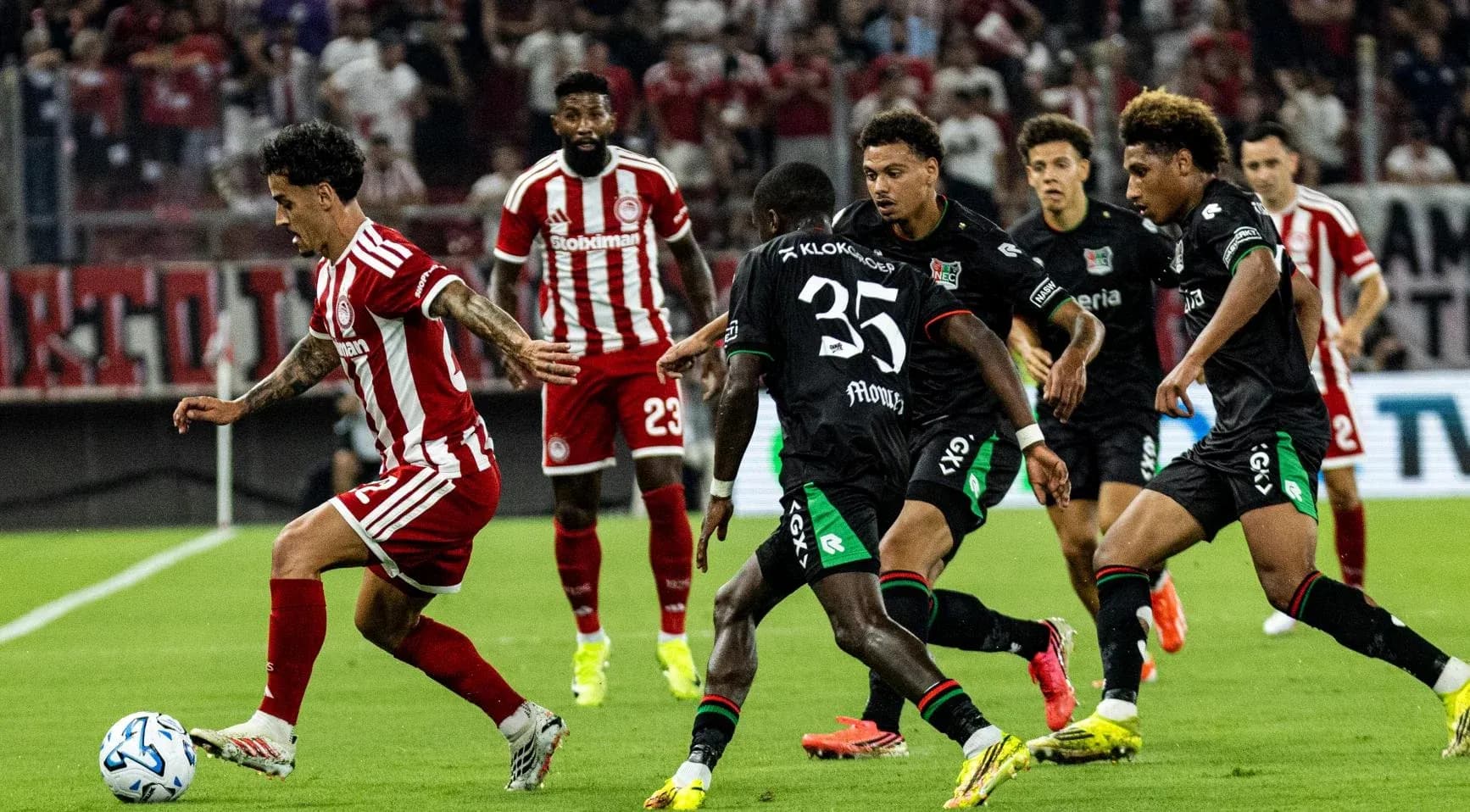
Olympiakos Piraeus vs NEC Nijmegen: Tactical Stalemate in UEFA Champions League
Olympiakos Piraeus and NEC Nijmegen produced a goalless but tactically dense first leg at Georgios Karaiskakis Stadium, with the 0-0 in the UEFA Champions League 3rd Qualifying Round shaped more by structure and control than chaos. Olympiakos had a slight edge in territory and ball circulation, but NEC’s compact 3-4-2-1 and disciplined back line ensured that neither side translated their periods of control into a decisive breakthrough. The match evolved into a duel between Olympiakos’ wide overloads and NEC’s back-five morph, with both teams forced into mid-game adjustments that ultimately preserved the stalemate.
Olympiakos set up in a 4-2-3-1 under Luis Mendilibar Jose, using the full width of the pitch to try to unbalance NEC’s three centre-backs. The back four of M. Saliakas, P. Retsos, David Carmo and B. Onyemaechi provided a stable platform, with the double pivot of Dani García and C. Mouzakitis tasked with both screening transitions and initiating play. Ahead of them, Rodinei and J. Roca flanked Chiquinho in the central attacking band, looking to connect with A. El Kaabi as the lone striker.
In possession, Olympiakos’ 4-2-3-1 often resembled a 2-3-5 in settled attacks. The full-backs pushed on, especially Saliakas on the right, while one of the pivots – typically García – held his position to guard against counters. With 54% of the ball and 394 total passes (264 accurate, 67%), Olympiakos were clearly the more ball-dominant side. However, NEC’s compact mid-block forced much of this circulation into less threatening zones, and Olympiakos’ 12 total shots yielded only 5 on goal and 5 from inside the box, underlining how difficult it was to access central finishing positions.
NEC Nijmegen, under Dick Schreuder, countered with a 3-4-2-1 that was primarily defensive in orientation but still carried a threat in transition. The back three of T. Storm, P. Sandler and D. Fonville sat narrow, with wing-backs S. Ouaissa and C. Bischoff dropping deep to form a situational back five when Olympiakos advanced. In midfield, J. Monteiro and D. Nejasmic worked to screen the half-spaces, while N. Lebreton and B. Linssen operated between the lines behind T. Chery, ready to spring forward when possession was won.
Out of possession, NEC’s shape was the defining feature of the match. Their 3-4-2-1 compressed centrally, inviting Olympiakos to play into wide areas where crosses could be defended with numerical superiority in the box. This approach limited Olympiakos to 2 blocked shots and forced many efforts from outside the box (7 of their 12 attempts). NEC themselves managed 13 total shots with 7 inside the box, a sign that when they did break, they found more direct routes to goal, even if the volume of possession (46%) and passes (348 total, 254 accurate, 73%) was lower.
The key tactical pivot for Olympiakos came immediately after half-time. At 46', G. Martins (IN) came on for J. Roca (OUT), a change that shifted the creative burden more centrally and aimed to inject greater verticality between the lines. Later, on 56', Jota Silva (IN) replaced Chiquinho (OUT), while L. Pirola (IN) came on for D. Carmo (OUT), signalling both a fresh attacking runner and a defensive reshuffle at centre-back. At 57', P. Maffeo (IN) replaced M. Saliakas (OUT), and at 64', Z. Smajlovic (IN) came on for P. Retsos (OUT). Collectively, these changes refreshed the back line and wide channels, but the overall structure remained a 4-2-3-1 with renewed emphasis on full-back overlaps and late box entries from midfield.
NEC’s substitutions were more about energy management and preserving the block. At 70', E. Mor (IN) replaced S. Ouaissa (OUT), adding more direct dribbling threat on the flank, while B. Pereira (IN) came on for T. Storm (OUT), maintaining the back three. At 74', D. Tadic (IN) replaced B. Linssen (OUT), and I. Hansen-Aaroen (IN) came on for P. Sandler (OUT), refreshing both the forward line and one centre-back role. Finally, at 90', W. T. Willumsson (IN) replaced J. Monteiro (OUT), giving NEC fresh legs in midfield for the final moments. Despite these changes, NEC stayed loyal to their 3-4-2-1/5-4-1 defensive scheme, prioritizing compactness over additional attacking risk.
Discipline subtly influenced the rhythm. At 11', David Carmo (Olympiakos Piraeus) received a yellow card — Foul — which likely constrained his aggression in duels and contributed to his eventual substitution. At 67', Dani García (Olympiakos Piraeus) was also booked — Foul — just as Olympiakos were pushing to tilt the game, forcing greater caution in counter-pressing. NEC’s only caution came at 90+1', when Willum Thor Willumsson (NEC Nijmegen) was shown yellow — Foul — as they looked to disrupt any late Olympiakos momentum. The card count closed at Olympiakos Piraeus: 2, NEC Nijmegen: 1, Total: 3, reflecting a competitive but not excessively physical contest.
In goal, B. Popovic (Olympiakos Piraeus) made 4 saves, while G. Crettaz (NEC Nijmegen) produced 5. The save counts align with the shot profiles: Olympiakos generated slightly more shots on goal (5) than they faced (4), but NEC’s goalkeeper had to respond to more sustained pressure phases, particularly after the introduction of fresh attacking players. Both goalkeepers, however, were well protected by their structures; neither side’s defensive line was routinely exposed to clear one-on-one situations.
Statistically, the match reads as finely balanced. Olympiakos’ marginal edge in possession, corners (5 to 2), and shots on goal (5 to 4) reflects their role as the more proactive side, while NEC’s superior pass accuracy (73% to 67%) and higher blocked shot count (4 to 2) highlight the efficiency and resilience of their defensive organization. Fouls skewed towards NEC at 16 to 11, consistent with their more reactive, disruption-based approach in midfield.
Without xG values, the shot distribution and territorial control suggest a slight territorial and chance-quality tilt towards Olympiakos, but NEC’s 7 shots inside the box versus Olympiakos’ 5 indicates that the Dutch side carved out comparable, if not slightly better, shooting positions when they did attack. Ultimately, the 0-0 feels like the logical outcome of two well-drilled systems: Olympiakos’ structured 4-2-3-1 probing against NEC’s disciplined 3-4-2-1 block, with neither coach willing to unbalance their side enough to chase a late, high-risk winner.