Ons Jabeur Partners with Special Olympics UAE to Promote Tennis Inclusion
Ons Jabeur has spent a career breaking barriers. Now she is trying to open the court even wider.
The Tunisian star, a former world No 2 and one of the most influential Arab athletes of her generation, has launched a formal partnership with Special Olympics UAE, aiming to bring athletes with developmental disabilities into tennis and onto the international stage.
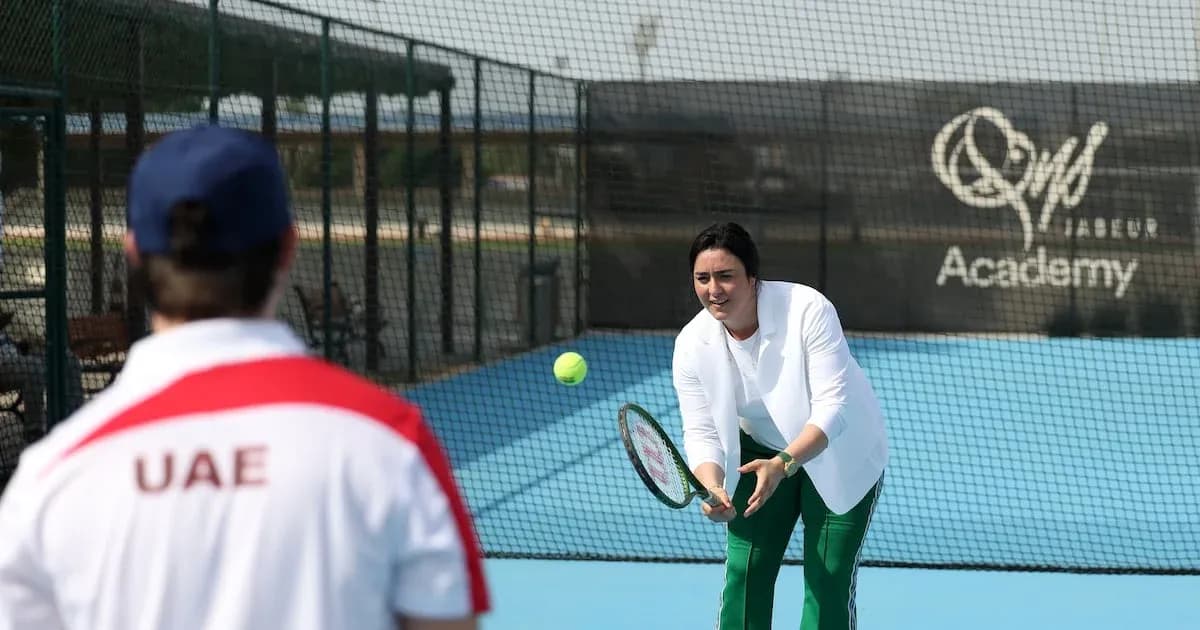
At her academy in Dubai’s Academic City, the project moved from paper to reality. Ten Special Olympics athletes stepped on court with Jabeur and her coaching team, trading balls and smiles with a player they usually only see on television.
“Having Special Olympics with us in a collaboration, it's really amazing. This is our new family,” Jabeur told The National, outlining a vision that goes far beyond a one-off clinic.
She wants them to fall in love with the sport first. The medals and rankings can follow.
“I believe in sharing the passion of playing tennis. The idea is for them to have fun, to enjoy playing tennis, hopefully compete internationally. I'm hoping we can help them train better and to enjoy every moment on the courts.”
A new chapter in Dubai
Jabeur, one of the most popular figures on the WTA Tour, opened the Ons Jabeur Tennis Academy in Dubai last year. This season she has stepped away from the circuit to have a baby boy in April, with plans to return to competition next year. In the meantime, her attention has shifted to building something lasting in the region.
The academy session with Special Olympics athletes felt like a first draft of that legacy.
Rallies were short, the encouragement constant. Coaches watched closely, looking for natural timing, footwork, instinct. The goal is clear: identify talent, guide it with expertise and then build tailored training programmes that can turn enthusiasm into genuine performance.
“We need to try everything and with our help and their motivation to play I think we can make a lot of things happen,” Jabeur said.
The challenge is real. She knows it. That is part of the appeal.
“It's going to be even sweeter because it's difficult and hopefully we can make the path easier for them. But the most important thing is I want them to enjoy tennis, see tennis from our perspective and enjoy it as much as possible.”
To do that, the academy staff will have to learn as well. Coaches and support teams will attend Special Olympics workshops to understand the spectrum of developmental and intellectual disabilities they will encounter. Only then can the sessions be structured to get the best out of every athlete, not just the most advanced.
“This is a new chapter for both of us. We’ve never done this before but we're looking forward to seeing how it goes,” Jabeur said. “We're hoping to share so many memories.”
World champions and new believers
For some of the visiting athletes, this is not a first step in tennis, but a leap forward.
Clari Lehmkuhl, a UAE resident from South Africa, is already a world champion, having won the women’s singles title at the Bauhaus Down syndrome World Championships in Sofia, Bulgaria this year. Sharing a court with Jabeur still felt special.
“It feels pretty amazing,” she said of the practice session. “I have been playing tennis since I was young, I played with my grandfather. I feel really proud, I’m grateful to be here.”
Others are still discovering how far sport can take them.
Emirati athlete Marwan Al Khaja kept his assessment simple: he likes “winning”. His mother, Aliya, has watched him grow stronger through unified sports, competing alongside athletes without disabilities in boxing and athletics at the Special Olympics.
“At first I was scared to put him in normal sports and then I saw it was good because they both learn from each other,” she said.
That exchange – not just of skills, but of confidence and respect – sits at the heart of the partnership. Special Olympics UAE will work closely with Jabeur’s coaches to map the different ability levels, design appropriate training blocks and then use those stories to raise awareness across the wider community.
Building a pathway to the world stage
Inside Special Olympics UAE, there is no mistaking the significance of having a global tennis star fronting the initiative.
Talal Al Hashemi, national director of Special Olympics UAE, spoke of pride at Jabeur’s involvement and the signal it sends.
He said she serves as an inspiration to athletes and plays an important role in raising community awareness of the abilities of people of determination and the importance of including them in sporting activities. Joint initiatives tailored to athletes with intellectual disabilities, he added, can unlock opportunities that did not exist before.
For Amr Badawi, head of sports and training at Special Olympics UAE, this is more than a partnership announcement. He called it a “new era of co-operation in tennis and inclusion”, one that he believes can directly strengthen preparations for the World Games in Chile next year.
The ambition is unapologetically big.
“We are aiming to grow the number of the athletes across the UAE,” he said. “Gathering all the groups together, giving more opportunities for our people of determination, give them the chance to be on the front line, play a sport, represent their families, their clubs and their country – this is our aim, our message.”
On a quiet weekday in Dubai, that message sounded loudly: a former world No 2, a group of determined athletes, and a handful of courts that might just reshape what tennis looks like in the region.