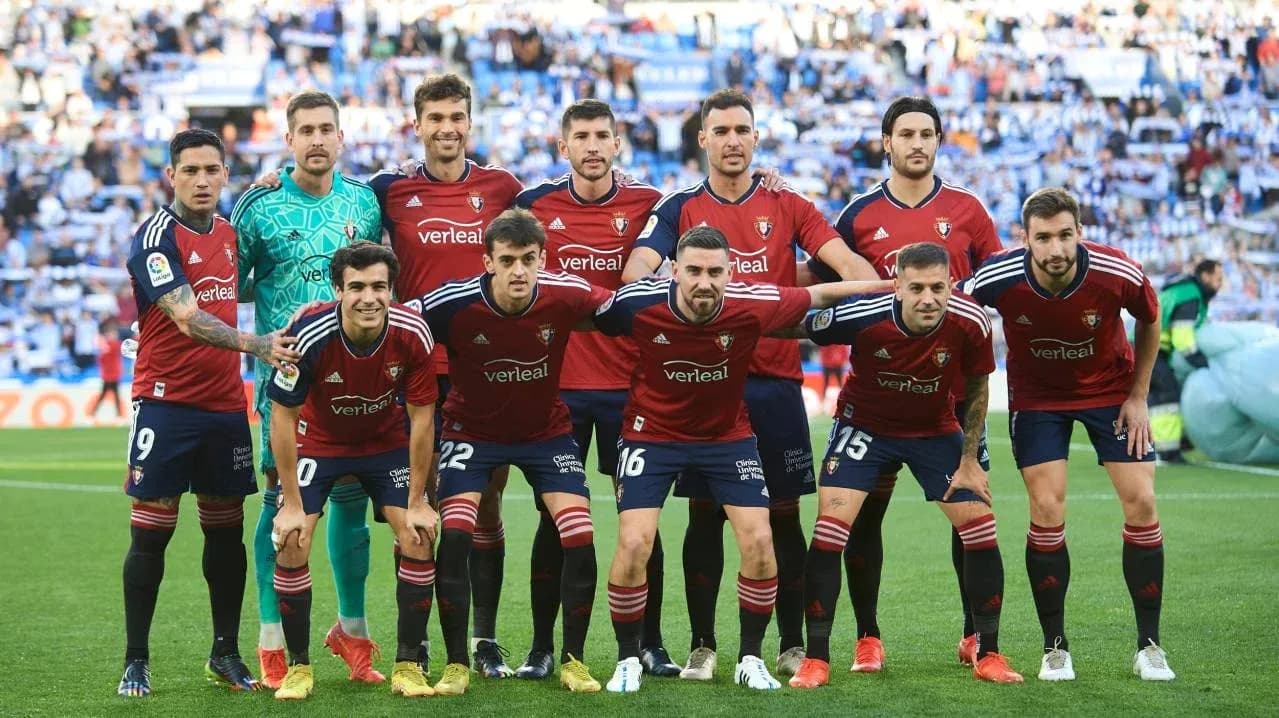
Osasuna Edges Girona 1–0 in Tactical Showdown
At Estadio El Sadar, Osasuna edged Girona 1–0 in a tight La Liga Regular Season - 29 fixture defined by territorial control versus penalty-box threat. Girona saw more of the ball (52% possession) and circulated it cleanly, but Osasuna’s 4-2-3-1 under Alessio Lisci generated far superior final-third incision, reflected in a 19–5 shot count and 1.71–0.21 xG advantage. A late strike from A. Budimir, created by substitute K. Barja, rewarded Osasuna’s persistent pressure. Defensively, the hosts were compact and aggressive without conceding a single shot on target, while Girona relied heavily on P. Gazzaniga’s goalkeeping to keep the scoreline narrow.
Scoring Sequence & Disciplinary Log
The match remained goalless through a balanced first half in terms of territory, but the underlying dynamics already tilted towards Osasuna’s penalty-box presence. Girona’s clearest early involvement in the event log was disciplinary: at 39', Viktor Tsygankov received a yellow card for a foul, reflecting Osasuna’s ability to draw challenges as they tried to break lines.
Osasuna’s pressure intensified after the break, and the key breakthrough arrived on 80'. K. Barja, introduced from the bench, delivered the decisive contribution, assisting A. Budimir for the only goal of the game. Budimir’s finish crowned an attacking performance in which Osasuna frequently worked the ball into central areas inside the box, turning their shot volume into a tangible lead.
The closing stages were shaped by game management from the hosts and a flurry of substitutions from both sides. Javi Galán had already been booked for a foul at 59', underlining Osasuna’s aggressive defensive posture in wide areas. In stoppage time, at 90+3', Jon Moncayola received a yellow card for time wasting, a direct consequence of Osasuna protecting their narrow advantage. No red cards were issued, and there were no VAR interventions recorded in the data.
Tactical Breakdown & Personnel
Both sides started in a 4-2-3-1, but the structures produced very different outputs. Osasuna’s back four of S. Herrera, V. Rosier, A. Catena, F. Boyomo and J. Galán sat behind a double pivot of Jon Moncayola and I. Muñoz, with an advanced line of R. Garcia (shirt 14, midfielder), A. Oroz and V. Muñoz supporting A. Budimir. Girona mirrored the shape with P. Gazzaniga in goal, H. Rincon, Vitor Reis, D. Blind and A. Martinez in defense, a double pivot of F. Beltran and A. Witsel, and an attacking trio of V. Tsygankov, A. Ounahi and J. Roca behind V. Vanat.
Osasuna’s 4-2-3-1 functioned more vertically. The double pivot facilitated secure progression (441 total passes at 88% accuracy), but the key was how quickly they played into the advanced trio and Budimir. With 15 of their 19 shots coming from inside the box, Osasuna consistently occupied Girona’s penalty area. R. Garcia (14) operated between lines as a late-arriving midfielder, distinct from substitute R. Garcia (9), who later came on as a forward. This distinction was important in the final phase, when Osasuna shifted from constructing attacks to protecting territory with fresh legs up front.
Girona’s version of 4-2-3-1 was more possession-oriented but lacked penetration. They completed more passes (494 at 86% accuracy) and held 52% of the ball, yet managed only 5 total shots and, crucially, 0 shots on goal. A. Witsel and F. Beltran gave control in the middle third, but the connection into the attacking quartet was sterile. V. Vanat was often isolated, and the advanced midfielders – Tsygankov, Ounahi, J. Roca – struggled to find pockets where they could turn and threaten.
Lisci’s in-game adjustments were decisive. At 69', K. Barja (IN) came on for A. Oroz (OUT), adding direct running and delivery from wide areas; this change directly produced the 80' winner. Immediately after the goal, Osasuna rebalanced: at 83', R. Garcia (shirt 9, forward) (IN) came on for A. Budimir (OUT), A. Bretones (IN) came on for R. Garcia (shirt 14, midfielder) (OUT), and A. Osambela (IN) came on for I. Muñoz (OUT). These triple substitutions shifted the side towards a more conservative, energy-based defensive block, with the forward R. Garcia (9) offering an outlet for clearances and counters, while A. Bretones and A. Osambela reinforced the flanks and midfield coverage.
Michel’s changes were more reactive. At 60', C. Echeverri (IN) came on for J. Roca (OUT), seeking greater creativity between the lines. At 75', A. Moreno (IN) came on for A. Martinez (OUT) and I. Martin (IN) came on for V. Vanat (OUT), refreshing both full-back and striker roles. Late on, at 86', T. Lemar (IN) came on for V. Tsygankov (OUT) and A. Ruiz (IN) came on for F. Beltran (OUT), further tilting the side towards attacking profiles. Yet despite these moves, Girona never translated possession into shots on target, underlining Osasuna’s compactness and control of central spaces.
Defensively, Osasuna were excellent as a unit. S. Herrera recorded 0 saves, a clear indicator that Girona were kept at arm’s length and largely forced into harmless zones. Defensive resilience was high on both sides: Osasuna saw 3 of their shots blocked, while Girona had 3 attempts stifled by the opposition.
The Statistical Verdict
The statistical profile strongly supports the narrative of Osasuna’s superiority in chance creation. Their 1.71 xG versus Girona’s 0.21 reflects a sustained ability to engineer high-quality opportunities, especially inside the box. Although the final score was only 1–0, Osasuna’s attacking volume (19 shots, 11 on target) suggests the margin could have been wider.
Girona’s possession edge and passing numbers did not translate into threat. With 0 shots on target and just 5 attempts overall, their 0.21 xG illustrates a sterile dominance of the ball, repeatedly repelled before reaching dangerous zones. P. Gazzaniga’s 10 saves, combined with Girona’s team metric of 2 goals prevented, underline how much the visitors relied on their goalkeeper and last-line defending to stay in the contest.
Conversely, Osasuna’s own goals prevented figure of 2 is a testament to collective defensive structure rather than goalkeeping heroics, given Herrera’s lack of saves. Across the full 90 minutes, the data frames this as a match where Girona’s control of possession was strategically outmatched by Osasuna’s superior verticality, box occupation and defensive compactness.