Osasuna's 2-1 Victory Over Sevilla: A Tactical Breakdown
The late afternoon light over Estadio El Sadar had barely begun to fade when the story of this match was already clear: a street‑wise home side, hardened by a season of grinding work, outmanoeuvring a desperate visitor clinging to survival hopes. Following this result, Osasuna’s 2–1 win over Sevilla in La Liga’s Regular Season – 32nd round felt like a confirmation of both teams’ seasonal identities as much as a standalone contest.
I. The Big Picture – A table fight in Pamplona
Osasuna arrive in the aftermath of this fixture sitting 9th with 42 points, their goal difference at -1, precisely the product of 39 goals scored and 40 conceded overall. The table tells you as much about their character as the eye test: solid, combative, and especially ruthless in Pamplona. At home they have now played 16 league games, winning 9, drawing 5 and losing just 2, with 28 goals for and 18 against. The numbers back the feeling inside El Sadar – this is one of La Liga’s more hostile, efficient home environments.
Sevilla, by contrast, leave Pamplona still 18th on 34 points, deep in the relegation zone with a goal difference of -15, the exact reflection of 40 scored and 55 conceded overall. On their travels they have played 17 times, winning 4, drawing 3 and losing 10, scoring 19 and conceding 32. Their away average of 1.1 goals for and a bruising 1.9 goals against mirrors the story of this game: enough attacking threat to worry opponents, but too porous to withstand sustained pressure.
II. Tactical Voids – Who was missing, and what that meant
Both coaches had to navigate important absences. For Osasuna, I. Benito (knee injury) and J. Cruz (illness) were ruled out. While neither is a headline name, their absence tightened Alessio Lisci’s rotation options, particularly in wide and defensive roles, putting more responsibility on the likes of J. Galan and V. Rosier to patrol the flanks for 90 minutes.
Sevilla’s gaps were more symbolic and structural. C. Azpilicueta (muscle injury) and Marcao (wrist injury) were both unavailable, stripping Luis Garcia Plaza of two experienced defensive figures. In a side already conceding 32 goals away from home this season, losing that leadership at the back was always likely to be felt, especially in a stadium that thrives on chaos and aerial duels.
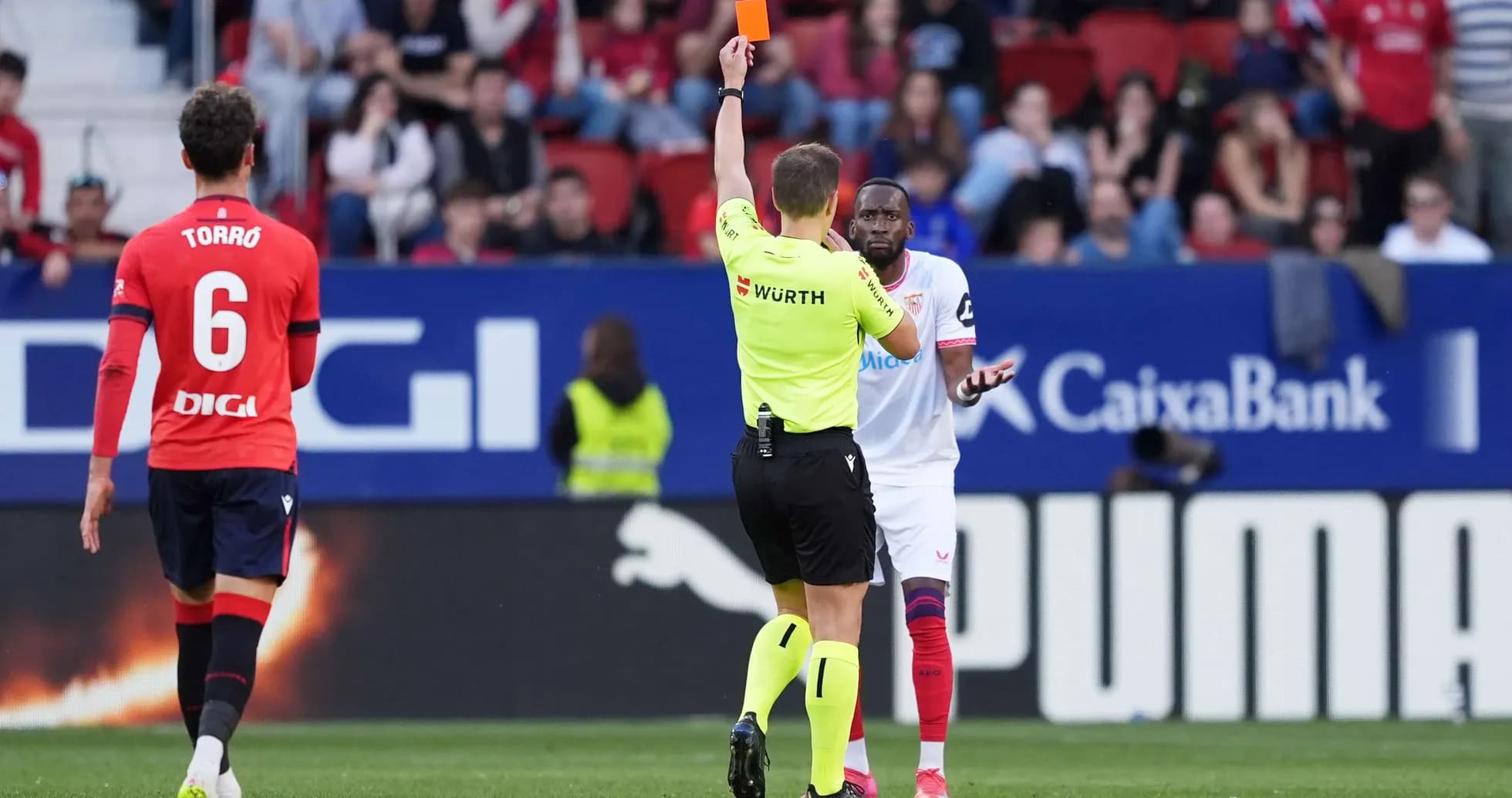
Disciplinary trends framed the risk profile. Osasuna’s yellow card distribution this season shows a clear late‑game spike: 21.25% of their yellows arrive between 76–90', and another 15.00% in 91–105', underlining how their intensity often tips into aggression as games stretch. Sevilla mirror that volatility: 19.15% of their yellows come between 76–90' and another 19.15% between 91–105'. Both sides are statistically most combustible in the closing stages – exactly the period when this match tilted decisively in the home team’s favour.
III. Key Matchups – Hunter vs Shield, and the battle for control
The headline duel was always going to be “Hunter vs Shield”: Ante Budimir against a Sevilla defence that has struggled to keep clean sheets on the road. Budimir came into this game as one of La Liga’s most effective strikers, with 16 goals in 32 appearances. He is not merely a finisher but a complete reference point: 74 shots with 35 on target, 336 duels contested and 160 won, plus 6 blocked shots from defender Alejandro Catena further up the pitch underline Osasuna’s commitment to defending from the front and through their spine.
Sevilla’s “shield” was a patched‑up back line. J. A. Carmona, one of La Liga’s most card‑prone defenders with 10 yellows, anchored the right side of a four‑man defence. He has made 57 tackles, 7 successful blocks and 33 interceptions this season, but his aggression can be a double‑edged sword, particularly away from home. Without Azpilicueta and Marcao, the responsibility for organising the line fell heavily on Carmona and K. Salas, with Castrin and G. Suazo asked to hold their zones against Osasuna’s wide surges.
Behind Budimir, the creative axis of A. Oroz, V. Munoz and R. Garcia (midfielder, shirt 14) floated between the lines in Lisci’s familiar 4‑2‑3‑1. Their job was to drag Sevilla’s double pivot of L. Agoume and D. Sow out of position. Agoume, a disciplined enforcer with 55 tackles, 5 blocks and 40 interceptions this season, is also one of Sevilla’s most booked players with 10 yellows. His duel with Jon Moncayola in the “engine room” was central: Moncayola’s 1,240 passes, 34 key passes and 44 tackles paint the picture of a modern box‑to‑box conduit. When Moncayola can step forward, Osasuna’s attacks gain both tempo and verticality.
On the flanks, R. Vargas – Sevilla’s top assist provider with 5 assists and 19 key passes – offered the main creative spark from midfield. His battle with J. Galan and V. Rosier was a micro‑war in itself. Vargas likes to receive high and wide, then cut in or combine with the front two of N. Maupay and Isaac Romero. Yet Osasuna’s full‑backs, backed by the aggressive stepping out of Catena and F. Boyomo, repeatedly compressed his space.
Catena himself epitomised Osasuna’s defensive personality. With 27 successful blocks and 31 interceptions this season, plus 10 yellow cards and 1 red, he is both shield and battering ram. His reading of Sevilla’s direct balls into Maupay and Romero was crucial, winning 122 of 227 duels and often turning defensive actions into quick transitions.
IV. Statistical Prognosis – Why this result made sense
Following this result, the numbers on the season only reinforce the narrative. Osasuna’s home averages of 1.8 goals for and 1.1 against fit neatly with a 2–1 scoreline in Pamplona: they usually do enough going forward and rarely keep things entirely clean. Sevilla’s away profile – 1.1 goals scored and 1.9 conceded – again aligns almost eerily with what unfolded.
In total this campaign, Osasuna have failed to score in 11 league games, all of them away; at home they have not failed to score once. That perfect scoring record at El Sadar, combined with Sevilla’s tendency to concede heavily on their travels and their lack of defensive leaders in this fixture, made a home breakthrough almost inevitable.
Both sides are flawless from the spot overall this season – Osasuna have scored 6 of 6 penalties, Sevilla 5 of 5 – but Budimir’s personal record adds nuance. He has scored 6 penalties but also missed 2, a reminder that even their primary marksman carries a small element of jeopardy from 12 yards, though it did not define this particular contest.
Defensively, Sevilla’s total of 55 goals conceded, with 32 of those on their travels, is the bedrock of their relegation struggle. Their inability to consistently protect leads or withstand pressure was once again exposed by an Osasuna side that thrives on sustained, physical phases of play, especially late on when both teams’ card data suggests emotional spikes and structural looseness.
In the end, this 2–1 at El Sadar was less an upset and more an expression of trajectory. Osasuna, mid‑table but with a top‑half edge, leaned into their home strength, their settled 4‑2‑3‑1 and the ruthless edge of Budimir and Moncayola’s engine. Sevilla, still searching for stability in a season of tactical reshuffles – from 4‑2‑3‑1 to 3‑5‑2 and now 4‑4‑2 – again paid the price for a fragile away defence and an overworked midfield shield.
Following this result, the tactical prognosis is clear: Osasuna look every inch a side capable of consolidating in the upper half on the back of El Sadar’s fortress‑like numbers, while Sevilla will need more than isolated flashes from Vargas, Agoume and Romero to escape the gravitational pull of the relegation zone.