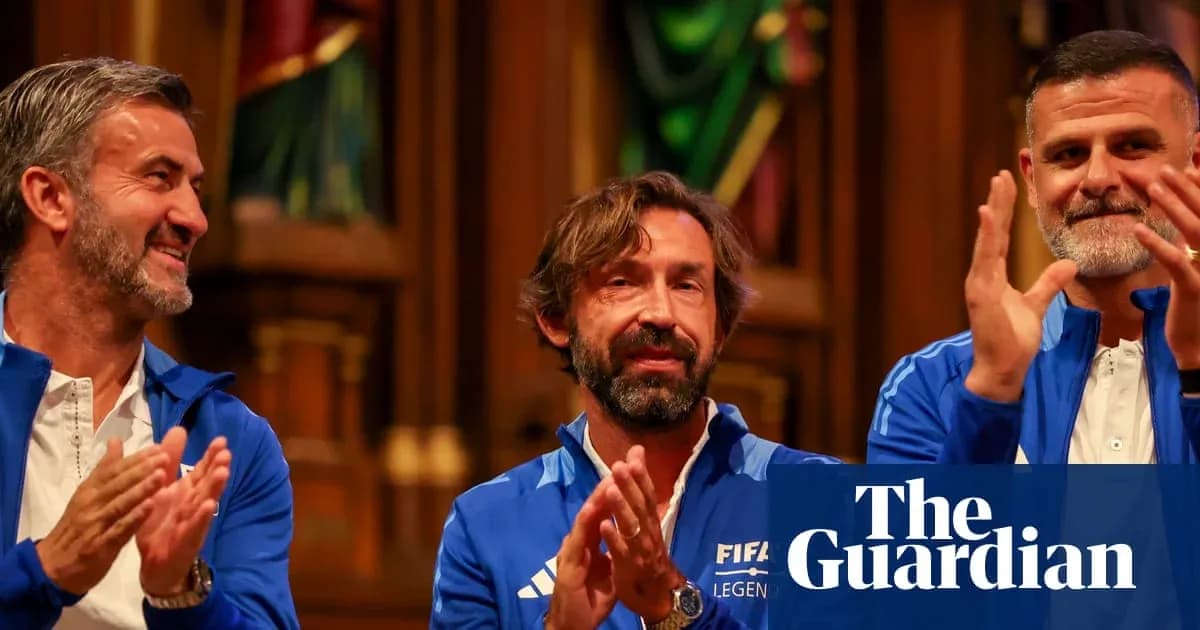
Andrea Pirlo Withdraws from Italy National Team Coach Candidacy
Andrea Pirlo has stepped out of the race to become Italy head coach, his candidacy effectively sunk not by tactics or results, but by a sponsorship deal with a Russian betting company that ignited a political storm.
The former Azzurri playmaker confirmed on Monday that the door had closed. Posting on Instagram, Pirlo wrote that he “heard last night that I’m no longer the candidate for the Italy national team job”, a blunt end to a process that had briefly placed him at the centre of Italian football’s attempted reset.
At the heart of the controversy lies his role as an ambassador for Fonbet, a Russian betting firm. Several Italian politicians argued that the figurehead of the national team cannot be commercially tied to Russia at a time when Italy backs Ukraine in the war. The debate quickly moved beyond football and into questions of ethics, symbolism and national identity.
Pirlo has consistently defended the arrangement. He has stressed that the Fonbet agreement is connected to his work in the United Arab Emirates and said it is “exclusively for commercial and sports purposes”, insisting that “attributing a political significance to that collaboration means attributing beliefs to me that I have never expressed and don’t belong to me.” His clarification did little to cool tempers in Rome.
Inside the Italian football federation, he was not without support. Paolo Maldini, recently appointed as technical director of the FIGC, had backed Pirlo’s candidacy, seeing in him a modern figurehead for a team still reeling from repeated failures on the biggest stage. That endorsement, though, collided head-on with resistance from high-profile political voices.
Pina Picierno, vice-president of the European Parliament, delivered one of the sharpest rebukes. She argued that after “yet another defeat and another missed World Cup qualification, Italian football desperately needed a cultural, ethical and managerial revolution,” before adding pointedly: “The choice of Andrea Pirlo goes in the exact opposite direction.” For her, this was not just a coaching appointment. It was a statement of values.
Ignazio La Russa, president of the Senate and a senior figure in prime minister Giorgia Meloni’s party, also cast doubt on the move. Speaking to Ansa on Saturday, he said: “I am speaking only because you called me: God help us. Of course I am an Italy fan and Pirlo was a great champion, but as a coach, it is a leap in the dark.” The message was clear: his admiration for the player did not extend to blind faith in the coach.
Carlo Calenda, leader of the Azione party, went even further, stripping the argument down to a single line. “Anyone who is or has been promoting Russia after 2022 should not hold national office,” he said. In that framing, the debate over Pirlo was never going to be about formations or player development. It was about whether the face of the national team could be separated from the geopolitics of his sponsors.
The FIGC had turned to Pirlo only after more ambitious plans fell through. The federation sounded out Pep Guardiola and Carlo Ancelotti as their preferred successors to Gennaro Gattuso, who departed by mutual consent in April after Italy failed to qualify for a third successive World Cup. Neither Guardiola nor Ancelotti proved attainable, and attention moved to a younger, more experimental option in Pirlo, who was ready to walk away from his role at Dubai United to take the job.
Now that experiment has been abandoned before it even began. With Pirlo out of the frame, the conversation has swung back to familiar names and familiar methods. Roberto Mancini and Antonio Conte, both former Italy coaches, are once again being seriously discussed as potential solutions.
Italy set out looking for a revolution. It may yet fall back on what it already knows.