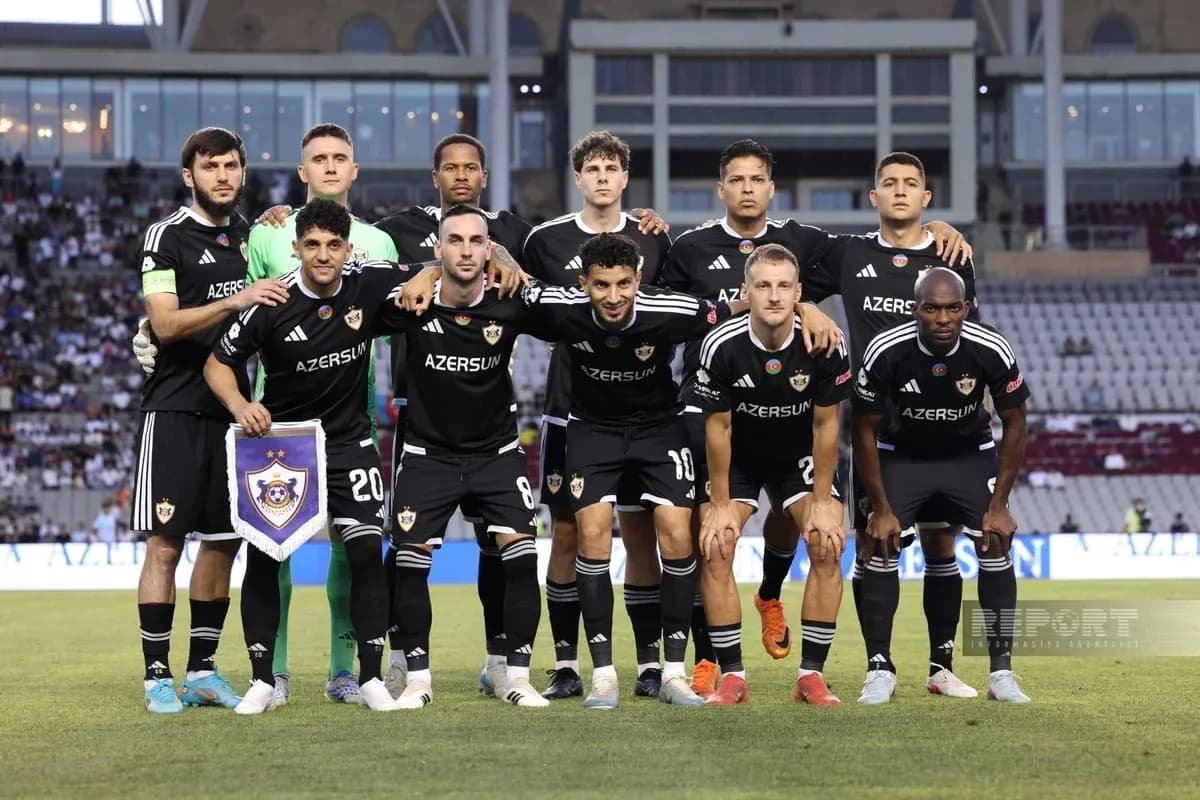
Qarabag vs CSKA Sofia: Tactical Analysis of a Goalless Draw
Qarabag and CSKA Sofia produced a tactically tight 0-0 at Azərsun Arena in the UEFA Europa League 2nd Qualifying Round, a match defined more by structure and control than by chaos. Across 90 minutes, both sides created similar shot volumes (12–11 to Qarabag) but expressed very different ideas with and without the ball, turning a balanced statistical picture into a clear contrast of game plans.
Qarabag, in their 4-2-3-1 under Qurban Qurbanov, used the double pivot of Pedro Bicalho and M. Janković as the central stabilising mechanism. The structure was classic Qurbanov: full-backs Matheus Silva and B. Langa provided width from deep, while the three behind striker Z. Sawo — O. Kashchuk on the right, Kady Borges centrally and A. Zoubir from the left — were tasked with occupying half-spaces and linking zones rather than simply stretching the pitch. Their 48% possession reflects a deliberate choice to alternate between controlled phases and rapid vertical attacks rather than pure domination.
The shot profile underlines that intent. Qarabag generated 12 total shots with 5 on goal but no blocked efforts, suggesting that when they did pull the trigger it was typically at the end of clean sequences rather than through scrappy, crowded-box play. The eight corner kicks they won were a direct product of this territorial pressure in the final third: repeated entries down the flanks, especially via Zoubir and Kashchuk, forced CSKA Sofia to defend deep and clear hurriedly. Yet the lack of blocked shots and the goalless outcome also hint at an issue: Qarabag found room to shoot but not enough separation or finishing quality to convert volume into a decisive edge.
The key in-possession mechanism was the interior rotation between Kady Borges and Janković. Borges frequently dropped off the front line to form a 4-3-3 in build-up, drawing out one of CSKA’s central midfielders and creating pockets for Kashchuk to attack diagonally from the right. When Qarabag lost Janković to substitution on 56 minutes, replaced by R. Cephas (IN) for M. Jankovic (OUT), Qurbanov shifted from a more balanced double pivot to a slightly more aggressive, forward-leaning setup. Cephas offered direct running and vertical threat, turning some of Qarabag’s possession into quicker, more transitional attacks.
CSKA Sofia, in Hristo Yanev’s 4-4-2, accepted a marginal possession advantage at 52% but used it conservatively. The back four of Pastor, Facundo Rodríguez, T. Ivanov and A. Martino sat relatively narrow, protecting the central channel and inviting Qarabag into wide areas. In front of them, the line of M. Ebong, J. Gbamin, B. Jordao and S. Sensi formed a compact block designed to screen passes into Kady Borges and deny Sawo clean service between the lines. Their 11 total shots with 4 on goal, and only two corner kicks, show a team more comfortable attacking in shorter, more selective bursts rather than through sustained pressure.
The two yellow cards for CSKA Sofia — Leandro Godoy at 35' and Facundo Rodríguez at 77' — emerged from this defensive posture. With the side often collapsing centrally, Godoy and Rodríguez were forced into interventions to stop Qarabag’s attempts to break lines or counter. Qarabag’s single yellow, to Marko Janković at 37', fits the mirror image: a midfielder stepping in to halt CSKA’s transitions through the centre, a reminder that both teams’ central corridors were fiercely contested even in a low-scoring context.
Substitutions in the second half subtly altered the tactical landscape without breaking the deadlock. On 56', alongside Cephas’s introduction, B. Langa (OUT) made way for E. Cafarquliyev (IN), refreshing Qarabag’s left side and adding more forward thrust from full-back. Later, at 74', O. Kashchuk (OUT) was replaced by J. Mouaddib (IN), and B. Huseynov (OUT) by C. Makreckis (IN), signalling a shift towards more energy and ball-carrying in midfield and a slight rebalancing of the back line. These moves suggested Qurbanov was chasing a late winner by adding dynamism rather than radically changing shape.
CSKA Sofia’s response was more about preserving structure while injecting fresh legs into key roles. At 73', L. Godoy (OUT) made way for J. Zwarts (IN) and M. Ebong (OUT) for I. Solet (IN), slightly reconfiguring the front and wide areas to maintain pressing intensity and offer a different running profile in transition. In the closing stages, A. Martino (OUT) was replaced by T. Ouorou (IN) at 84', while at 90+1' Pastor (OUT) gave way to M. Brahimi (IN) and S. Sensi (OUT) to P. Panayotov (IN). These late switches looked aimed at protecting the clean sheet and managing physical load rather than dramatically increasing attacking risk.
The statistical balance paints a picture of a finely poised tie. Qarabag’s 12 shots (5 on target) against CSKA Sofia’s 11 (4 on target) underscore how evenly matched the sides were in chance creation. The absence of blocked shots for both teams suggests a game of relatively clear shooting lanes but disciplined defending in and around the box, with back lines stepping out to confront rather than simply dropping into the six-yard area.
From a broader perspective, Qarabag will view the 0-0 as a partial missed opportunity: they leveraged home advantage at Azərsun Arena to generate more corners and a slightly higher volume of efforts on goal, but could not transform that territorial edge into a lead in the tie. CSKA Sofia, meanwhile, will be satisfied with the strategic outcome. Their compact 4-4-2, modest but controlled use of possession, and disciplined late-game substitutions allowed them to leave Baku with a clean sheet and a platform to tilt the tie on their own ground.
Tactically, this first leg felt like a chess opening: cautious, structured, and rich in small adjustments rather than decisive blows. The second leg will likely hinge on which coach is prepared to break the symmetry — either by loosening defensive constraints or by finding a more aggressive way to exploit the spaces that were only tentatively probed in this goalless but tactically dense encounter.