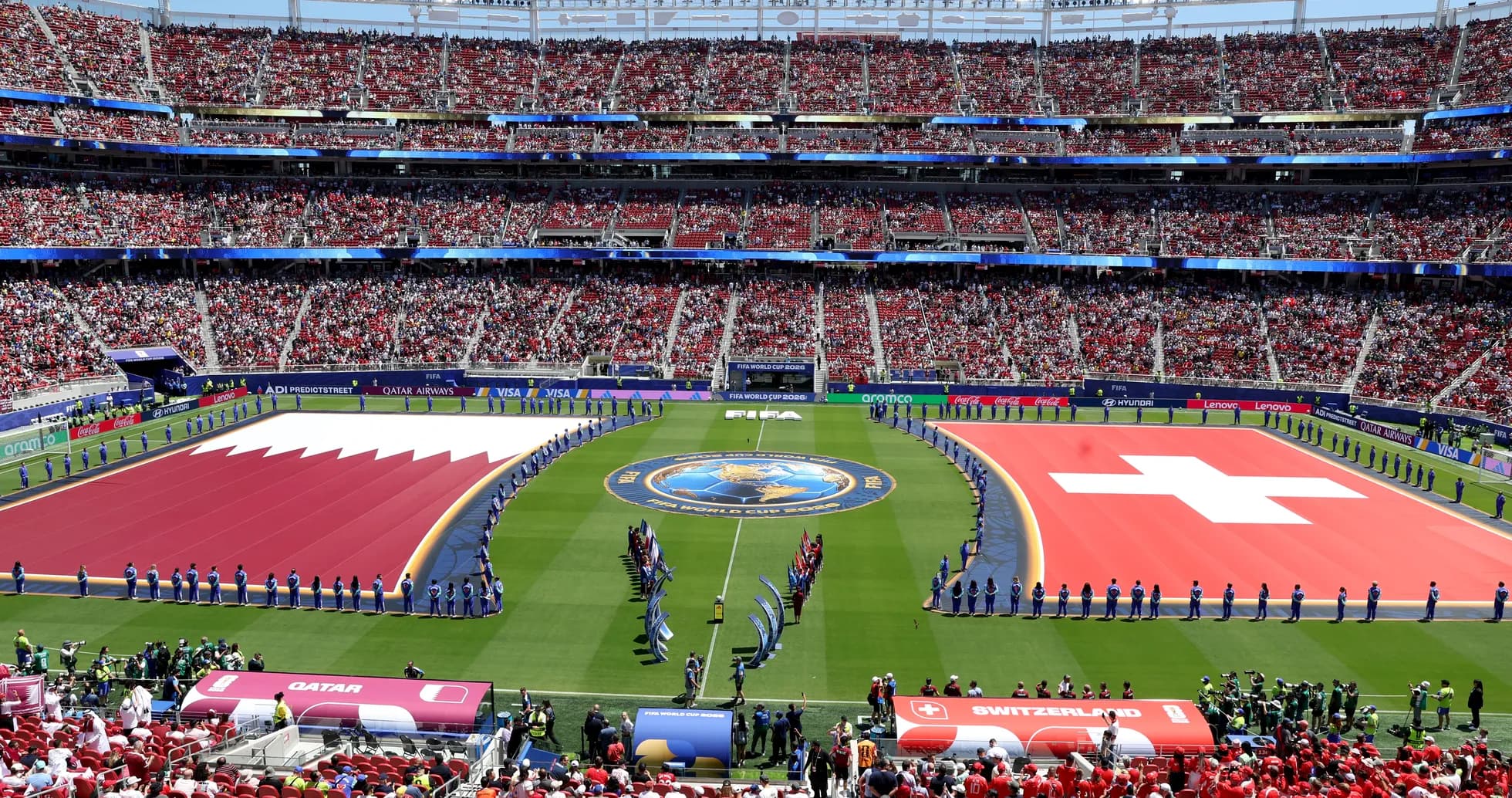
Qatar Stuns Switzerland with Late Equalizer in Tactical Battle
Qatar’s 1-1 draw with Switzerland at Levi's Stadium was a classic example of a low-possession, deep-block game plan straining to survive a technically superior opponent. Switzerland dominated territory and tempo, but inefficiency in the box and one late defensive lapse allowed Qatar to steal a point.
Qatar set up in a 4-3-3 that functioned for long stretches as a 4-5-1 without the ball. Julen Lopetegui’s side ceded possession (32%) and compressed the central lane, with Assim Madibo and Jassem Gaber Abdulsallam screening the back four while Issa Laye tucked in from midfield. The front line of Edmilson Junior, Yusuf Abdurisag and Akram Afif rarely pressed high; instead they formed the first line of a mid-block, trying to funnel Switzerland outside and deny clean entries into the half-spaces.
Switzerland, also in a 4-3-3, had the structural control you would expect from 68% possession and 575 passes (522 accurate, 91%). Granit Xhaka orchestrated from the left half-space, dropping alongside Manuel Akanji and Nico Elvedi to start build-up, while Remo Freuler and Michel Aebischer pushed higher to pin Qatar’s midfield. The full-backs, Denis Zakaria on the right and Ricardo Rodríguez on the left, advanced aggressively, creating wide overloads and allowing Rubén Vargas and Dan Ndoye to move inside closer to Breel Embolo.
The penalty sequence in the 16th–17th minute underlined Switzerland’s capacity to unbalance Qatar’s block. A VAR-confirmed penalty for a foul in the box came from Switzerland’s ability to combine centrally after drawing Qatar’s midfield out of shape. Once the spot kick was confirmed, Embolo converted, and from that point Switzerland’s attacking pattern was clear: sustained pressure, repeated entries into the box, but poor final execution.
The raw shot volume tells the story. Switzerland produced 26 total shots, 18 from inside the box, yet only 7 on goal. Qatar, by contrast, had just 7 shots (5 inside the box, 4 on goal). The quality gap is captured by xG: Switzerland at 3.24 versus Qatar’s 0.76. Tactically, that reflects Switzerland’s repeated success in reaching cut-back and cross zones, but also their failure to convert territorial dominance into a decisive lead.
Individually, the goalkeepers framed the game’s competitive tension. Mahmud Abunad (Qatar) faced sustained pressure and made 5 saves, matching Switzerland’s 7 shots on target minus the penalty goal only in part because so many Swiss efforts were blocked or off target. His interventions, combined with a goals prevented figure of 0.43, indicate that he added measurable value beyond the baseline expectation of the shots faced. On the other side, Gregor Kobel (Switzerland) had a quieter night in volume terms, with 3 saves, but was largely untroubled until the final minutes; Switzerland’s compact rest-defense and territorial control kept Qatar away from his area for long stretches.
Defensively, Qatar’s approach was minimalist but disciplined. With only 0 blocked shots, they were not stepping out aggressively to challenge shooters; instead they relied on deep positioning, narrow spacing and Abunad’s shot-stopping. The back four of Homam Al-Amin, Boualem Khoukhi, Pedro Miguel and Ayoub Al Oui stayed tight, rarely overcommitting to wide duels. The late equaliser at 90+4’, scored by Khoukhi and assisted by Homam Al-Amin, was a rare moment where those defenders impacted the game in the opposite box, capitalising on a set or second-phase situation after Qatar had thrown numbers forward.
Switzerland’s 9 blocked shots underline how often they defended facing their own goal in transition or late phases, despite overall control. When Qatar did attack, it was typically via direct balls into Afif or Abdurisag and secondary runs from midfield. The triple substitution on 60’ — Ahmed Alaaeldin (IN) came on for Yusuf Abdurisag (OUT), Karim Boudiaf (IN) came on for Jassem Gaber Abdulsallam (OUT), and Ahmed Fathi (IN) came on for Ayoub Al Oui (OUT) — signalled Lopetegui’s attempt to freshen legs and add more vertical threat while preserving the basic 4-3-3 shape. Later, Mohamed Naceur Almanai (IN) for Assim Madibo (OUT) at 79’ and Hassan Al Haydos (IN) for Edmilson Junior (OUT) at 88’ tilted Qatar further towards a chase mode, with more attacking profiles on the pitch.
Murat Yakin’s substitutions reflected game-state management rather than structural change. With Switzerland leading 1-0, Johan Manzambi (IN) came on for Dan Ndoye (OUT) and Fabian Rieder (IN) for Michel Aebischer (OUT) at 65’, maintaining the 4-3-3 but refreshing the front and midfield lines. At 79’, Zeki Amdouni (IN) replaced Rubén Vargas (OUT), again a like-for-like attacking change. In the final minutes, Miro Muheim (IN) for Ricardo Rodríguez (OUT) and Ardon Jashari (IN) for Remo Freuler (OUT) at 89’ suggested a desire to stabilise the left flank and midfield energy. Yet those changes did not prevent Qatar’s late surge and the decisive 90+4’ equaliser.
Discipline also shaped the rhythm. Qatar picked up two yellows: at 16’, Mahmud Abunad (Qatar) — Time wasting, and at 23’, Jassem Gaber Abdulsallam (Qatar) — Foul. Switzerland had one: at 42’, Denis Zakaria (Switzerland) — Foul. The early booking for Abunad is revealing tactically: Qatar were already trying to slow the game and disrupt Switzerland’s tempo even in the first half, an explicit game-management strategy from a team under siege.
Statistically, Switzerland’s passing dominance — 575 passes, 522 accurate (91%) — reflects a side comfortable circulating the ball, shifting Qatar’s block and repeatedly accessing the final third. Qatar’s 275 passes, 196 accurate (71%), underline their reactive posture and limited ability to sustain possession. Yet the combination of Abunad’s 5 saves, his 0.43 goals prevented, and Switzerland’s wastefulness in front of goal meant that the expected 3.24 xG haul translated into only one goal.
From a tactical verdict standpoint, Switzerland’s overall form in possession was strong: clear structure, heavy box occupation, and consistent creation of shooting opportunities. However, their defensive index is blemished by conceding from one of the few genuine chances they allowed, and by failing to close out the final minutes despite numerical and territorial superiority. Qatar’s overall form was modest with the ball but resilient without it; their defensive index, anchored by Abunad and a compact 4-3-3 block, allowed them to survive a high-xG onslaught and snatch a point that, on the balance of play, felt like a tactical heist.