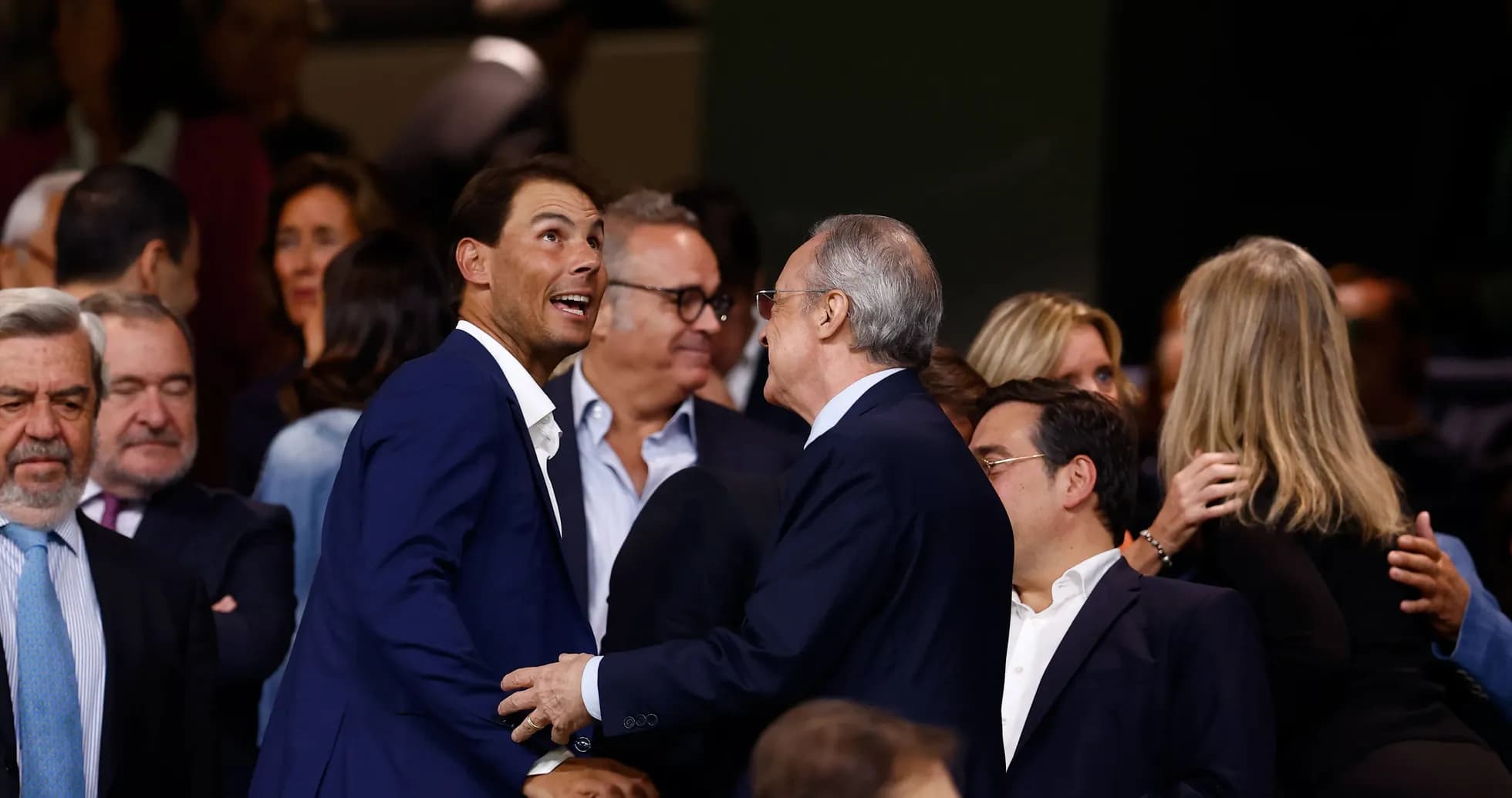
Rafael Nadal's New Role at Real Madrid: Path to Presidency
Rafael Nadal has spent a lifetime conquering courts of clay and grass. Now he is edging towards a very different stage: the Real Madrid boardroom.
This is no token gesture to a national hero. His nomination to the club’s board, announced on 4 November and set to be ratified by the general assembly on 21 November, feels like the prologue to a much larger story at the Bernabéu. One that could, one day, place him in direct succession to Florentino Pérez.
From Centre Court to the Corridors of Power
On paper, Nadal’s new role is simple: a place on the board of directors of Real Madrid. In reality, it hands him something far more valuable than a seat at the table. It gives him time. Time to learn how the club actually functions, to understand its political machinery, its economic weight, its internal codes. Time to build the administrative experience his glittering playing career never required.
None of this guarantees he will become president. It does, however, place him closer to the levers of power than any other global sporting icon of his generation.
Real Madrid’s official statement highlighted the reasons behind the move: his competitive spirit, his commitment, his respect for rivals. Those are the qualities the club likes to see reflected in its own crest. For Madrid, associating that identity with a 22-time Grand Slam champion and double Olympic gold medallist is a powerful message, both internally and to the world.
For Nadal, this is not a ceremonial box to tick. Those around him, according to Spanish newspaper Marca, are adamant: he wants to work, to contribute, to apply the lessons of a career built on discipline, pressure and winning at the very highest level. He has said himself that joining the board will allow him to understand the club’s workings in depth and play an active part in its management.
The tennis legend, long a declared Real Madrid fan and honorary member since 2011, is no longer just a famous supporter in the presidential box. He is stepping into the structure.
The Road to the Presidency
At Real Madrid, the presidency is not a popularity contest alone. It is a legal and financial commitment written into the club’s statutes.
Article 40 of those statutes lays out the requirements. Any candidate for president must have been a club member for 20 consecutive years. The threshold drops to 15 years for the vice-presidency and 10 for the rest of the board. There is also a strict financial barrier: a bank guarantee worth at least 15% of the club’s budgeted expenses, backed by the personal assets of the board members.
Nadal has been an honorary member since 2011, under number 67778. Count from that date and he will only meet the 20-year membership requirement in 2031. On the face of it, that pushes any electoral run into the next decade.
Yet his arrival on the board quietly opens a second path.
If the presidency becomes permanently vacant, the statutes say the board must choose one of its own members to take over on an interim basis. That decision then goes before the general assembly of members for ratification. The other conditions still apply, but the route is different: succession from within, rather than a direct electoral assault from the outside.
In other words, if a vacancy arises at the right moment, Nadal could be more than just a symbolic name on a ballot. He could be the board’s chosen man.
Nadal, Pérez and the Open Door
Nadal has never hidden his fascination with the idea of leading Real Madrid. He has also never framed it as an immediate objective.
Speaking to Ana Pastor on El Objetivo on La Sexta in 2024, he admitted as much: “Of course I would be happy with that, but it is not among my future plans.” It was a carefully balanced line. The dream acknowledged, the intention parked. The door left ajar.
He has also been careful not to place himself in opposition to the current president. In May 2026, he publicly distanced himself from reports linking him to Enrique Riquelme’s potential bid for the Real Madrid presidency. Nadal underlined his respect for Florentino Pérez and his focus on his own projects, while refusing to close off any possibility for the future.
That posture matters. At Real Madrid, the presidency is not just an office; it is a power network. Aligning yourself too early with one camp can close doors in another. Nadal, used to playing the long game on court, appears to be doing the same off it.
A Legend at the Threshold
So what does this all mean right now?
It means that one of the greatest athletes in history is beginning an administrative journey at the club he has loved since childhood. It means Real Madrid have added a global figurehead to their board, someone whose name alone brings moral authority and media impact. It means the idea of “President Rafael Nadal” has shifted from fantasy to a structured, if distant, possibility.
There is still no concrete sign he is actively preparing to succeed Pérez. The statutes, the timelines and the financial guarantees all stand between him and the presidential chair. His own words insist the presidency is not yet part of his plans.
But plans change. Careers evolve. Power vacuums appear.
Nadal now has a foothold inside the royal club’s inner circle. What he learns there, how his ambitions grow, and whether he ultimately meets every condition for candidacy will shape the next chapters.
For Real Madrid, the question is no longer whether Nadal could one day be president.
It is how ready the club will be if, when the moment comes, he decides he wants it.