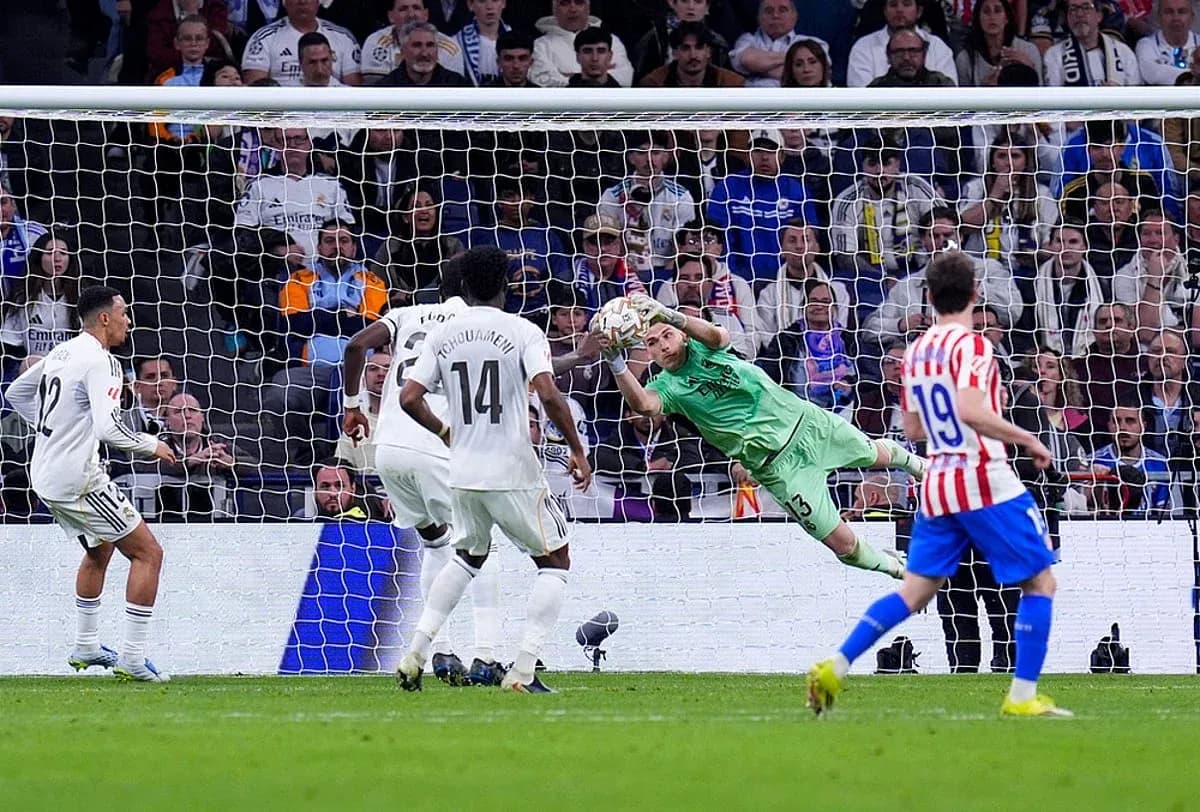
Real Madrid Edges Alaves in Tactical Battle
Under the lights of the Estadio Santiago Bernabéu, Real Madrid edged a 2–1 win over Alaves, a result that felt entirely in character for both sides’ seasonal DNA. Following this result in La Liga’s Regular Season - 33, it was second against eighteenth on paper: a heavyweight with 73 points and a +37 goal difference (67 goals for, 30 against overall) against a relegation-threatened side on 33 points with a -12 goal difference (36 for, 48 against overall).
The scoreline mirrored the broader balance of power. At home this campaign, Real Madrid have been ruthless: 14 wins from 17, just 2 defeats, scoring 39 and conceding 14. Their home attacking average of 2.3 goals per game and home defensive average of 0.8 goals against framed this as a fixture where control and inevitability were expected.
Alaves arrived with a very different story. On their travels, they had played 17 times, winning only 3, drawing 3 and losing 11, scoring 17 and conceding 30. An away attacking average of 1.0 against an away defensive average of 1.8 told of a side that tends to be outgunned. Their 5-3-2 at the Bernabéu was less a tactical flourish and more a survival mechanism.
Tactical Voids and Selection Choices
Both coaches were forced into adjustments by absences. Real Madrid were without T. Courtois (thigh injury), Rodrygo (knee injury) and R. Asencio (illness), removing an elite goalkeeper, a key wide forward and a rotational attacker from the equation. The response was telling: Andriy Lunin in goal, and a front pairing of Kylian Mbappé and Vinicius Júnior, supported by a four-man midfield that blended control and incision.
The back four of Trent Alexander-Arnold, Éder Militão, Dean Huijsen and Álvaro Carreras was aggressive by design. With Alexander-Arnold and Carreras both comfortable stepping into midfield, the 4-4-2 often morphed into a 2-4-4 in possession, with Aurélien Tchouaméni anchoring transitions and Federico Valverde and Jude Bellingham free to surge into half-spaces. Arda Güler’s inclusion on the flank added a playmaker’s brain in wide zones, consistent with his league output of 9 assists and 70 key passes overall.
Alaves had their own voids to cover. F. Garces (suspended), C. Protesoni (muscle injury) and A. Rebbach (yellow cards suspension) stripped depth and some aggression from their squad. The solution was a compact 5-3-2: Antonio Sivera behind a line of five—Ángel Pérez, Jonny Otto, Nahuel Tenaglia, Victor Parada and Youssef Enriquez Lekhedim—designed to compress central channels and defend the width of the box.
In midfield, Jon Guridi, Antonio Blanco and Denis Suarez formed a trio aimed at screening and springing counters. Up front, Toni Martínez and Lucas Boyé offered complementary threats: Martínez as the channel runner and presser, Boyé as the physical focal point and top scorer with 11 league goals overall, plus 3 penalties scored.
Disciplinary profiles also shaped the tone. Real Madrid’s season-long yellow-card distribution shows a clear spike between 61–75 minutes (22.41%) and consistent late-game bookings (18.97% between 76–90 and 18.97% between 91–105), a reflection of how aggressively they defend leads. Their red cards are scattered but significant: 14.29% in each of 31–45, 61–75 and 76–90, and a heavy 28.57% in 91–105, underlining how their intensity can tip over late on.
Alaves, meanwhile, are no strangers to disciplinary strain. Their yellow cards peak at 76–90 minutes with 20.25%, and 17.72% between 91–105—a classic profile of a side forced into desperate defending. Their reds cluster overwhelmingly late too: 20.00% in 61–75, 20.00% in 76–90 and a striking 60.00% between 91–105. The Bernabéu, against this opponent, was always likely to push them toward that edge.
Key Matchups
Mbappé entered as La Liga’s most devastating finisher: 24 goals and 4 assists overall from 27 appearances, 97 shots with 60 on target, and 8 penalties scored but with 1 missed—proof that even his ruthlessness has a human edge. His duel with an Alaves away defence conceding 1.8 goals per game on their travels was the central tension of the night.
The 5-3-2 was built to crowd his zones, but Mbappé’s movement between the lines and into the left half-space, dovetailing with Vinicius, repeatedly asked questions of Tenaglia and Parada. With Real Madrid’s overall attacking average of 2.1 goals per match and Alaves conceding 1.5 overall, this was a meeting of an elite hunter and a porous shield.
On the other side, Lucas Boyé and Toni Martínez represented Alaves’ counter-punch. Boyé’s 11 goals, 1 assist and 6 blocked shots overall mark him as both finisher and first defender from the front. Martínez, with 9 goals and 3 assists overall, plus 418 duels contested and 215 won, is a relentless physical presence. Their battle with Militão and Huijsen—who has blocked 14 shots overall and carries a red-card history—was as much about restraint as dominance.
Engine Room
In midfield, the game’s control centre pitted Real Madrid’s creative core against Alaves’ screen. Güler, with his 9 assists and 90% passing accuracy overall, and Valverde, with 8 assists, 43 key passes and 40 tackles, formed a dual-threat engine: one to unpick, one to drive and destroy. Tchouaméni, with 60 tackles, 12 successful blocks and 36 interceptions overall, sat beneath them as the metronomic destroyer, but his 8 yellow cards underline the cost of that role.
For Alaves, Antonio Blanco and Jon Guridi had to compress space, while Denis Suarez looked for the first pass out. Their task was to disrupt the rhythm of a side that has failed to score at home only twice all season and has produced 11 clean sheets overall, turning Madrid’s territorial dominance into sterile possession whenever possible.
Statistical Prognosis and Tactical Verdict
Following this result, the numbers and the narrative remain aligned. Real Madrid’s home profile—39 goals for and 14 against from 17 matches—suggests that even when the scoreline is tight, the underlying Expected Goals picture tilts heavily their way. Their penalty record this season, 12 scored from 12 overall with 0 missed, adds another layer of inevitability once they reach the box.
Alaves’ away pattern—17 goals scored, 30 conceded across 17 games—frames their 1-goal return at the Bernabéu as par for the course: capable of striking through Boyé and Martínez, but structurally unable to suppress sustained pressure. Their 3 clean sheets overall underline how rare it is for them to shut opponents out.
Tactically, the 2–1 feels like the logical intersection of these trends. Real Madrid’s layered attack, driven by Mbappé’s finishing, Vinicius’ chaos, Güler’s creativity and Valverde’s two-way power, eventually overwhelmed a five-man back line that could delay but not deny. Alaves’ compactness and counter-attacking threat ensured the contest stayed alive, but the statistical gravity of one of Europe’s most potent home sides against one of La Liga’s weakest travellers always pointed toward a narrow but deserved home win—exactly what unfolded on the night.