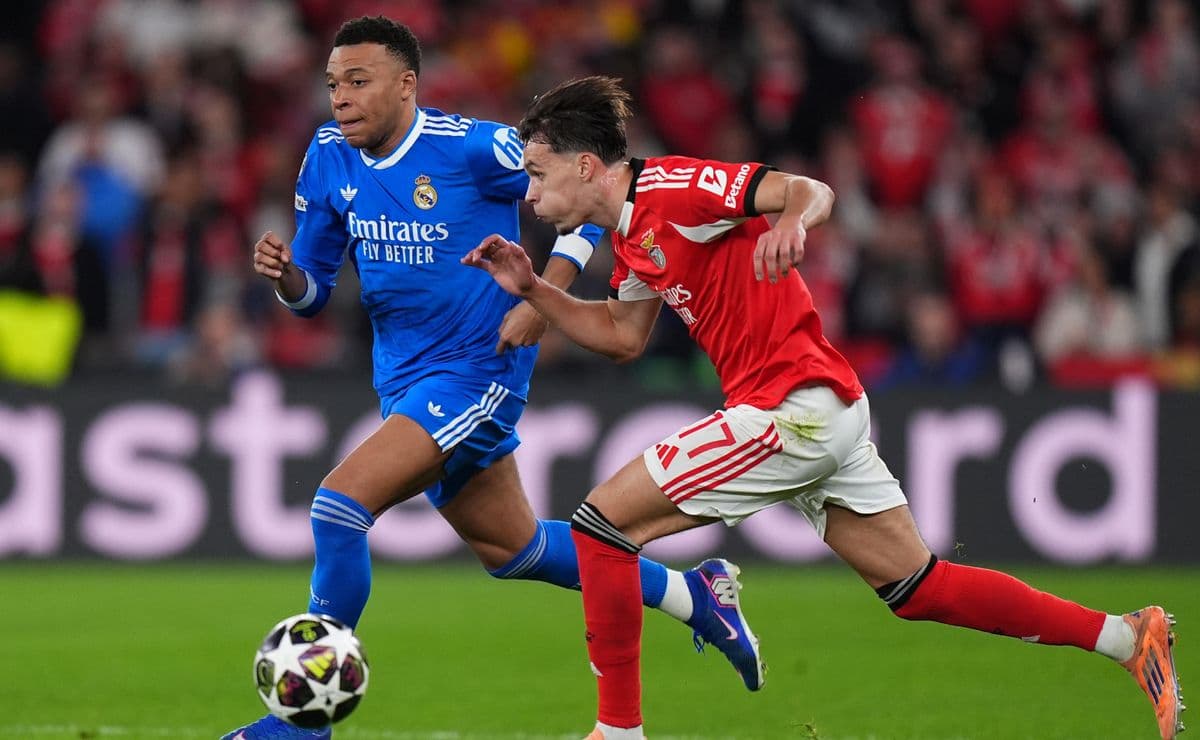
Real Madrid Edges Benfica 1–0 in Champions League Clash
At Estádio da Luz on Tuesday night, Real Madrid ground out a 1–0 win over Benfica in a finely balanced UEFA Champions League Round of 32 clash. A single second‑half goal from Vinícius Júnior, set up by Kylian Mbappé, separated the sides after a cagey opening 45 minutes. Madrid’s superior control of the ball and greater cutting edge in the box ultimately told, while Jose Mourinho’s Benfica were left to rue a disciplined but conservative display. The result underlines Madrid’s status near the top end of the competition’s overall standings and leaves Benfica, already in mid-pack, with little margin for error in the return leg.
First Half Analysis
The first half unfolded as a tactical stalemate. With neither side registering on the scoresheet before the interval, both Mourinho and Alvaro Arbeloa saw their game plans largely cancel each other out. Benfica’s 4‑2‑3‑1, anchored by Leandro Barreiro and Fredrik Aursnes, was clearly set up to protect Anatoliy Trubin and deny space to Madrid’s front line.
Real Madrid, in a 4‑4‑2, sought to progress through the midfield quartet of Federico Valverde, Arda Güler, Aurélien Tchouaméni and Eduardo Camavinga, but while they enjoyed more of the ball over the course of the night, that early dominance did not translate into a breakthrough before half-time. Crucially, there were no goals, cards or substitutions in the opening 45 minutes, underscoring how measured and risk‑averse both teams were in the initial phase of the tie.
Second Half & Tactical Shifts
The game sprang to life immediately after the restart. On 50', Vinícius Júnior was booked for Real Madrid, but he responded in the most decisive way moments later. Also on 50', Vinicius Junior found the net with a normal goal, assisted by K. Mbappe, giving Arbeloa’s side a vital away advantage and validating their more progressive use of possession.
The football itself quickly faded into the background after an ugly episode erupted midway through the second half. Moments after finding the net, Vinícius Júnior accused Gianluca Prestianni of directing racist abuse at him, leading referee François Letexier to activate UEFA’s three-step anti-racism protocol. Play was halted for a fraught 11 minutes as players argued over whether to leave the pitch and objects were hurled from the stands. In the midst of the turmoil, Benfica manager José Mourinho was dismissed in the 86th minute following an explosive outburst at the officials, ruling the “Special One” out of the dugout for the decisive return leg at the Santiago Bernabéu.
Chasing the game, Mourinho turned to his bench on 74'. Andreas Schjelderup made way for Georgiy Sudakov, and Rafa Silva was replaced by Richard Ríos, like‑for‑like midfield changes that aimed to inject fresh energy and creativity between the lines rather than alter the structure. The tension rose soon after when Gianluca Prestianni was booked for simulation on 78', a sign of Benfica’s increasing desperation to find a route back.
Mourinho then adjusted his defensive base: at 80', F. Aursnes went off for defender S. Lopes Cabral, a somewhat conservative switch for a trailing side, followed by a more attacking move on 81' as winger G. Prestianni was replaced by forward Dodi Lukebakio.
Arbeloa’s first change came late, at 86', with Arda Güler withdrawn for Brahim Díaz, a fresh runner to help Madrid manage transitions and hold the ball. Mbappé collected a yellow card on 87', further illustrating the competitive edge of the closing stages. In stoppage time, Sudakov was booked for a foul at 90+2', encapsulating Benfica’s increasingly aggressive press. Arbeloa then used two time‑management substitutions: A. Carreras went off for Daniel Carvajal at 90+9', and E. Camavinga was replaced by Thiago Pitarch at 90+4', helping Madrid see out a narrow but precious 1–0 victory.
Statistical Deep Dive
Across the 90 minutes, Real Madrid controlled 58% of the ball to Benfica’s 42%, reflecting their greater territorial authority. That possession was underpinned by superior passing: Madrid completed 549 of 621 passes for an 88% accuracy rate, compared to Benfica’s 355 of 443 at 80%. The Portuguese side were compact and organised, but struggled to progress the ball with the same fluency.
In attack, Madrid’s superiority was even clearer. They produced 16 total shots to Benfica’s 10, and crucially hit the target seven times against the hosts’ three. The expected goals figures – 1.11 for Madrid versus 0.41 for Benfica – mirror the scoreline and underline how much more dangerous Arbeloa’s team were in the box. Both goalkeepers finished with the same goals_prevented value of 0, suggesting the result tracked the quality of chances created.
Discipline was relatively balanced but telling. Madrid committed nine fouls to Benfica’s six, with both sides collecting two yellow cards. The bookings for Vinícius, Mbappé, Prestianni (for simulation) and Sudakov (for a foul) illustrated a contest that was intense but never out of control.
Standings & Implications
In the broader Champions League standings, Real Madrid strengthen their position near the top tier of the competition. With 15 points, a +9 goal difference and five wins from eight, they sit 9th overall and look well placed to push deep into the knockout rounds despite an inconsistent recent form line of LWLWL. Benfica, 24th with nine points and a -2 goal difference (three wins, five defeats), remain in the playoff positions but with little cushion. Their home record of two wins and two losses now looks fragile, and they will likely need a far more adventurous display in Madrid to overturn this first‑leg deficit and keep their campaign alive.