Real Madrid Triumphs Over Manchester City in Dramatic Champions League Clash
On a cold Champions League night at the Etihad Stadium in Manchester, Real Madrid edged a dramatic Round of 16 tie 2-1 (HT: 1-1) against a Manchester City side reduced to ten men after just 20 minutes. Referee Clement Turpin oversaw a contest that mixed high tactical detail with moments of chaos, ultimately decided deep into stoppage time.
City came into the game as one of the competition’s form teams, sitting 8th in the overall Champions League standings with 16 points, a +6 goal difference and a record of five wins from eight. Real Madrid, 9th with 15 points and a +9 goal difference, had been more volatile (five wins, three defeats) but carried greater attacking punch with 21 goals already in the campaign. The full-time scoreline and the underlying numbers underlined that contrast: Madrid were more ruthless, City more wasteful.
Turning Point
The first major turning point arrived on 20 minutes. Bernardo Silva was sent off for handling, leaving City to play more than 70 minutes with ten men. It was not just the numerical disadvantage that hurt Pep Guardiola’s side, but the loss of a key midfielder in a 4-2-3-1 system built around control and circulation.
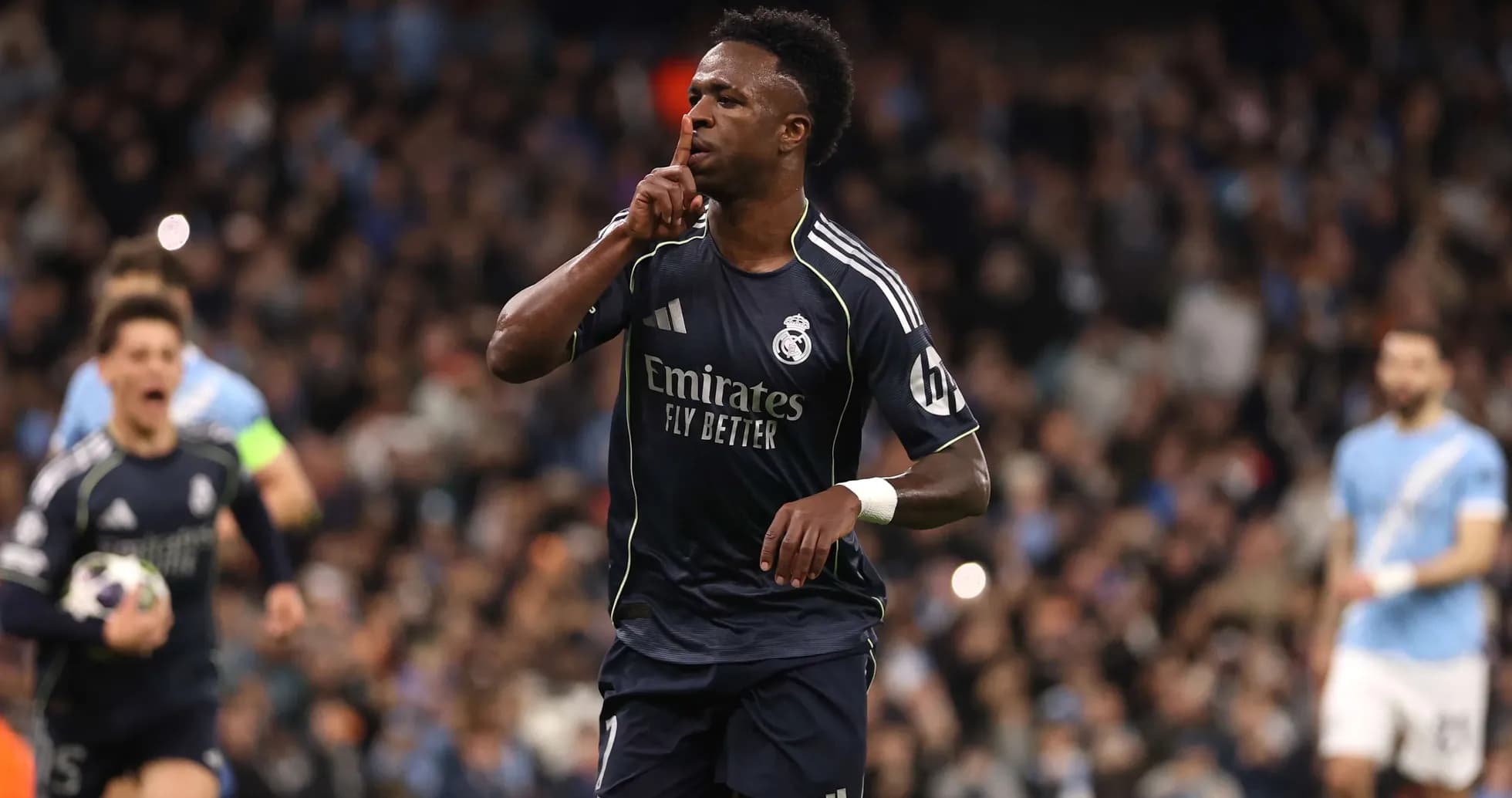
Madrid capitalised almost immediately. Two minutes later, Vinicius Junior converted from the penalty spot to put the visitors ahead. With City’s structure compromised and their double pivot under extra strain, Real found spaces between the lines, yet they never fully took control of the ball in the way their extra man might have suggested.
City’s response before the break was a testament to their resilience and Haaland’s enduring threat. On 41 minutes, Erling Haaland struck from open play to restore parity. The equaliser sent the sides into half-time at 1-1, fully aligned with the interval scoreline. Even with ten men, City had created enough to justify being level, and their 14 shots inside the box by full-time show how often they still managed to penetrate Madrid’s defence.
The first half closed with further disruption for City as Abdukodir Khusanov was booked for elbowing at 45+4, adding a layer of jeopardy to an already fragile back line.
Half-Time Changes
Guardiola moved quickly at the interval, reshaping his defence and midfield. Rúben Dias made way for Marc Guéhi and Tijjani Reijnders was replaced by Nathan Aké, both changes arriving at 46 minutes. The logic was clear: fresh legs and a more conservative defensive profile to cope with the numerical deficit. On the opposite bench, Thibaut Courtois was withdrawn at the break for Andriy Lunin, a notable decision given Courtois had not conceded from open play and Madrid would later rely heavily on their goalkeeper.
City’s ten men continued to punch above their weight. They finished with 22 total shots to Madrid’s 14, and 8 shots on target to Madrid’s 7. Their xG of 1.91 against Madrid’s 2.93 reflects that while Real carved out the slightly higher-quality chances overall, City generated a volume and danger that belied their red card. Nine corners to Madrid’s six further underline how often they pushed the Spanish side back.
Second Half Substitutions
Haaland’s withdrawal on 57 minutes for Omar Marmoush was another significant inflection point. Guardiola also removed Matheus Nunes for Antoine Semenyo at the same time, tilting his side towards mobility and counter-attacking rather than a focal-point striker. Later, Rodri was replaced by Nico González on 74 minutes, leaving City without their metronome in midfield in the closing stages.
Alvaro Arbeloa’s changes were more about adding firepower and managing energy. Brahim Díaz went off for Kylian Mbappé on 69 minutes, introducing an elite transition threat against a tiring ten-man side. Arda Güler and Thiago Pitarch were replaced by Eduardo Camavinga and Manuel Ángel Morán on 74 minutes, injecting fresh legs into midfield. Trent Alexander-Arnold, booked for holding on 80 minutes, was then substituted for Dani Carvajal at 83 minutes to protect Madrid’s right flank and avoid a second yellow.
Chaotic Finale
Madrid’s pressure eventually told in a chaotic finale. Vinicius Junior thought he had scored at 90+1, only for VAR to rule the effort out for offside. Two minutes later, at 90+3, he did find a decisive goal from open play, assisted by Aurélien Tchouaméni. The Brazilian’s brace encapsulated Madrid’s cutting edge in the final third.
Statistically, Madrid shaded possession with 52% to City’s 48%, completing 499 of 544 passes with a 92% accuracy rate, identical in percentage terms to City’s 443 of 483. Yet City’s goalkeeper, Gianluigi Donnarumma, made four saves and recorded zero goals prevented, while Lunin produced seven saves at the other end, also without any goals prevented credited. City’s attacking weight forced Madrid’s keeper into more work, but Madrid’s finishing, via Vinicius, was more decisive.
Discipline played its part. City collected one yellow card (for Khusanov) and the crucial red for Bernardo Silva, while Madrid’s two bookings went to Mbappé (delay of game) and Alexander-Arnold. Real’s ability to stay at eleven men, combined with their deeper bench, proved vital as the match stretched.
Champions League Context
In the context of the Champions League snapshot, City remain on 16 points in 8th place with a +6 goal difference and a form line of WLWLW, their home record still strong at three wins from four. Madrid stay on 15 points in 9th, with a +9 goal difference and the same volatile LWLWL pattern, but this victory at the Etihad, adding to an away record of two wins and two defeats, reinforces their reputation as a side that can suffer, bend, and still find a way through in Europe’s biggest moments.