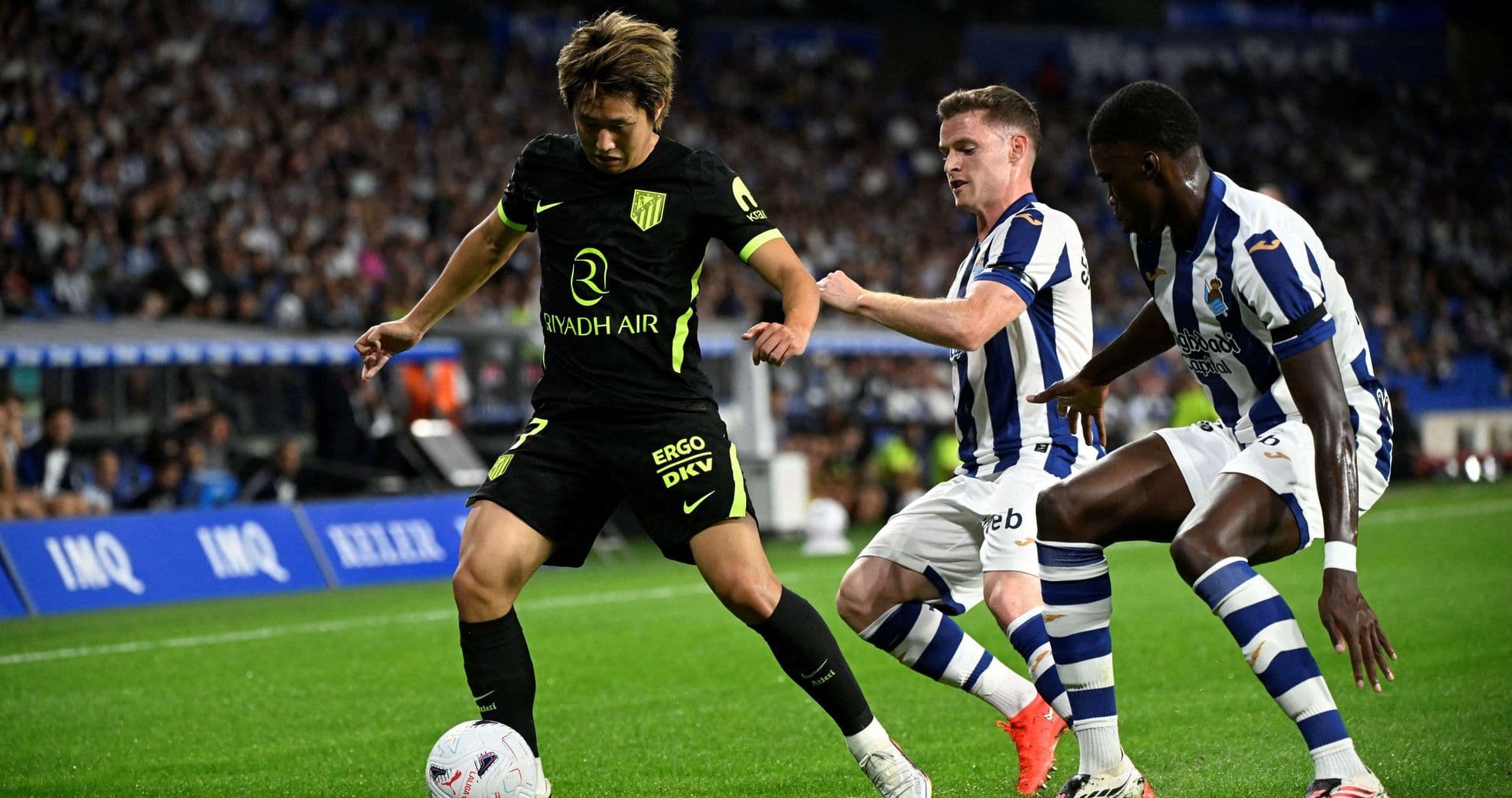
Real Sociedad vs Atletico Madrid: Tactical Analysis of 0-3 Defeat
The night at Reale Arena ends with a brutal clarity. Real Sociedad, already wobbling in La Liga, are taken apart 3–0 by an Atletico Madrid side that looks increasingly comfortable living in the space between control and cruelty.
I. The Big Picture – trajectories diverging
This was Round 5 of the La Liga regular season, but the table heading into this game already framed it as a clash of two different realities. Real Sociedad arrived in mid-table turbulence, ranked 12th with 7 points from 6 matches, their overall goal difference a worrying -5 (6 scored, 11 conceded). The numbers underline a side caught between ideas: at home they had managed just 2 goals in 3 matches, with an average of 0.7 goals for and 1.3 against per game in San Sebastián.
Atletico Madrid, by contrast, travelled north sitting 5th with 10 points from 5 games and an overall goal difference of +4 (10 for, 6 against). On their travels they had been efficient and ruthless: 2 away wins from 3, 6 goals scored and 4 conceded, averaging 2.0 goals both home and away. This 3–0 away win fits perfectly into that pattern – a team that doesn’t need to dominate the ball to dominate the scoreboard.
The formations told their own story. Pellegrino Matarazzo kept Real Sociedad in their favoured 4-2-3-1, a shape they had already used 4 times this season, while Diego Simeone doubled down on the more modern, aggressive 3-4-2-1 that has appeared once in Atletico’s tactical palette. One side sought structure to rediscover identity; the other used structure as a platform to unleash its weapons.
II. Tactical Voids – absences and discipline
Real Sociedad came into this fixture with important holes in their defensive core. Jon Martín, a 19-year-old defender who has already collected a red card this season, was suspended. His numbers this campaign – 366 minutes, 1 red card, 8 tackles and 1 blocked shot – speak of a young defender still learning the line between aggression and recklessness. Without him, Matarazzo turned to a back four of J. Aramburu, Luken Beitia, M. Sarr and Sergio Gómez, protecting Álex Remiro.
The absences of A. Odriozola and I. Zubeldia further stripped the hosts of experience and rotation options in the defensive line. It left Aramburu, already one of the most card-prone players in La Liga with 3 yellows and 24 fouls committed in 6 appearances, as the senior full-back presence. That is a risky anchor for a defensive structure that had already conceded 11 goals overall before this match.
Atletico had their own missing pieces – J. Alvarez, P. Barrios and A. Sorloth all out with muscle injuries – but Simeone’s squad depth softened the blow. In particular, the absence of Sorloth changed the profile of the front line, pushing A. Lookman into the spearhead role and increasing the creative burden on Lee Kang-In and Álex Baena behind him.
Disciplinarily, the pre-match data painted a clear picture: Real Sociedad’s yellow cards were spread across the game, but with a noticeable concentration between 16-30, 46-60 and 61-75 minutes (each window accounting for 21.43% of their yellows). Atletico, meanwhile, tended to pick up yellows between 31-45 and 46-60 (22.22% each), with a notable late-game red card spike at 76-90 (100% of their reds in that window). This fixture, however, was decided long before any late chaos could tilt it back toward the hosts.
III. Key Matchups – Hunter vs Shield, Engine Room battles
The “Hunter vs Shield” duel was always likely to revolve around Atletico’s multi-headed attack and Real Sociedad’s fragile defensive record. Atletico arrived averaging 2.0 goals per match overall, while Real Sociedad were conceding 1.8 goals per match across the season. On their travels, Atletico’s 2.0 goals per game met a home defence that had only kept 1 clean sheet at Reale Arena and had already suffered a 0-3 home defeat in their “biggest loss” profile. This 0-3 felt less like a shock and more like a grim repetition of a pattern.
Álex Baena, one of La Liga’s more influential attacking midfielders so far, was central to that threat. Heading into this game he had 3 goals and 1 assist from 5 appearances, with 10 key passes and a rating of 7.34. His ability to drift into pockets between the lines, combined with 8 total shots (4 on target), posed a direct challenge to Real Sociedad’s double pivot of Y. Herrera and Carlos Soler.
Herrera himself is a fascinating figure in this matchup. Statistically one of the league’s most combative midfielders – 51 duels contested, 25 won, 9 tackles, 3 yellow cards – he is both shield and potential liability. His presence is essential to Real Sociedad’s defensive structure, but his disciplinary profile and the team’s overall card distribution (a red card already in the 61-75 minute window this season) make him a magnet for pressure. Atletico’s interior duo of Marcos Llorente and M. Hjulmand were set up to exploit that: one running beyond, the other anchoring and recycling.
On the flanks, the battle between Aramburu and Atletico’s left-sided combination of Álex Grimaldo and Baena was always going to be decisive. Aramburu, who has already attempted 8 dribbles (5 successful) and made 21 tackles with 15 interceptions, thrives in high-contact duels. But against Grimaldo’s timing and Baena’s movement, his aggression risked being turned against him, opening channels for cut-backs and late arrivals at the edge of the box.
For Real Sociedad, the creative burden was shared between Luka Sučić and Mikel Oyarzabal. Sučić came in as their leading scorer with 2 goals, 13 shots (5 on target), and 211 passes at 89% accuracy, while Oyarzabal led the team in assists (2), key passes (6) and attacking involvement from the left half-space. The idea was clear: use Sučić between the lines, Oyarzabal drifting inside from the front, and Barrenetxea plus Gonçalo Guedes to stretch Atletico’s back three.
Yet Atletico’s back line, led by D. Hancko, has been one of the league’s most quietly dominant units. Hancko’s campaign so far – 450 minutes, 361 completed passes at 90% accuracy, 5 tackles, 3 blocked shots, 8 interceptions and 21 duels won – underpins a defence that had already kept 2 clean sheets overall. His ability to step out of the line to engage Oyarzabal or Sučić without losing structural integrity is a key reason why Atletico can afford to commit wing-backs and midfielders forward.
IV. Statistical Prognosis – why 0-3 made sense
Strip away the emotion and the 3-0 away win looks like the logical outcome of intersecting trends.
Real Sociedad’s attack at home has been blunt: 2 goals in 3 matches, failing to score in 2 of those. Overall they have already failed to score in 3 of 6 league games. Atletico’s defence, meanwhile, had conceded just 6 goals in 5 matches, with 2 clean sheets and only 1 game in which they failed to score themselves. When a side averaging 2.0 goals per game overall meets a team averaging 1.8 goals conceded and 1.0 scored, the margin for error is tiny for the underdog.
Atletico’s penalty record also hints at a clinical edge: 1 penalty awarded, 1 scored, 100% conversion, while Real Sociedad have yet to win or convert a penalty this season. In tight matches, that kind of ruthlessness often separates points from regrets. Here, Atletico didn’t even need the spot-kick safety net; their open-play structure and pressing triggers were enough.
The disciplinary undercurrents also fed into the tactical flow. Real Sociedad’s tendency to pick up yellows in the middle phases of each half invited Atletico to accelerate around those windows, knowing that one more late tackle from Herrera or Aramburu could tilt the balance further. Atletico themselves, while not spotless, have managed to keep their aggression mostly within bounds, with just 1 red card overall and a spread of yellows that reflects controlled intensity rather than chaos.
Following this result, the narrative hardens. Real Sociedad’s overall goal difference, already negative, sinks further into red territory, and the pattern of home fragility becomes a genuine concern. Atletico Madrid, by contrast, reinforce their identity as a side that travels well, defends with intelligence, and trusts the creative instincts of Baena, Lee Kang-In and Lookman to turn territorial parity into scoreboard dominance.
This was not just a 3-0 scoreline. It was a tactical confirmation: one squad built to absorb and strike, the other still searching for a way to protect its own ambition.