Roberto ‘Pico’ Lopes: From Bank Desk to World Cup Hero
On another life path, Roberto “Pico” Lopes might be spending this weekend discussing fixed rates and repayment plans in a Dublin branch office. Instead, the 34-year-old is plotting how to stop Uruguay at a World Cup.
The Shamrock Rovers centre-back, once a mortgage advisor juggling spreadsheets by day and League of Ireland fixtures by night, has become one of the most unlikely storylines of this tournament. His performance on Monday, marshalling Cape Verde to a gritty 0-0 draw against European champions Spain, felt like the ultimate vindication of a gamble he took seven years ago.
Back in 2017, Lopes was splitting his time between Bohemians and the bank when Shamrock Rovers offered him a full-time professional contract. It was a step into the unknown. He took it. The decision has carried him from domestic derbies to the sport’s biggest stage.
Now the World Cup has dragged him into the global spotlight. The defender from Crumlin, born in Ireland to Cape Verdean father Carlos and Irish mother Judy, has gone from local cult figure to international curiosity. The tiny volcanic archipelago he represents — a nation of just 525,000 people — has announced itself with an impressive World Cup debut, and Lopes has become one of its most recognisable faces.
US television picked up the story. So did James Corden’s World Cup show on Fox, where Lopes appeared as the everyman-turned-World-Cupper. He called it “the stuff of dreams.” It is, and it almost never happened.
A LinkedIn Message That Changed Everything
The sliding-doors moment arrived in the most modern way possible: a LinkedIn message.
In 2018, then Cape Verde coach Rui Aguas contacted Lopes on the networking site. The message sat there, unread and untranslated, for months. When Lopes finally dropped it into Google Translate, the opportunity became clear. Aguas followed up nine months later, checking if he had thought about the offer.
“He said they were interested in getting new players into the national team and asked if it would be of interest,” Lopes told AFP in 2024. His response was immediate and apologetic. Absolutely interested. Sorry for the delay. If the chance was still there, he wanted in.
The delay had a simple explanation. Lopes thought it was a wind-up.
“I grew up in an era of prank phone calls and prank messages so I was always a bit skeptical,” he told the Irish Sun. “I never thought an international call-up would come that way.”
It did. Since his debut in 2019, he has played at two Africa Cup of Nations, helping Cape Verde reach the quarter-finals in the 2023 edition, and now he stands at the summit of the game: a World Cup.
A Family Story Spanning Islands and Streets
His display against Spain was not just for the millions watching around the world. It was for several generations of his own family, scattered between Dublin and Cape Verde.
In the islands, his 98-year-old grandfather watched on. In Atlanta, his parents, two brothers, his wife Leah and baby son Diego were in the stands. Diego slept through most of it.
“He slept through most of the match — it shows you how boring Spain was,” Lopes joked.
Back home and abroad, the family have been swept up in the wave. Judy, his mother, told RTE that Cape Verde fans have been stopping them in the street.
“They’ve seen us on TV, they’ve been approaching us on the street saying, ‘We recognize you’, all the way from Crumlin, can you believe it?” she said.
Lopes himself remains in the team bubble at Cape Verde’s base, insulated from most of the noise. But he knows what this means, not just for him, but for the communities that shaped him — the Dublin neighbourhood where he grew up and the Atlantic islands whose shirt he now wears.
Degrees, Titles and a Dreamer’s Mind
For all the romance, Lopes has never forgotten how close he came to a different career. The degree he earned in Dublin is not just a footnote; it was the bridge that led him to LinkedIn, and indirectly to the national team.
“If I didn’t go to college or I didn’t pursue education, I wouldn’t have known what LinkedIn was,” he told the Irish Sun. “Your education is just as important.”
He balanced work and football for as long as he could. Only when Rovers came calling and the opportunity became undeniable did he finally walk away from the bank and commit fully to the game. Since then, he has collected five Irish league titles with Shamrock Rovers, becoming a cornerstone of their domestic dominance.
Yet even before all of that, the dream was already flickering. Watching Cape Verde’s first-ever Africa Cup of Nations appearance in 2013, he allowed himself to wonder.
“I am a dreamer. You watch anything yourself… ‘Could that be me? I wonder if that would ever happen to me?’”
The answer, a decade on, is playing out in real time. Thirteen years after that first AFCON appearance, he is no longer the fan on the sofa. He is in the arena, part of the ‘Beautiful Game’s’ grandest show, preparing to face Uruguay with a nation — and a Dublin neighbourhood — watching every step.
Canada 6–0 Qatar: History, at a Cost
In Vancouver, another World Cup story unfolded, this one painted in red and white and tinged with concern.
Canada did not just win a match on Thursday; they rewrote their own World Cup history. A 6-0 demolition of Qatar delivered the country’s first-ever World Cup victory and left Jesse Marsch’s side on the brink of the knockout stages, according to The Associated Press.
Jonathan David scored a hat trick. Canada, a team that once struggled to score at this level, suddenly could not stop.
The numbers tell the scale of it. Before this tournament, Canada had just two World Cup goals to their name: Cyle Larin’s strike in their opening draw against Bosnia-Herzegovina and Alphonso Davies’ goal four years ago in a loss to Croatia, along with an own goal by Morocco. They were shut out three times at the 1986 World Cup.
Against Qatar, they tripled that all-time tally in one night.
BC Place shook under the weight of it. The stands were packed, 52,497 fans roaring every time the net rippled. Among them, Canadian Prime Minister Mark Carney, seated alongside FIFA President Gianni Infantino, after missing Canada’s previous game in Toronto because of the G7 summit in France.
“It was amazing. After every goal it got louder and louder,” David said. “It gave us motivation to get the next goal and the next goal.”
Marsch, walking off the pitch, held up six fingers. His words matched the gesture.
“No one will forget this, and no Canadian will forget this day,” he said. “It’s an incredibly seminal moment for everyone to understand that there’s talent in this country, that there’s mentality, that there’s desire, that there’s a lot of things that make this country special.”
The crowd felt it too. “We’re soaking up history right here,” fan Matthias Kempe said, capturing the mood in the stands.
Goals, Red Cards and a Grim Twist
On the pitch, the game quickly spiralled away from Qatar.
Larin struck first in the 16th minute, reacting quickest after Qatar goalkeeper Mahmoud Abunada punched away a David volley. Larin pounced on the rebound and wheeled away, pointing to his ears as the red wall behind the goal erupted.
David doubled the lead in the 29th minute with a crisp right-footed volley, his first goal in open play in more than a year. Qatar were wobbling. Soon they were down to ten men.
Homan Ahmed’s night ended in the 33rd minute. Initially shown a yellow card and penalised for a spot-kick, he saw the decision upgraded after a video review. The penalty became a free kick just outside the box, and the yellow turned to red. Qatar’s task, already daunting, became almost impossible.
Canada smelled blood. In first-half stoppage time, David added his second, stabbing home in a scramble after a shot crashed off the crossbar. Qatari players stood with hands on hips, resigned, as Canada celebrated a 3-0 lead at the break.
Then came the moment that silenced even a jubilant stadium.
Early in the second half, Assim Madibo lunged into a tackle from behind on Ismaël Koné. The Canada midfielder crumpled, his lower left leg bent at a horrifying angle. Players from both sides immediately signalled for help. Koné was stretchered off, the celebrations suddenly replaced by anxiety and anger.
Madibo, clearly distraught, was shown a red card. Qatar, already struggling, were down to nine.
Koné was taken to hospital, where he was preparing for surgery. Marsch confirmed his leg was broken and said the player’s family were with him. Canada’s biggest World Cup win arrived wrapped in the anguish of losing a key midfielder in brutal fashion.
David’s Hat Trick and a Statement Night
The goals kept coming.
Nathan Saliba, brought on to replace Koné, curled in a free kick in the 64th minute to make it 4-0. Qatar’s misery deepened in the 75th when Mohamed Manai deflected a shot into his own net.
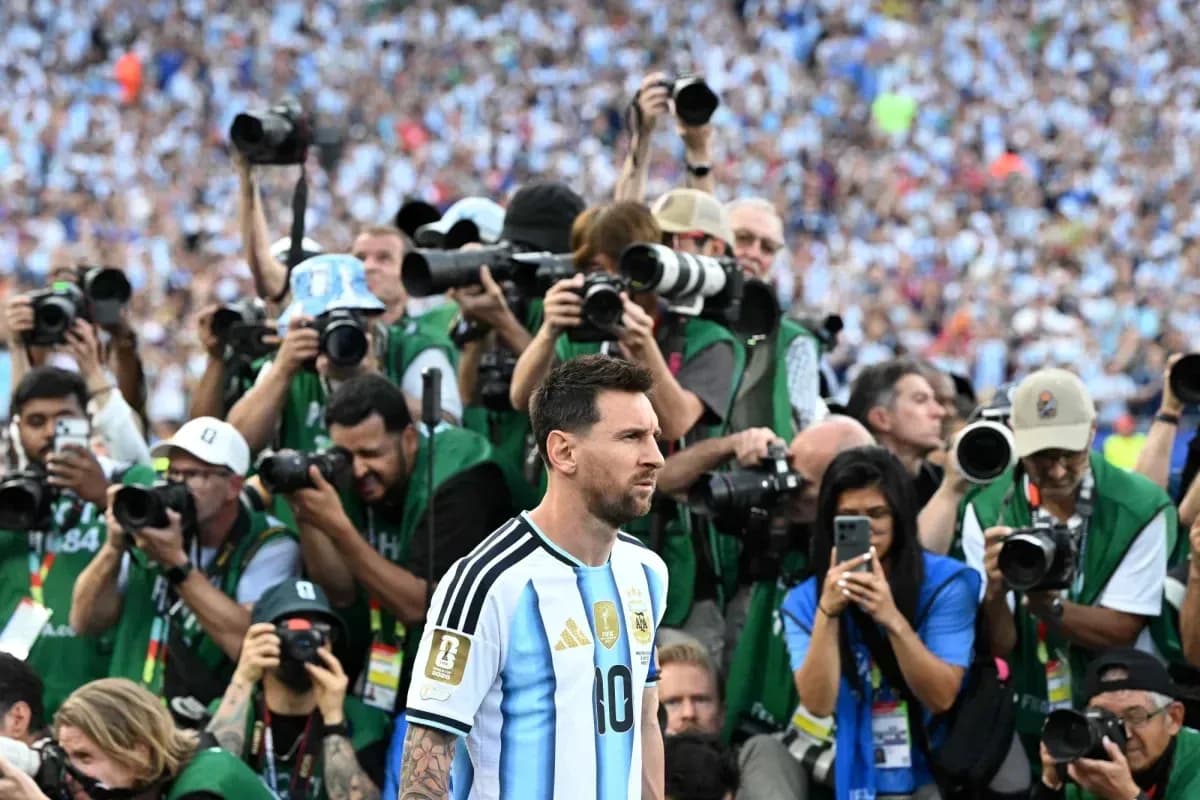
David, the face of this Canadian attack, completed his hat trick in stoppage time. The finish placed him in elite company: he joined Argentina’s Lionel Messi as the only players to score three in a single match at this World Cup.
For Qatar, it was a chastening night. Coach Julen Lopetegui could only reflect on a contest that had slipped away on every front.
“It was a very tough match for many reasons. The players did their best. It was very difficult to face this match with two players less with this environment,” he said.
Qatar had started their campaign with a measure of optimism, snatching a stoppage-time equaliser to draw 1-1 with Group B favourites Switzerland. They are still searching for a first-ever World Cup victory, having lost all three group games as hosts four years ago.
Switzerland, meanwhile, strengthened their grip on the group earlier in the day with a 4-1 win over Bosnia-Herzegovina.
Canada’s night belonged to history and heartbreak in equal measure: a six-goal statement that announced them as genuine contenders to escape the group, overshadowed by the image of Koné leaving the field with his World Cup in tatters. The result will live long in the record books. The cost may linger even longer in the dressing room.