AS Roma's Evolving Identity Shines in 4–2 Victory Over Cagliari
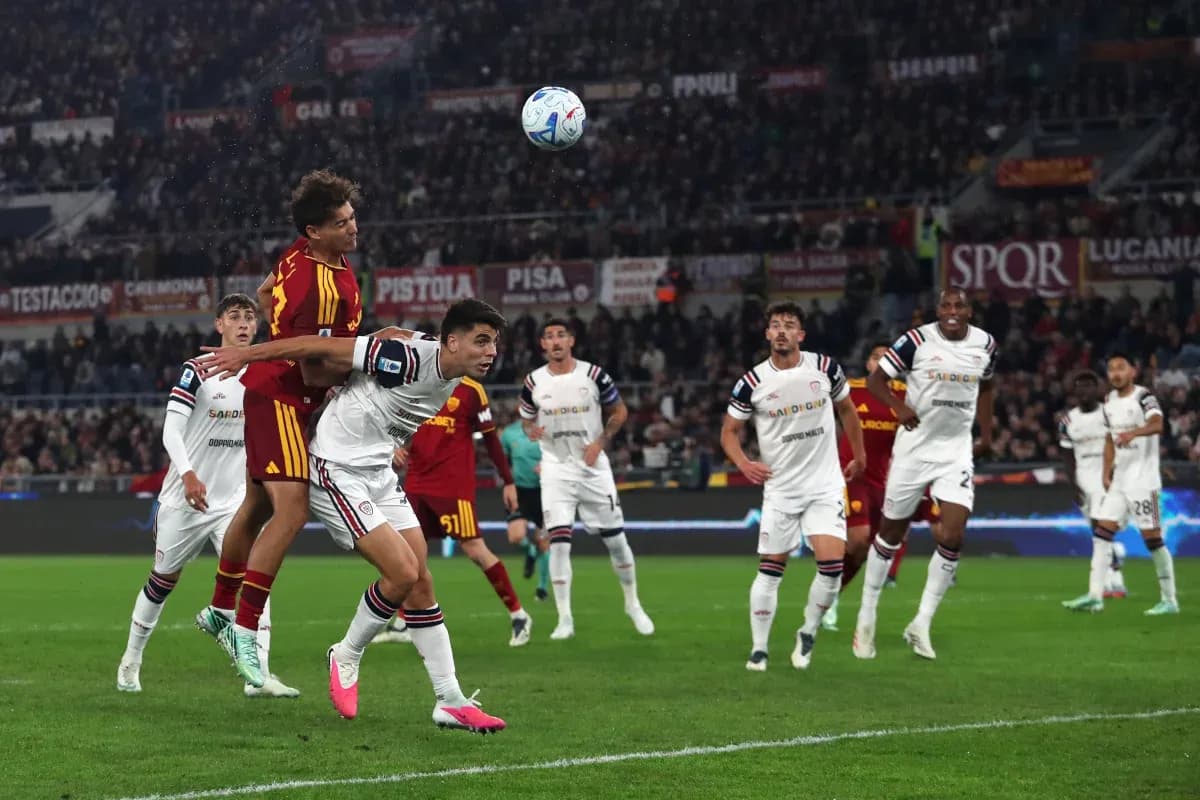
Under the lights of the Stadio Olimpico, this was billed as a meeting of two very different Serie A projects – and the final 4–2 scoreline to AS Roma told the story of a side that knows exactly what it is becoming.
I. The Big Picture – Roma’s evolving identity vs Cagliari’s volatility
Heading into this game, Roma were already shaping the league narrative. Third in Serie A with 21 points from 9 matches, they were unbeaten overall, with 6 wins and 3 draws. The numbers underlined a team built on controlled aggression: 23 goals scored overall against just 8 conceded, giving them a goal difference of +15. At home, they had been even more ruthless – 14 goals scored and 5 conceded across 5 matches, an attacking average of 2.8 goals per home game against 1.0 conceded.
Cagliari arrived in Rome in a very different mood. Tenth in the table on 13 points from 9 matches, their season was built on streaks and swings. Overall, they had scored 8 and conceded 13 for a goal difference of -5, with a curious split: only 2 goals scored at home but 6 on their travels, where they had already collected 3 wins. Yet their away defensive record – 9 conceded in 5 away games, an average of 1.8 per match – hinted at exactly the kind of chaos Roma’s front line thrives on.
The 4–2 full-time score, after a 2–1 first half, fit the pre-match mathematics: Roma’s attacking volume and Cagliari’s away openness colliding in a game that rarely felt under control for the visitors.
II. Tactical Voids – Absences that shaped the game
Roma’s squad sheet came with significant absences that would have forced Gian Piero Gasperini to recalibrate his creative structure. Paulo Dybala, one of Serie A’s leading assist providers this season with 4 assists in 6 appearances, missed out with a calf injury. Lorenzo Pellegrini, another key conduit between midfield and attack, was sidelined by a thigh injury. M. Bah, M. Kone and goalkeeper M. Svilar were also unavailable.
Those injuries pushed responsibility onto a younger, more vertical core. The starting 3-5-2 – with P. Gollini behind a back three of G. Mancini, E. Ndicka and K. Koulierakis – placed the creative burden on the central trio of B. Cristante, M. de Roon and N. Pisilli, with N. Molina and E. Lulli as wing-backs and the front pairing of M. Soulé and S. Castro asked to stretch and destabilise Cagliari’s line.
Cagliari’s own absences were less glamorous but still influential. M. Felici and R. Idrissi were out with knee injuries, while H. Winks’ back injury removed a potential metronome from the visitors’ midfield. Without Winks’ control, F. Pisacane leaned into a more combative 3-5-1-1, anchored by Y. Mina and flanked by Zé Pedro and J. Rodríguez at the back, with A. Deiola, M. Adopo and A. Romano forming a physically imposing but less creative central block.
Disciplinary trends also framed the contest. Roma’s season-long card profile showed a tendency for yellow cards to spike after the hour mark – 29.41% of their yellows arriving between 61–75 minutes and 23.53% between 76–90. Cagliari, by contrast, were most combustible even later, with 38.46% of their yellows between 76–90 minutes and another 15.38% in added time. This was a match almost designed to get more ragged as legs tired and spaces opened.
III. Key Matchups – Hunter vs Shield, and the battle for the middle
The most intriguing attacking weapon in the stadium did not start but hovered on Roma’s bench: D. Malen, one of Serie A’s top scorers with 7 goals in 8 appearances. His profile is that of a pure “hunter” – 24 shots, 12 on target, 13 key passes and a willingness to attack space relentlessly. Even from the bench, his presence shaped Cagliari’s defensive choices, forcing them to consider how much they could push their wing-backs without leaving lanes for his introduction.
On the pitch from the first whistle, the creative mantle fell to M. Soulé. With 3 goals and 1 assist in 9 league appearances, and 15 key passes already, Soulé has been Roma’s live wire between the lines. His duel volume – 69 total duels with 36 won – and 20 successful dribbles from 29 attempts speak to a player who relishes isolation battles. In this 3-5-2, he floated off S. Castro, dropping into the half-spaces to pull Cagliari’s back three into uncomfortable decisions.
Cagliari’s “shield” against this came in layers. In the first line, Y. Mina’s physicality and penalty-box instincts were central, but the real pressure point was in front of him. A. Deiola, who leads Serie A in yellow cards with 4 and has also blocked 5 shots this season, is a classic enforcer. His job was to disrupt Roma’s rhythm, step aggressively into Soulé’s receiving zones and protect A. Romano from being overrun.
Yet this is where Cagliari’s disciplinary profile worked against them. A team that accumulates the bulk of its bookings late, combined with a midfielder like Deiola who lives on the edge, was always likely to fray as Roma’s possession game wore them down. As the match stretched, Roma’s wing-backs – particularly the energetic N. Molina – could push higher, pinning Y. Sugawara and A. Obert deeper and isolating Cagliari’s lone forward M’Bala Nzola.
In the “engine room”, the contrast was clear. Roma had structure and layers: Cristante as the deep organiser, de Roon as the disruptor and Pisilli as the runner. Cagliari had muscle but less guile. Without Winks, transitions were more direct, often funnelling quickly to A. Fadera or Nzola rather than progressing through controlled passing.
IV. Statistical Prognosis – Why the game tilted Roma’s way
From a season-long lens, the outcome mirrored the numbers. Roma’s overall attacking average of 2.6 goals per game, combined with Cagliari’s overall concession rate of 1.4 and their 1.8 goals conceded per away match, pointed toward a multi-goal home performance. Roma’s defensive baseline – only 8 conceded overall, 0.9 per match – was always likely to withstand the sporadic threats of a side averaging just 0.9 goals overall.
Cagliari’s one clear statistical edge, penalties, never materialised as a lifeline. They came into the fixture perfect from the spot, with 2 penalties taken and 2 scored, no misses. But without sustained pressure in Roma’s box, that weapon stayed holstered.
In narrative terms, this 4–2 felt like a confirmation. Roma, even without Dybala and Pellegrini, have the squad depth and tactical clarity to overwhelm mid-table visitors. Gasperini’s use of a flexible back three, hard-running wing-backs and a rotating cast of forwards – with Malen ready to change the temperature from the bench – gives them multiple ways to hurt teams.
Cagliari, meanwhile, remain a dangerous but unstable away side: capable of scoring, always at risk of conceding heavily, and still searching for a midfield balance that can protect their defence without surrendering too much initiative. At the Olimpico, against a side with Roma’s rhythm and relentlessness, that imbalance was ruthlessly exposed.