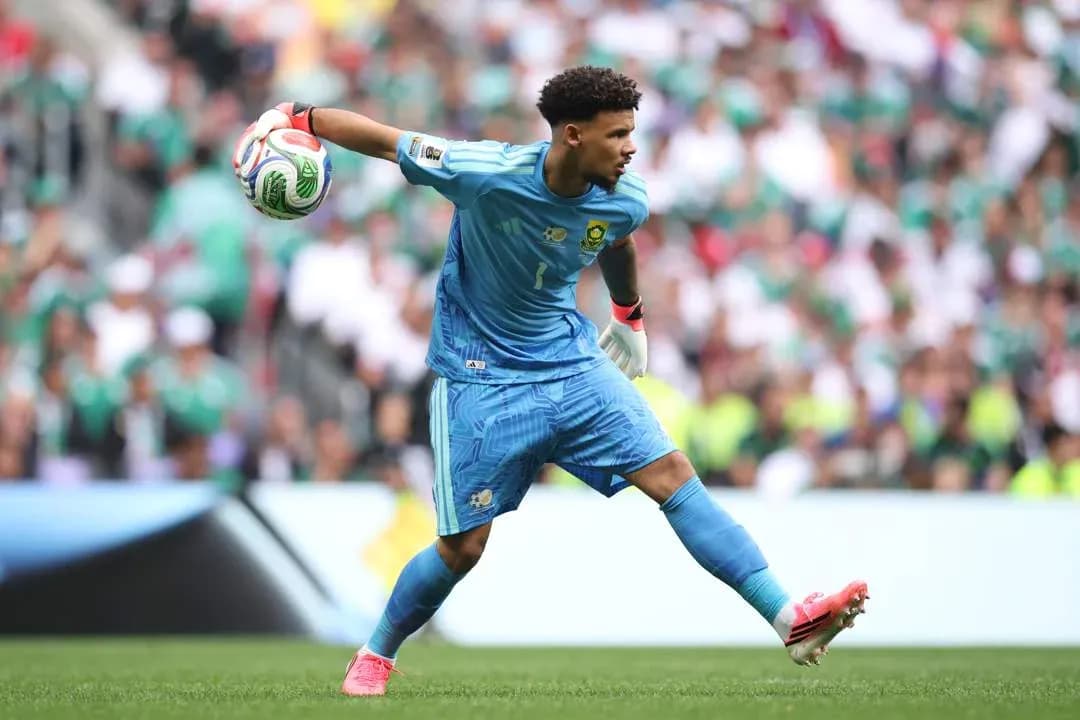
Ronwen Williams Faces Political Storm Ahead of World Cup Match
Ronwen Williams stands in the middle of a World Cup storm that has very little to do with football.
The Bafana Bafana captain is preparing for a match that could define his generation’s legacy, yet his phone tells a different story – a torrent of abuse from his own countrymen and from across the continent, fuelled by politics, fake quotes and South Africa’s hardening stance on immigration.
A World Cup dream poisoned by politics
For this South African squad, the 2026 FIFA World Cup was meant to be a full-circle moment. Many of them were kids when the country last graced the global stage in 2010, watching on home soil as Bafana carried the hopes of a nation. Sixteen years later, they are the ones in the shirts, the ones meant to restore that feeling.
Instead, the dream has been dragged into a bitter debate about borders and belonging.
South Africa’s anti-immigrant posture has become a lightning rod across the continent, and Bafana have been pulled into the crossfire. Their poor start – a 2-0 defeat to Mexico at Azteca Stadium on 11 June – lit the first spark of anger online. The politics poured petrol on it.
FIFA’s social media protection service has tracked the fallout. The governing body says Bafana players have been subjected to unprecedented levels of online abuse since the tournament kicked off. Alarmingly, the total number of incidents detected at this World Cup has already surpassed the entire volume recorded at Qatar 2022 – and we are only a week into the competition.
That revelation came at the National Centre for Civil and Human Rights in Atlanta, a short drive from Atlanta Stadium, where Bafana will face Czechia on Thursday. The date is no coincidence: the fixture falls on the International Day for Countering Hate Speech.
For Williams, the timing feels cruelly apt.
Fake quotes, real damage
The abuse has not stopped at criticism of performances. It has been sharpened by lies.
A fabricated quote attributed to Williams has done the rounds, even finding its way into reputable publications. In it, he is falsely portrayed as chastising Africans who supported Mexico over Bafana, supposedly saying the team was saddened and almost in tears.
The captain is clear. He never said it.
“We know how difficult it is now on social media, where everyone is attacking you,” Williams explained. “Sometimes it’s because of false information. If you lose a game, and you don’t perform, you can take it as players. You can put your hand up. But when there’s false information that goes around, then it hurts.”
He has become a lightning rod for anger far beyond football.
“I have been a target over the last few days over things I didn’t say. I didn’t say anything about Africa, or people supporting Mexico. I have always said that as Africa, we are one. We support each other in good and bad moments.
“We’ve all got our own politics, our own problems and our own fights that we deal with back home. Every country has that. I don’t know where that stems from. It does hurt. I have been attacked... my country as well, for things that are going on back home.”
The line between Bafana’s World Cup campaign and South Africa’s domestic tensions has blurred.
Marches, deadlines and “hate watching”
At the heart of the anger lies March and March, a vigilante group that calls itself “a grassroots citizen movement addressing growing concerns about undocumented immigration in South Africa”.
Their voice has grown so loud that President Cyril Ramaphosa felt compelled to address the nation, outlining measures to deal with the country’s porous borders. March and March have gone further, setting 30 June as the deadline for undocumented migrants to leave South Africa.
They have not spelled out what happens after that date, but the tone of their marches and the images they generate hint at the threat of violence.
The ripple effect has reached football. Across the continent, some supporters are “hate watching” Bafana – tuning in not to back an African side at a World Cup, but to revel in its struggles as a proxy protest against South Africa’s politics.
It is not the first time the national team has been dragged into the country’s immigration and xenophobia crisis. In 2019, Madagascar and Zambia refused to play international friendlies against Bafana in response to xenophobic attacks in South Africa. That left then-new coach Molefi Ntseki to begin the 2021 Africa Cup of Nations qualifying campaign without the benefit of proper preparation.
The cost was heavy. Bafana failed to qualify, finishing third in a group with Ghana, Sudan and São Tomé and Príncipe.
Six years on, the resentment has evolved from cancelled fixtures to targeted online hostility. The players are once again paying for a political climate they did not create.
“Players are human beings as well. We go through it. Sometimes it gets a lot,” Williams said. “You want to focus on doing your job, which is being a footballer, but then you get involved in politics even though you don’t want to get into that space.”
Football’s fragile sanctuary
Yet even in Atlanta, under the weight of criticism and suspicion, Williams still sees something worth fighting for.
“We are in Atlanta now, and I see so many Africans... so many South Africans and people from Mexico, in one room. That’s the beauty of sport. That’s the beauty of football,” he said.
“But the wonderful thing about sport is that it can unite, it can make or break you. It can bring people together.
“So, let’s just enjoy and have a wonderful time, and we leave politics to the politicians. Let us just play football, and enjoy ourselves.
“Criticise us for what happens on the field, but off the field things – we can’t deal with that, and it has nothing to do with us. As Africans, let’s unite and keep going because we are all in this together.”
That plea for separation – football here, politics there – sounds almost old-fashioned in an age where national teams often become the most visible symbols of their countries’ values and failures. But it is all Bafana have as they try to claw their way out of Group A.
Blocking out a million voices
The stakes against Czechia are clear. The top two teams in each group advance automatically to the last 32, joined by eight of the best third-placed sides from the 12 groups. One result can tilt an entire campaign.
For Bafana, the equation is brutal. Their route out of Group A will depend not only on tactics and talent, but on how well they can carry the weight of anger from across Africa – and the sting of their own supporters’ disillusionment.
“As sad as this sounds, players have accepted it, that that’s how things are in the world now,” Williams admitted of the online abuse.
The squad has held internal meetings to address it. The message from coach Hugo Broos has been simple, almost old-school: strip it back to football.
“You have an experienced coach in coach Hugo, who says that the most important thing is to analyse the game,” Williams said. “That is the most important thing, to block out the noise, focus on how we can do better, learn from our mistakes and just stick together as a team.
“If you are going to listen to a million people’s opinions, then you will lose your mind. So, at this moment, the most important comment and the person to listen to is our coach and technical team. He knows us, and we know him. He knows our strengths and weaknesses.”
Inside the camp, the response is unity.
“We are there for one another. We came here together, and we will leave here together. So, let us stick together as a team and keep the focus.”
On Thursday in Atlanta, Bafana Bafana will walk into a stadium carrying more than a nation’s hopes. They will carry its fractures, its fears and its fights – and try, for 90 minutes, to prove that their story can still be about football.