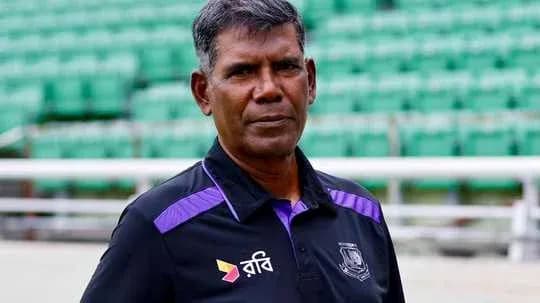
Sarowar Imran: The Coach Who Challenged Comfort in Bangladesh Women's Cricket
Sarowar Imran cuts an isolated figure now, on the outside of a Bangladesh setup he helped shape for decades, convinced he has been punished for trying to make players uncomfortable.
The former Bangladesh women's team head coach, whose contract was not renewed by the BCB after it expired in October 2026 following the Asian Games, believes his insistence on standards – not his temperament – cost him his job. The board has since turned to David Hemp, and cited concerns over Sarowar's behaviour as a key reason for the change. Senior players, Cricbuzz understands, had also gone to the board, complaining about his approach and saying they felt uneasy under him.
From Sarowar's perspective, the story is very different.
'They cannot improve in this comfort zone'
Speaking to Ekattur TV on Tuesday (November 10), the veteran coach painted a picture of a dressing room wrapped in cushions and compromise, where staff stayed quiet and players dictated terms.
"BCB did not communicate with me after the Asian Games and Asia Cup. I got a letter that I am not going to the Australia tour as another coach will go. This is all the communication I had with BCB," he said, making it clear he felt shut out of the process that ended his tenure.
Then came the real sting. He described walking into the women's setup and finding a support staff he considered too submissive.
"As far as my ill temper is concerned when I entered the women's team, what I saw was that there from bowling coach to spin bowling coach, batting coach, trainer, physio all were very quiet. They listen to whatever the women cricketers say and they cannot improve living in this comfort zone. That is the reason our team is still the same as it was five years back."
The examples he gave were stark. A spinner stopping after 30 balls in the nets – and the coach agreeing. One or two batters monopolising the crease all day. Sessions drifting, unchallenged.
"After seeing all these I started interfering," he said. "I also interfered regarding their fitness. When I needed to scold them I did that and if you say this is ill temper in that case I don't feel Bangladesh cricket can improve."
For him, this was coaching. For some of his players, and ultimately his employers, it became a problem.
A long career, a blunt defence
Sarowar is not a marginal figure in Bangladesh cricket. He guided the men's side as head coach during their inaugural Test against India in 2000, and his long service was one reason the BCB eventually backed away from issuing a show-cause notice after unrest followed the Asian Games exit.
He insists, though, that respect for his past work did not translate into a fair hearing over his future.
He says no one from the board sat down with him to hear his side before he was removed from the women's job. In his eyes, a long career has earned him the right to be judged on more than one bad stretch.
"I felt I could improve them and had seven to eight tours and everything ended just because of failing in one or two tours," he said.
There is pride, almost defiance, in the way he talks about his own standards.
"I have my own dignity and I am aware of what I am capable of and I don't work to show off. I don't have any problem and there is no reason to feel that my prestige has gone down because I know my work."
The accusation that he is ill-tempered clearly grates.
"If anyone says that I am ill-tempered that is wrong because in life I can have temper but when I am coaching I am not ill-tempered because I am a professional and I know what needs to be done."
Then he draws a hard line on the coach-player relationship.
"A coach cannot be a friend of a player because if I am a friend of a player I cannot drop the player. I am a coach and I am not their friend," he said. It is old-school, unforgiving, and entirely in character with the rest of his defence.
'Ensuring the job' vs ensuring improvement
Sarowar did not stop with criticism of players. He went after the culture around them, suggesting local and foreign coaches alike have chosen job security over confrontation.
"I think whoever worked with them (women cricketers) adjusted with them but the women cricketers won't improve if they are in the comfort zone and I felt foreign coaches also did the same. I feel a coach ensures his job by doing this (adjusting and remaining silent)."
In his telling, the staff bend so the players never have to. The result, he argues, is stagnation.
Fitness under the microscope
His harshest assessment came on fitness. He did not sugarcoat it.
"I am telling you more than half of the first XI cricketers do not have the required fitness level. Most of them are below average (in fitness) while some of them are medium while a couple have standard fitness level," he said.
"Fitness is a big issue and when the fitness test is conducted the trainer can say how many of them match international fitness level. They don't have that (fitness level). If I feel that I will be world champion only by bowling 30 balls, that will never happen."
For a national side trying to close the gap on the top women's teams, those words land heavily. From his vantage point, the physical base simply does not match international demands.
A divided dressing room?
On the question of dressing-room harmony, Sarowar chose his words more carefully. He did not outright confirm factions, but he hinted at fault lines.
"I cannot say about grouping but some were close to the captain while some others were not close to the captain," he said, referring to skipper Nigar Sultana.
He stopped short of naming names or detailing incidents. Still, the suggestion is clear: not everyone in that room pulled in the same direction, or felt equally connected to the leadership.
In the end, Sarowar stands by his methods and his message. The BCB has moved on, the players have a new voice in David Hemp, and the old coach has been left to watch from a distance, convinced that discomfort is the only path to progress.
The real test now is not of his temperament, but of whether this Bangladesh women's side can rise without the hard edges he insists they need.