Sevilla vs Real Madrid: Tactical Analysis of a 1-0 Defeat
Sevilla’s 1-0 defeat to Real Madrid at Estadio Ramón Sánchez Pizjuán was defined less by volume of chances and more by control of space and tempo. Real Madrid, under Alvaro Arbeloa, leaned on a 4-3-3 that monopolized the ball (59% possession) and dictated where the game was played, while Luis Garcia Plaza’s 4-4-2 for Sevilla was designed to compress central zones and spring forwards quickly. The decisive moment came early, and from then on Madrid’s structure and game management allowed them to protect a narrow lead without being forced into chaos.
Vinicius Junior’s 15th-minute strike – a “Normal Goal” with no assist recorded – was the tactical hinge.
Madrid’s 4-3-3 stretched Sevilla’s back four horizontally: Vinicius held very wide on the left, Kylian Mbappe pinned the centre-backs, and Brahim Diaz stayed high on the right. With Jude Bellingham and Aurelien Tchouameni both comfortable receiving under pressure, Madrid were able to progress through the thirds and isolate Vinicius 1v1 against the Sevilla right side. The early goal changed the dynamic: Sevilla’s compact 4-4-2 block, initially designed to frustrate and counter, now had to advance higher and more often, exposing the spaces that Madrid’s front three could threaten in transition.
Sevilla’s attacking structure in possession was a fairly orthodox 4-4-2: O. Vlachodimos behind a back four of J. A. Carmona, Castrin, Kike Salas and G. Suazo, with a flat midfield line of R. Vargas, Nemanja Gudelj, Djibril Sow and Oso behind the front pairing of A. Adams and N. Maupay. They generated 14 total shots, with 6 on goal and a balanced distribution between shots inside (7) and outside the box (7). The xG of 0.73 underlines that, while they reached shooting positions, Madrid largely kept them to efforts of modest quality. Sevilla’s 355 passes, 285 accurate (80%), reflect a side that could build in phases but struggled to consistently break Madrid’s last line.
The turning point in Sevilla’s tactical approach came after the interval. Trailing 0-1 and having gone into half-time already behind, Garcia Plaza increased risk levels. The first yellow card, at 48', to Nemanja Gudelj for an “Off the ball foul”, hinted at a more aggressive, front-foot approach to duels. On 53', Alexis Sanchez (IN) came on for N. Maupay (OUT), giving Sevilla a forward more comfortable dropping between the lines to link play. One minute later, C. Ejuke (IN) replaced R. Vargas (OUT), adding direct 1v1 dribbling on the flank, and L. Agoume (IN) came in for N. Gudelj (OUT), injecting fresher legs and more vertical energy into central midfield.
These three changes reshaped Sevilla into a more fluid, almost 4-2-3-1/4-2-4 in possession: Sanchez and Ejuke operated between lines and wide channels, Adams often led the line, and Oso moved into more advanced pockets until he himself was replaced by I. Romero (IN) at 78'. The cumulative effect was to push Sevilla’s attacking line higher, increasing their shot volume and forcing Thibaut Courtois into 6 saves. However, Madrid’s defensive structure remained largely intact: the centre-back pairing of Antonio Rudiger and Dean Huijsen defended the box aggressively, and full-backs Dani Carvajal and Fran Garcia narrowed in to form a compact back four when Sevilla crossed.
Madrid’s possession game was the main defensive tool. With 528 total passes and 463 accurate (88%), they recycled the ball with patience, using Tchouameni as a pivot before his withdrawal, and Bellingham as the advanced connector. The midfield trio, completed by T. Pitarch, allowed Madrid to form triangles on both sides, pulling Sevilla’s midfield band out of shape. After 70', Arbeloa freshened that core: Eduardo Camavinga (IN) came on for A. Tchouameni (OUT), adding press resistance and ball-carrying, while F. Mastantuono (IN) replaced T. Pitarch (OUT), giving Madrid a more mobile, technically sharp option between the lines.
The substitutions on the front line were equally strategic. At 77', T. Alexander-Arnold (IN) replaced B. Diaz (OUT), adding a deeper, playmaking right-sided presence who could also help in build-up and crossing from withdrawn zones, while G. Garcia (IN) came on for Vinicius Junior (OUT), preserving width and defensive work rate on the left as Madrid prepared to defend the lead. At 87', A. Leiva (IN) replaced J. Bellingham (OUT), a clear game-management move to bring fresh legs into midfield for the closing minutes.
Sevilla’s late-game push came with increased emotional and physical intensity, reflected in their disciplinary record: 18 fouls and 4 yellow cards, compared to Madrid’s 12 fouls and no bookings. After Gudelj’s earlier card, Alexis Sánchez was booked at 80' for “Argument”, a sign of rising frustration as Sevilla chased the equaliser. Juanlu Sánchez, who had come on for J. A. Carmona at 70', was cautioned at 84' for “Foul”, and Lucien Agoumé received a yellow at 90+4' for “Argument”. The cards illustrate how Sevilla’s attempt to raise the tempo and disrupt Madrid’s rhythm tipped into emotional overreach, without materially increasing the quality of their chances.
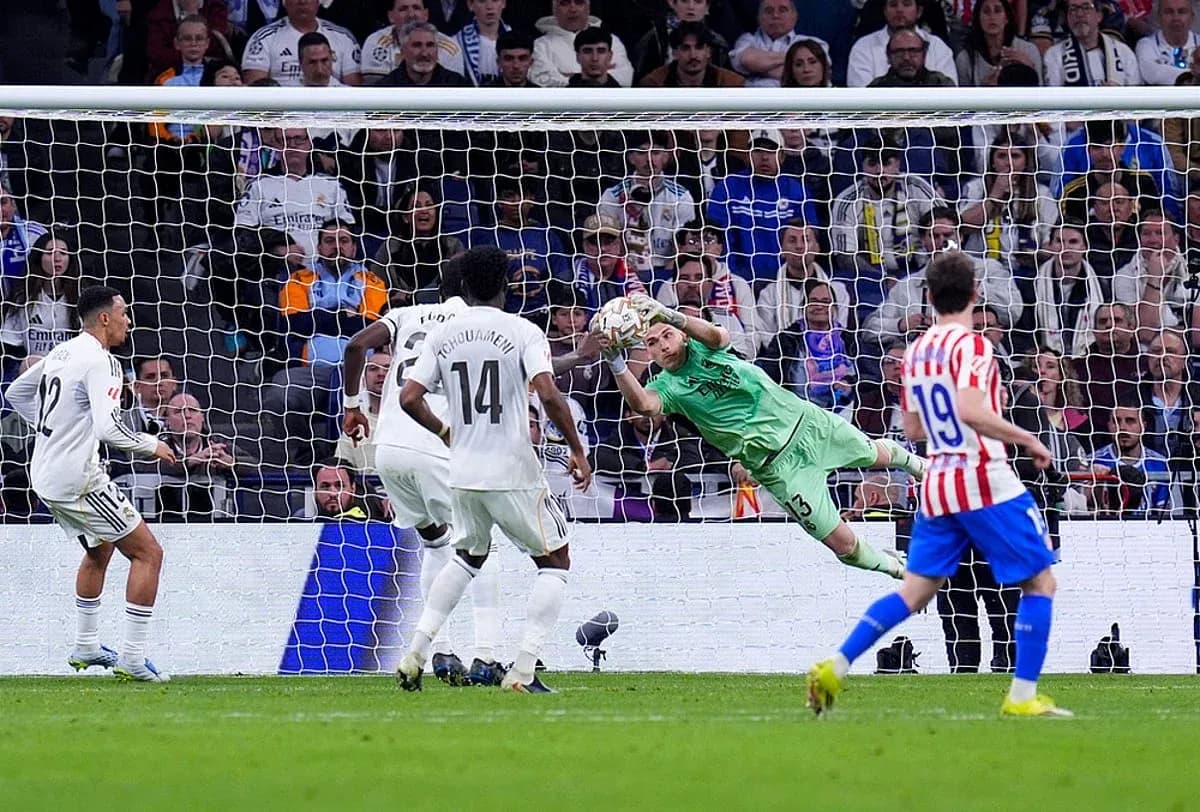
From a defensive standpoint, both goalkeepers delivered within the expectations of the underlying numbers. Vlachodimos faced only 1 shot on goal and made 1 save, with Sevilla’s goals prevented at 0.46, suggesting he performed roughly in line with the quality of efforts faced, conceding once from Madrid’s xG of 1.03. At the other end, Courtois’ 6 saves were decisive. Madrid’s goals prevented figure of 0.46 indicates he neutralised close to half a goal’s worth of chances beyond a baseline expectation, aligning with the eye test of a keeper who, while not under constant siege, had to be sharp on the few clear looks Sevilla created.
Statistically, Madrid’s 12 total shots (only 1 on goal, that decisive strike) and higher xG underline a pragmatic, outcome-focused performance. They created fewer but better chances, then shifted into a controlled, possession-based defensive posture. Sevilla, with more shots on target but lower xG, embodied a side that reached shooting zones often but rarely in optimal conditions. The combination of Madrid’s superior passing accuracy, territorial control, and clean disciplinary slate allowed them to manage the game on their terms, turning Vinicius Junior’s early goal into a platform for a tactically mature away win.