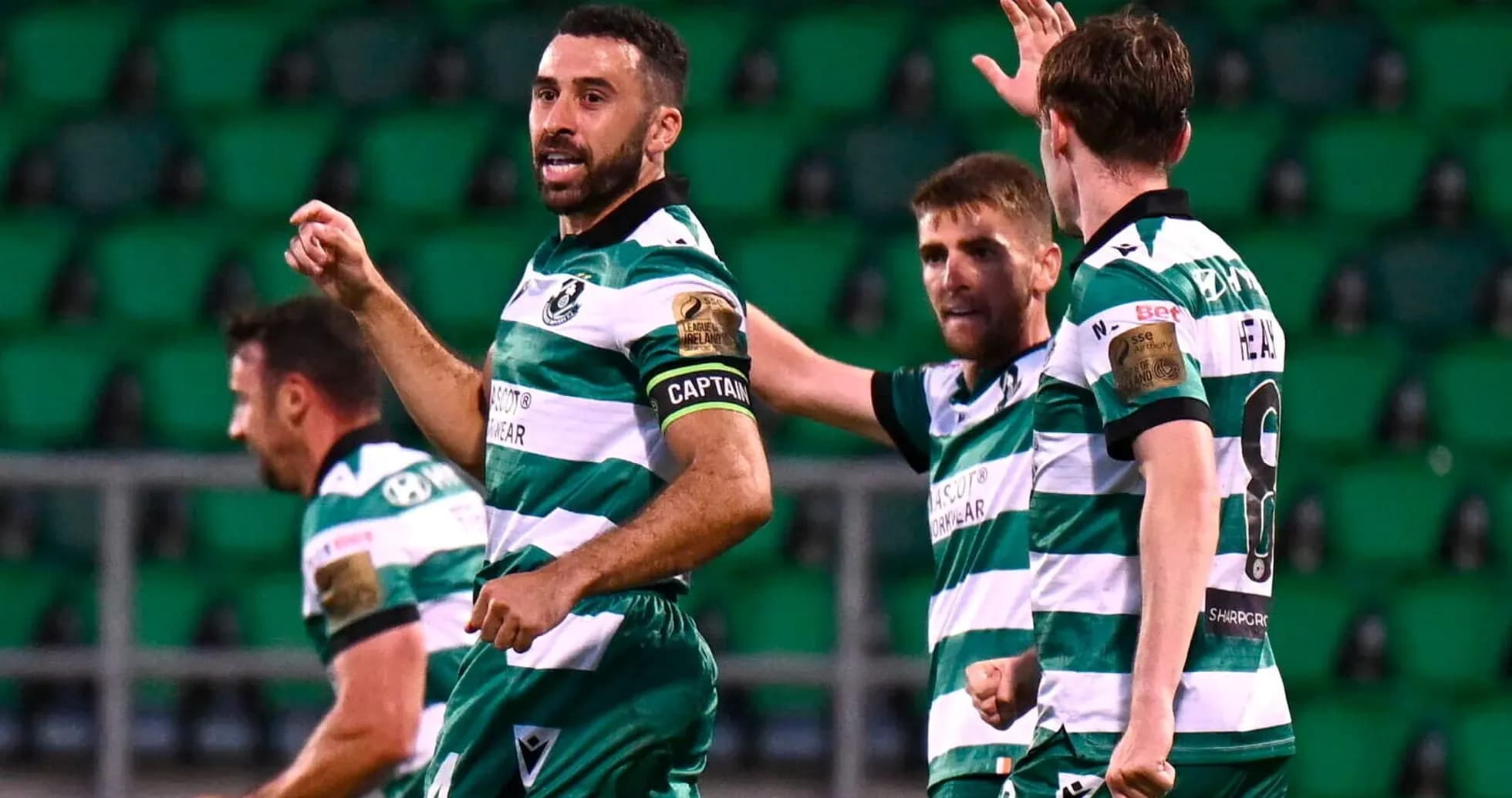
Shamrock Rovers Dominate Egnatia Rrogozhinë 3-1 in Europa League Qualifiers
Shamrock Rovers’ 3-1 win over Egnatia Rrogozhinë at Tallaght Stadium in the UEFA Europa League 3rd Qualifying Round was built on structural clarity and superior adaptation over 90 minutes. With both sides mirroring each other in a 3-5-2, the home team gradually imposed their version of the system more effectively, turning a 1-1 half-time score into a controlled, two-goal victory despite the absence of detailed statistical splits like possession or shots.
Stephen Bradley’s 3-5-2 for Shamrock Rovers was balanced and fairly orthodox. The back three of T. Sobowale (right), R. Lopes (central) and E. Stevens (left) provided a stable platform rather than aggressive overlapping. Width and progression came primarily from the five-man midfield line, with W. Fitzgerald and A. Brennan operating as high, wide options and the central trio of J. Byrne, M. Healy and D. Watts tasked with controlling tempo and linking to the front two. Up front, G. Burke and A. Greene formed a complementary pairing: Burke dropping to receive and combine, Greene stretching the last line.
The first major tactical hinge came on 29 minutes, when Burke converted a penalty for Shamrock Rovers. The award itself (not detailed in the data) underlined how Rovers’ structure was already pinning Egnatia’s back three deep, forcing them into reactive defending in their own box. Burke’s central role as a second striker, drifting into pockets between the lines, clearly troubled Egnatia’s midfield screen and back line, culminating in that opening goal.
Egnatia’s 3-5-2 under Nevil Dede was more hybrid. On paper, G. Jaime was listed as a defender in the line of three, but his influence higher up the pitch was decisive. The Albanian side’s midfield of Fernando Medeiros, A. Kryeziu, I. Diabate and A. Yago, with I. Gruda nominally advanced, aimed to crowd central zones and spring forward quickly. Their response to going behind was telling: at 38 minutes, Ildi Gruda collected a yellow card for “Foul”, a sign of Egnatia’s increasing aggression out of possession as they tried to disrupt Rovers’ rhythm.
The 41st minute was a microcosm of Egnatia’s volatility. First, Guillem Jaime missed a penalty, but moments later he scored a “Normal Goal” to level the match 1-1 before the break. Tactically, this underlined Egnatia’s capacity to overload and threaten in transitional or broken-play moments, even if their base structure was under pressure. The half-time score of 1-1 reflected a contest where Rovers had the clearer positional framework, but Egnatia had enough individual quality and vertical intent to stay alive.
Bradley’s in-game management at the interval sharpened Rovers’ edge. At 46 minutes, A. Brennan (OUT) made way for J. Mulraney (IN), a like-for-like switch on paper but with different attacking tendencies. Mulraney’s introduction suggested a desire for more direct 1v1 threat and crossing quality from wide areas, pushing Egnatia’s wing-backs and wide centre-backs deeper. Simultaneously, Dede made a triple change: I. Diabate (OUT) for A. Albanese (IN), I. Gruda (OUT) for K. Loukili (IN), and D. Adjessa (OUT) for J. Montenegro (IN). This early reshaping at 46 minutes indicated dissatisfaction with Egnatia’s first-half balance and an attempt to inject fresh legs and attacking impetus.
However, the immediate aftermath showed the risks of such disruption. At 47 minutes, Alessandro Albanese was booked for “Foul”, suggesting that Egnatia’s new midfield configuration struggled to adjust to Rovers’ patterns and timing in central areas. Rovers capitalised on this instability on 55 minutes: R. Lopes scored a “Normal Goal” for Shamrock Rovers, assisted by J. Byrne, to make it 2-1. The centre-back’s goal hints at well-rehearsed set-piece routines or aggressive involvement of the central defender on attacking restarts, with Byrne’s delivery quality a key weapon.
Two minutes later, at 57 minutes, came the decisive tactical blow. An own goal by A. Yago, credited to Shamrock Rovers, extended the lead to 3-1. While the data does not specify the exact pattern, own goals in this zone frequently arise from sustained territorial pressure and dangerous deliveries into the box, forcing defenders into rushed interventions facing their own goal. Rovers’ wide supply line and the presence of multiple bodies in the area likely created that stress environment.
Bradley continued to manage energy and roles intelligently. At 58 minutes, A. Greene (OUT) was replaced by J. Afolabi (IN), refreshing the forward line with a different physical profile to attack space and hold up play as Rovers protected their two-goal cushion. On 60 minutes, Dylan Watts received a yellow card for “Foul”, an understandable by-product of Rovers’ increased focus on disrupting Egnatia’s build-up and breaking their momentum.
The 69th-minute double change further recalibrated Rovers’ midfield and attack: G. Burke (OUT) was replaced by D. Mandroiu (IN), and D. Watts (OUT) by N. Razi (IN). Burke’s withdrawal after an influential hour, including the opening penalty, pointed to a shift from creative, roaming threat to more controlled possession and defensive discipline in central areas. Mandroiu and Razi offered fresh legs and tactical discipline to lock down the middle third and manage transitions. Egnatia, for their part, swapped Z. Aliyev (OUT) for N. Ajetovikj (IN) at the same 69-minute mark, adjusting their back line but without altering the overall 3-5-2 shape.
In the final phase, Rovers made another midfield adjustment at 77 minutes, with J. Byrne (OUT) replaced by J. O’Sullivan (IN), further consolidating control and adding defensive security ahead of the back three. Egnatia’s last throw of the dice came at 81 minutes, with A. Yago (OUT) replaced by E. Ndreca (IN), but by then the structural and scoreboard damage was done; the earlier own goal had swung both the tactical and psychological balance irreversibly.
Although detailed metrics such as shots, possession, passes, saves, xG, and goals prevented are not available, the pattern of goals, substitutions and cards outlines a clear tactical story. Shamrock Rovers used a stable 3-5-2 base, intelligent in-game adjustments, and strong wide play to first create, then extend and finally protect a lead. Egnatia Rrogozhinë’s more frantic reshaping, early second-half bookings, and defensive error under pressure (the own goal) highlight a side unable to stabilise its structure after half-time. The 3-1 full-time score, matching the 1-1 half-time snapshot, reflects a home team that tactically grew into the match while the visitors’ adjustments only deepened their instability.