Slovan Bratislava vs Celje: Tactical Analysis of Champions League Play-off
Slovan Bratislava’s 1-1 draw with Celje at Tehelne Pole Stadion was a finely balanced Champions League Play-offs tie in which structure and discipline, rather than chaos, dictated the rhythm. Both sides ended with identical 50% possession and a goal apiece, but the underlying patterns were quite distinct: Slovan built pressure through volume and territory, while Celje prioritised compactness, verticality and efficiency in the final third.
Yaya Toure set Slovan Bratislava up in a 4-3-3 that played like a classic home-first-leg structure: two full-backs high, a single pivot and two advanced interiors, with a narrow front three. S. Cruz and C. Blackman pushed on from the back line, giving width and allowing wingers T. Barseghyan and S. Camara (before his substitution) to come inside and operate between the lines. In possession, that often morphed into a 2-3-5, with P. Pokorny anchoring and C. Martinez stepping into the half-spaces as an advanced midfielder.
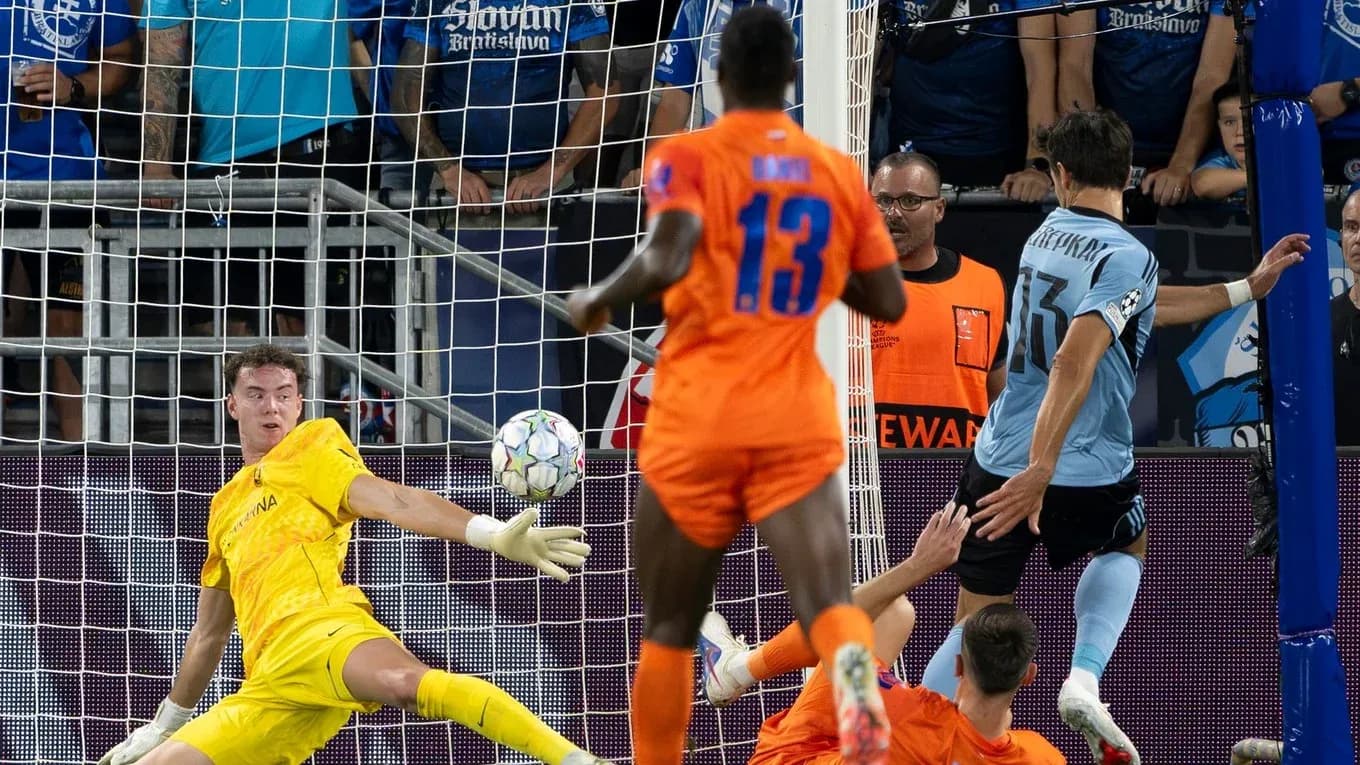
The numbers underline this territorial approach. Slovan produced 14 total shots to Celje’s 8, with 9 efforts inside the box and 6 blocked — a sign of sustained pressure around the area but also of Celje’s last-ditch defensive organisation. Despite this volume, only 2 of those attempts hit the target, pointing to an attacking structure that created shooting zones but not consistently clean looks at goal.
Out of possession, Slovan’s 4-3-3 narrowed quickly, with the wide forwards dropping to form a 4-5-1 block. The foul count (12) and two yellow cards for “Roughing” to K. Bajric and C. Blackman suggest a back line willing to step in aggressively when Celje broke the first press. The centre-backs, Bajric and S. Markovic, defended high and tried to compress the space on Celje’s lone striker A. Kucys, but the concession of the equaliser to left-back M. Avdyli underlined a recurring issue: tracking wide runners from deep when the full-backs were advanced.
In goal, D. Takac (Slovan Bratislava) had a relatively quiet but concentrated evening, making 3 saves. Given Celje’s 4 shots on goal, the home goalkeeper was beaten once but otherwise protected by a structure that largely kept Celje to lower-volume, more selective attacks. His role was more about sweeping and recycling possession than high-volume shot-stopping.
Celje, under Vitor Campelos, lined up in a 4-2-3-1 that was clearly designed for control without the ball and sharpness in transition. The double pivot of P. Daniel and M. Zabukovnik screened the back four, with the three advanced midfielders — M. Ivansek, S. Seslar and M. Kvesic — tasked with springing forward once possession was won. The lack of corner kicks (0) and the low shot count (8 total) point to a team that rarely sustained pressure in the final third, but when they did attack, they did so with purpose: 4 shots on goal from just 8 attempts is a high accuracy rate.
Celje’s 5 offsides are tactically revealing. They indicate a deliberate strategy to push the defensive line of Slovan with early runs from the wide players and Kucys, looking to exploit the space behind Slovan’s advanced full-backs. The equaliser at 41’, with Avdyli scoring from a Kvesic assist, was emblematic: a defender arriving from deep into a vacated channel, timing his movement to escape the immediate attention of Slovan’s midfield.
Defensively, Celje’s back four remained compact and narrow, inviting crosses and long shots rather than allowing Slovan to play through the centre. The 4 blocked shots and only 2 shots on target conceded from 14 attempts show a line that defended the box well, even under sustained pressure. When Slovan tried to overload centrally, Celje’s double pivot dropped into almost a 4-4-2/4-5-1 low block, compressing the space between lines and forcing Slovan to circulate the ball side to side.
In goal, Z. Leban (Celje) faced less volume but higher-quality moments, registering 1 save. While the raw number is low, it reflects Slovan’s inaccuracy rather than a lack of threat; Celje’s defensive structure ensured that many of Slovan’s efforts were rushed or taken under pressure, reducing the need for heroics from the goalkeeper.
The substitution patterns from both coaches were tactical adjustments rather than like-for-like rotations. Campelos introduced B. Verbic for M. Ivansek and A. Kotnik for A. Kucys around the hour, shifting some creative responsibility and freshening the press on Slovan’s build-up. Later changes — A. Dionkou for P. Sirvys and I. Calusic for P. Daniel — suggested a desire to maintain defensive energy in wide areas and in the pivot as Slovan pushed for a winner.
Toure’s changes were more attacking in intent. A. Yirajang (IN) came on for R. Cerepkai (OUT) at 62’, followed by D. Matsuoka (IN) for A. Mustafic (OUT) and M. Kianga (IN) for S. Camara (OUT) at 70’, then R. Ibrahim (IN) for C. Martinez (OUT) and A. Sporar (IN) for T. Barseghyan (OUT) at 84’. These moves gradually reconfigured the 4-3-3 into a more fluid, risk-taking shape, with fresh legs in midfield to keep counter-pressing and additional forward profiles to attack the box. Despite this, Celje’s compact block and disciplined defensive line held firm.
Discipline was a subtle but important tactical layer. Both sides finished with 2 yellow cards each (4 in total), all for specific infractions rather than systemic breakdowns. Bajric and Blackman’s “Roughing” cautions reflected Slovan’s aggressive line-stepping, while Avdyli’s “Roughing” and Zabukovnik’s “Tripping” bookings showed Celje’s willingness to disrupt Slovan’s rhythm when their block was threatened.
Statistically, the game’s equilibrium is clear: 1-1 on the scoreboard, 50%-50% possession, and near-identical passing volumes — 465 passes for Slovan (380 accurate, 82%) and 487 for Celje (402 accurate, 83%). Slovan’s higher shot count but lower accuracy contrasted with Celje’s lower volume but greater precision, encapsulating the tactical story: the hosts as territorial protagonists, the visitors as efficient counter-punchers. Over two legs, this kind of balance suggests a tie that will hinge on which side can either sharpen its finishing (Slovan) or sustain its defensive intensity and transition threat (Celje) under mounting pressure.