Spain Dominates Austria with 3-0 Win in World Cup
Spain’s 3-0 win over Austria at SoFi Stadium in this World Cup Round of 32 tie was a controlled, territorially dominant performance built on positional superiority and relentless ball circulation. The 1-0 half-time lead was an accurate reflection of the pattern: Spain camped in Austria’s half, Austria defending deep and narrow, hoping to survive transitions that never truly materialised. By full time, the statistical profile – 65% possession, 23-5 shots, 9-0 corners and 2.84 to 0.32 in xG – underlined how comprehensively Luis de la Fuente’s side imposed their game.
Scoring Sequence
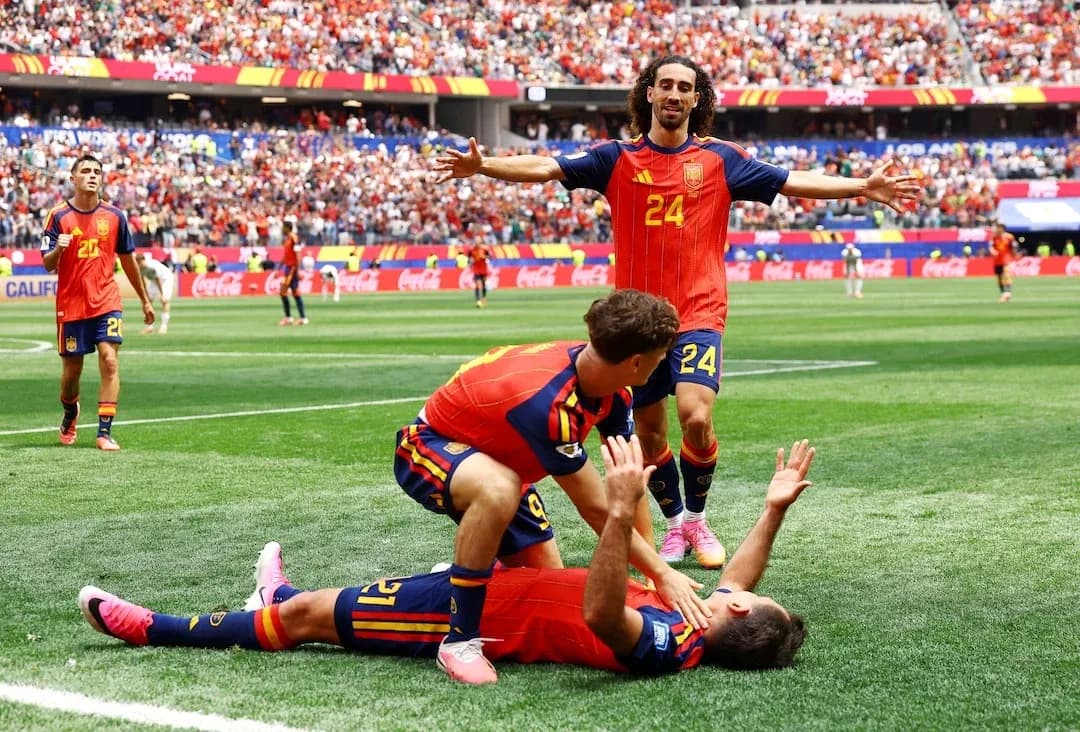
The scoring sequence itself tracks Spain’s growing territorial squeeze. On 36', Mikel Oyarzabal (Spain) finished the first sustained breakthrough, assisted by Marc Cucurella after prolonged pressure on Austria’s right. That goal crystallised what had already been evident: Spain’s left-sided overloads, with Cucurella advancing high and Dani Olmo drifting inside, were prising open the Austrian block.
At 66', Spain’s dominance turned into a cushion. Pedro Porro (Spain), pushing aggressively from right-back, struck the second, assisted by Alex Baena. The pattern here was instructive: Austria had just made multiple substitutions around the hour mark, trying to freshen central zones, but Spain’s circulation simply shifted the angle of attack and found Porro free on the weak side.
The contest was effectively over, but Spain continued to manage tempo rather than chase volume. On 89', Oyarzabal added his second and Spain’s third, again assisted by Cucurella, who repeatedly found space to deliver from advanced left-back positions. That late strike confirmed the 3-0 full-time scoreline, mirroring Spain’s territorial control.
Disciplinary Events
Disciplinary events were minimal but telling of the game’s dynamic. Austria collected the only card: at 83', Stefan Posch (Austria) — Foul. Spain finished without a booking, consistent with their low foul count (8 to Austria’s 15) and the fact they defended largely in structure rather than in emergency situations. The card came in the phase where Austria were increasingly late into duels as Spain circulated the ball with comfort.
Substitution Patterns
Substitution patterns reinforced the tactical story. Ralf Rangnick acted first, double-changing at 46' with Carney Chukwuemeka (IN) came on for Nicolas Seiwald (OUT) and Florian Grillitsch (IN) came on for Xaver Schlager (OUT), a clear attempt to add more progression and press resistance in midfield. On 60', Marko Arnautović (IN) came on for Michael Gregoritsch (OUT) and Saša Kalajdžić (IN) came on for Romano Schmid (OUT), a shift towards more direct, penalty-box-oriented profiles. None of these changes altered the shot pattern: Austria still failed to register a single shot on target.
Spain, in contrast, used substitutions to maintain control and energy rather than to chase the game. On 71', Mikel Merino (IN) came on for Dani Olmo (OUT) and Ferran Torres (IN) came on for Alex Baena (OUT), refreshing the attacking midfield and wide channels without changing the positional structure. At 85', Pablo Gavi (IN) came on for Lamine Yamal (OUT), and at 90', Marc Pubill (IN) came on for Aymeric Laporte (OUT) and Fabián Ruiz (IN) came on for Pedri (OUT). These late changes were about load management and preserving intensity in Spain’s counter-press.
Structural Analysis
Structurally, Spain operated from a clear possession-first framework, even if the exact formation is not specified. The numbers paint the picture: 629 passes, 570 accurate, at 91% accuracy. Rodri’s presence as the central pivot allowed the centre-backs – Pau Cubarsí and Aymeric Laporte – to hold an aggressive line, while both full-backs, Pedro Porro and Marc Cucurella, stepped high to lock Austria in. The 15 shots inside the box out of 23 total show that Spain were not reduced to speculative efforts; they consistently progressed into dangerous zones.
The flanks were decisive. On the left, Cucurella’s two assists to Oyarzabal underline how often Spain created 2v1s against Austria’s right side, with Olmo and later Ferran Torres or Merino helping to overload. On the right, Porro’s goal epitomised the benefit of switching play quickly: Austria’s compact block shifted towards Spain’s left, leaving Porro free to attack the far side. Lamine Yamal, operating nominally from the right, contributed to stretching the last line before being replaced by Gavi to consolidate midfield control late on.
Austrian Defensive Approach
Austria’s defensive approach was clearly reactive. With only 35% possession and 346 passes (284 accurate, 82%), they accepted long spells without the ball and tried to keep distances tight between their lines. The problem was the lack of counter-attacking threat: 5 total shots, just 1 blocked and none on target, plus 0 corner kicks, reveal that they rarely advanced with enough numbers to sustain attacks. Their 5 offsides suggest occasional attempts to release runners early, but Spain’s high line and timing in the press largely neutralised those outlets.
Goalkeeping Performance
In goal, Unai Simón (Spain) had an almost purely organizational role rather than a shot-stopping one, with 0 saves recorded – a direct consequence of Spain’s territorial dominance and Austria’s inability to test him. At the other end, Alexander Schlager (Austria) made 6 saves, a figure that, against 10 Spanish shots on target, indicates that several efforts either missed the target or were blocked (Spain had 7 blocked shots). The “goals prevented” metric at -0.57 for Austria suggests that, relative to the quality of chances conceded (2.84 xG), the 3 goals allowed were slightly above expectation, but not wildly so; Spain’s finishing was efficient without being freakish.
Statistical Overview
Statistically, the match was an archetype of a top seed controlling a knockout tie against a lower-possession opponent. Spain’s xG of 2.84 aligns closely with their 3 goals, while Austria’s 0.32 xG and 0 shots on target confirm that their attacking plan never truly materialised. The 9-0 corner count and 65-35 possession split underline how often the game was played in Austria’s third. Fouls (8 vs 15) and cards (Spain 0, Austria 1, total 1) further emphasise that Spain dictated tempo and rhythm, forcing Austria into more last-ditch interventions.
In synthesis, Spain’s 3-0 victory was less about explosive moments and more about sustained positional control, full-back aggression, and intelligent use of the ball. Austria’s structural adjustments and personnel changes could not disrupt Spain’s passing network, and the data profile matches the eye-test narrative of a one-sided, professionally managed knockout performance.