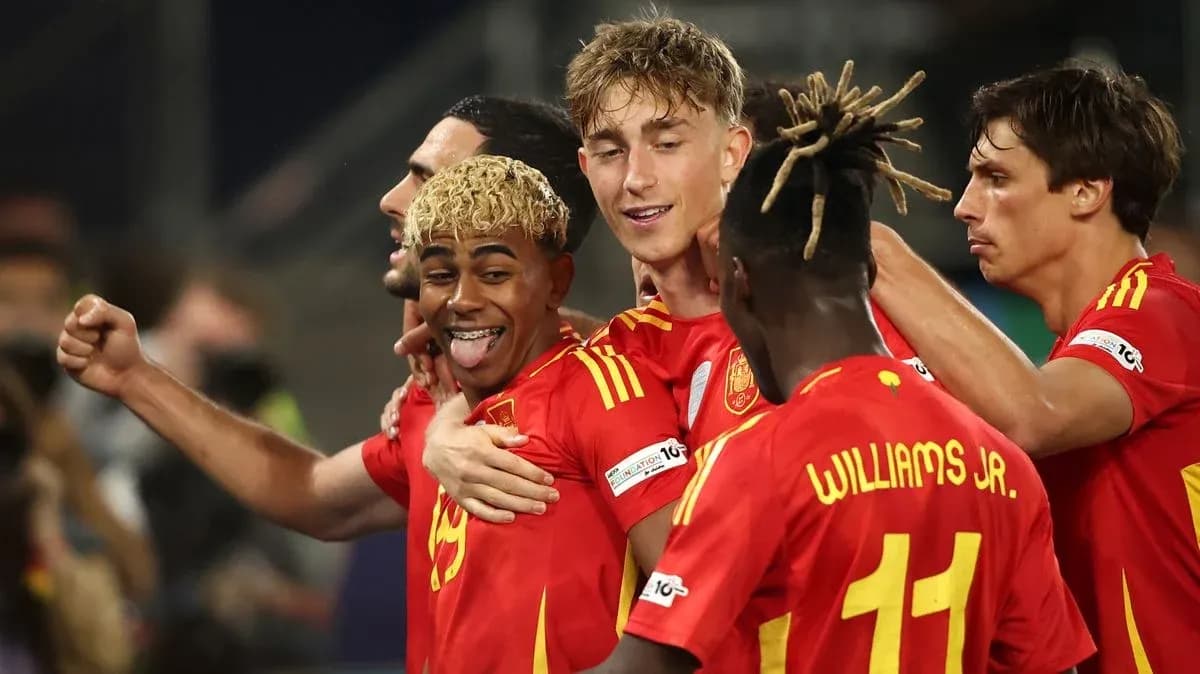
Spain's Transformation: From Entitlement to Grounded Belief
There was a time when Spain walked into every tournament as if the trophy already had their name etched on it. From 2008 to 2012, La Roja didn’t just win; they rewrote the sport, lifting two European Championships and a World Cup while the rest of the world chased shadows.
Then came the crash. A decade of early exits, false dawns and tactical rewrites stripped away the arrogance. The entitlement vanished. In its place, as Spain head into the 2026 World Cup, sits something far more stable – and arguably more threatening: a calm, grounded belief.
Fresh from ripping through Euro 2024 and beating Croatia, Italy, Germany, France and England on their way to the title, Luis de la Fuente’s side no longer feel like heirs defending a crown. They look like a machine that knows exactly what it is.
Semra Hunter, Spanish-American journalist and ITV World Cup presenter, sees a national team that has finally learned to breathe again.
A nation that learned the hard way
The old “win or bust” hysteria used to suffocate Spain. Every tournament felt like a referendum on an entire generation. That dynamic has shifted.
“I don't think it's that extreme anymore,” Hunter says of the pressure surrounding this team. The country, she argues, has been forced into perspective. “The fans learned their lesson from how spoiled they were getting with all the success from 2008 to 2012. There was almost this level of confidence that we were untouchable. But things came crashing down very hard after 2012, and it was very painful.”
That pain bred scepticism. By the time Euro 2024 rolled around, it had curdled into outright doubt. De la Fuente was hammered in the build-up. The mood was bleak.
“Going into the Euros, fans were super critical of Luis de la Fuente. There was almost no hope,” Hunter recalls. The response from the dressing room was emphatic. Spain stormed the tournament, playing with a defiance that matched their fluency. “I actually think that helped because the players went in with a chip on their shoulder to prove everyone wrong. They were consistently the best team.”
The payoff is a healthier relationship between stands and pitch. Belief has returned, but without the poison.
“Now, fans feel confident and they trust the team again, but it isn't a case of 'you have to do it or you're failures'.”
Two fragile livewires on the flanks
If Spain are to climb the mountain again this summer, their most devastating weapons must survive the ascent. That is where the anxiety begins.
The camp is nursing twin hamstring concerns around Lamine Yamal and Nico Williams, two wingers who give this Spain side a terrifying extra gear.
Yamal, just 18, picked up his injury in April. He is expected to make the World Cup, but no one knows what version of him will arrive on opening day.
“They are two of the most special, unique wingers in world football at the moment and they give Spain an edge they wouldn't have without them,” Hunter says. “Lamine Yamal provides so much unpredictability; he's a destabilising force. We've even seen him starting to evolve into the Messi role a little bit, coming more inside. He's capable of conjuring up a moment of brilliance when the going gets tough.”
On the opposite flank, Williams – arguably Spain’s standout performer at Euro 2024 – suffered his own hamstring problem in May. This one, at least, came with better news.
“Thankfully, that one doesn't seem to be as bad, and he should be back to fitness to start training,” Hunter explains.
Spain can still function without them. The structure is that strong. But there’s a difference between functioning and frightening.
“Spain can win without them because of the team's structure, but they really need both at full tilt to go all the way.”
Midfield: where Spain still suffocates you
If there is one area where the old Spain never really died, it’s in the middle of the pitch. The names have changed, the dominance hasn’t.
Rodri anchors everything, the Manchester City metronome who now feels like the most important midfielder in the international game. Around him, De la Fuente can draw from Barcelona talents Pedri, Gavi and Dani Olmo, Arsenal duo Martin Zubimendi and Mikel Merino, and PSG’s Fabian Ruiz.
Hunter is clear: two of those names are written in ink.
“As long as Rodri and Pedri are fit and firing, they are non-negotiable starters,” she says. “Then after that, it's a question of what the manager wants to do. Gavi provides more of the bite, the aggression, and the physicality. Dani Olmo is someone who can break through the lines, score goals, and practically play as a forward.”
The depth is absurd, but it’s not untouched by misfortune. Barcelona’s Fermin Lopez, who produced 30 goal contributions this season, broke his foot and will miss the tournament.
“Fermin Lopez is a big loss. He's somebody who probably could have been a breakout player for Spain, but he underwent surgery and won't make it in time,” Hunter notes.
Even that blow is cushioned by the squad’s flexibility. “Luckily, Spanish players are so versatile. Even with Martin Zubimendi acting as a direct, like-for-like backup for Rodri, Spain is completely spoiled for choice.”
It is a familiar Spanish story: endless midfielders, all comfortable, all clever. Which leads to the one problem they never seem to solve.
The eternal hole at centre forward
For all the silk and control, Spain’s old Achilles heel is still staring them in the face. The country has not produced a ruthless, penalty-box predator since David Villa and Fernando Torres.
“Our biggest weakness is so obvious for me - we haven't had a proper, lethal 'fox in the box' striker who can put balls away first touch since the days of David Villa and Fernando Torres,” Hunter says. “No disrespect to Alvaro Morata but Spain just doesn't produce that kind of player. It's all about midfielders.”
The burden this time is expected to fall on Mikel Oyarzabal, the Real Sociedad forward who scored the winner against England in the Euro 2024 final. Intelligent, versatile, reliable – but not the sort of striker who terrifies defenders on reputation alone.
In this Spain, the fear still comes from deeper. From Rodri dictating, from Pedri slipping passes between lines, from Yamal or Williams twisting full-backs inside out. The No.9 remains more puzzle piece than headline act.
A country of coaches
What Spain lack in classic centre forwards, they make up for in thinkers. The production line of elite managers has become as famous as their midfielders.
Pep Guardiola, Mikel Arteta, Unai Emery, Xabi Alonso, Andoni Iraola – all cut from a culture where football is studied as much as it is played.
“In Spain, football is a language,” Hunter says. “From a very young age, players learn about tactics. Everybody fancies themselves a football philosopher in Spain, really. There's so much romance about it. When Spanish managers go to the Premier League, they bring that tactical obsession with them. Players like Guardiola and Xabi Alonso were already managers on the pitch when they played.”
It isn’t just chalkboard obsession. It’s a worldview.
“They focus on the collective, on being collaborative, on the whole being more important than the individual. They're very humble, they're hardworking people. And I think that is reflected in their management style - and the players' playing style too.”
De la Fuente sits squarely in that tradition: calm, detailed, quietly ruthless in his choices. The Euro 2024 title has given him authority. The World Cup will test the limits of it.
Group stage: comfortable… until it isn’t
Spain’s path begins with a group that, on paper, offers a gentle ramp into the tournament: Cape Verde, Saudi Arabia and Uruguay.
“They should get through relatively comfortably. Cape Verde are debutants and Saudi Arabia are organised, but Spain should get past them,” Hunter predicts.
The sting lies in the final opponent. Uruguay bring a very different type of examination.
“Uruguay will be the biggest test. They are intense, aggressive, streetwise, and technically more talented than people give them credit for. If they want to rough up Spain, they certainly can.”
That match will reveal whether this Spain can handle being kicked as well as being admired. Whether the Euro champions can embrace the dark arts when the whiteboard isn’t enough.
Hunter expects them to pass it.
“I see them getting seven to nine points, topping the group and advancing. Quite honestly, I think they will make it all the way to the final.”
Pressed on a winner, she doesn’t blink.
“I think it's going to be Spain to win it.”
Not the swaggering Spain of old, drunk on its own brilliance. A Spain that remembers the fall, carries the scars, and still believes the trophy is theirs for the taking.