Sparta Praha's Tactical Mastery in 2-1 Comeback Against Lyon
Sparta Praha’s 2-1 comeback win over Lyon at Pragues Letna Hill was defined by structural clarity versus systemic imbalance. The Czech side’s 4-2-3-1 under Brian Priske gradually imposed control over Paulo Fonseca’s 3-4-3, turning a half-time deficit into a controlled second-half surge built on width, second balls and better occupation of advanced zones.
In possession, Sparta used their double pivot of R. Macek and A. Irving as the hinge of the game. With 52% of the ball and 442 passes (383 accurate, 87%), they circulated with more security than Lyon’s 404 passes (331 accurate, 82%), especially after the interval. The back four of M. Rynes, A. Sorensen, A. Sevinsky and M. Suchomel provided a stable rest-defence platform: full-backs stepped high in possession while the two centre-backs plus one pivot formed a triangle behind the ball to control Lyon’s transitions.
Lyon’s 3-4-3 had early promise, particularly in how the front three of Abner Vinicius, L. Openda and C. Tolisso pinned Sparta’s back line. The French side generated 11 total shots to Sparta’s 9 and led 1-0 at half-time through the own goal by M. Suchomel, reflecting their initial territorial threat. Their wing-backs A. Maitland-Niles and M. Ouedraogo (before his substitution) tried to stretch Sparta horizontally, but the structure became increasingly flat: the midfield box of T. Morton and M. de Carvalho could not consistently break Sparta’s first line, and Lyon’s possession (48%) became more lateral than penetrative.
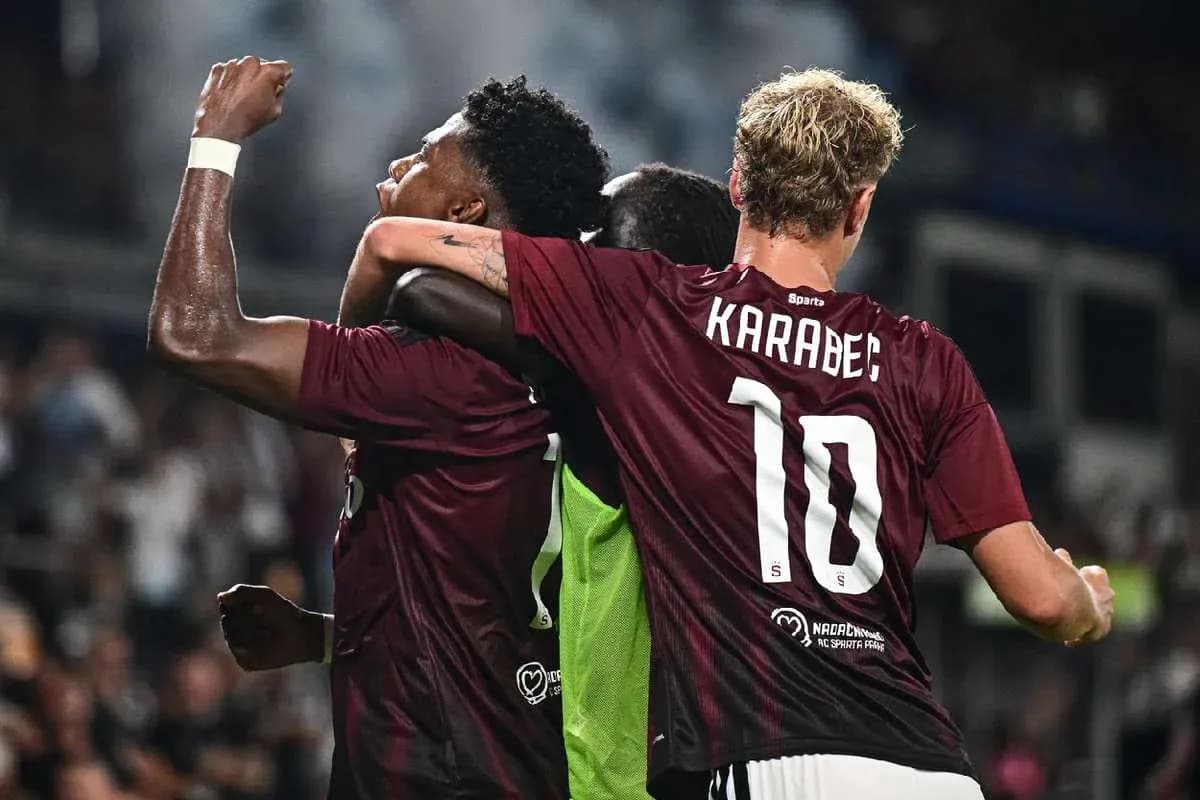
The tactical pivot of the match came in the way Sparta attacked the half-spaces after the break. With J. Mercado, A. Karabec and J. Alcocer operating between Lyon’s wide centre-backs and wing-backs, Sparta repeatedly forced Lyon’s back three to defend running towards their own goal. The equaliser from M. Rynes, assisted by A. Irving, was emblematic: a full-back arriving from deep, exploiting the space vacated by Lyon’s wing-back stepping out, and finishing a move that began with controlled circulation through midfield.
Sparta’s shot profile underlined their territorial superiority in the second half: 8 of their 9 shots came from inside the box, compared to Lyon’s 8 from 11. Although Lyon registered more total shots and more blocked efforts (4 to Sparta’s 1), Sparta’s attacks were more consolidated, with better spacing around the ball and more players in position to contest second phases. Their 6 corners to Lyon’s 9 show that Lyon still had set-piece volume, but Sparta defended their box with composure, conceding only 4 shots on goal.
In goal, J. Surovcik (Sparta Praha) was decisive in maintaining the platform for the comeback. He made 4 saves, a higher workload than D. Greif (Lyon), who recorded just 1 save despite Sparta scoring twice. That disparity highlights the nature of the chances: Lyon were more sporadic but forced Surovcik into genuine interventions, while Sparta’s two goals were both high-quality finishes that left Greif with limited chance to intervene. The missed penalty by Corentin Tolisso further illustrated Lyon’s inability to convert their key moments into scoreboard pressure.
Out of possession, Sparta’s 4-4-1-1 defensive shape (with Karabec stepping onto Morton or de Carvalho) compressed Lyon’s central lanes. The front line, led by J. Brunes, angled their pressing to push Lyon’s build-up towards the flanks, where Sparta could trap against the touchline. The foul count — 11 for Sparta, 7 for Lyon — indicates Sparta were prepared to break up transitions aggressively, particularly once they had turned the game around at 2-1. The two yellow cards for Sparta, to Adam Karabec for “Argument” and Matěj Ryneš for “Foul”, show a side playing on the edge in key duels and game-management moments, but without losing numerical parity.
Fonseca’s substitution pattern attempted to inject direct threat rather than adjust the structural issues. The introductions of M. Fofana and E. Nuamah for M. de Carvalho and M. Ouedraogo shifted Lyon towards a more vertical, forward-heavy shape, but this further disconnected the lines. Sparta, by contrast, used their changes — S. Eneme for A. Irving, L. Haraslin for J. Alcocer, E. Singhateh for J. Brunes, H. Sochurek for A. Karabec, and G. Kuol for J. Mercado — to refresh energy in the same functional roles. The system remained intact; the legs were simply renewed, allowing Sparta to sustain their pressing intensity and compactness until the final whistle.
Statistically, the match supports the tactical impression of Sparta’s controlled superiority after the break. They out-passed Lyon with better accuracy, generated nearly as many shots despite trailing for a long period, and crucially concentrated their attempts in the penalty area. Lyon’s higher volume of total shots and corners hints at phases of pressure, but their inability to translate that into clear, repeatable patterns — and the failure from the spot — speaks to a side relying more on individual moments than on a cohesive attacking structure.
Sparta’s defensive index on the night was strong: limited fouling in dangerous zones, disciplined rest defence, and a goalkeeper in J. Surovcik (Sparta Praha) who answered when called upon. Lyon’s overall form within this 3-4-3 framework looked less convincing once Sparta raised the tempo and pressed higher; the back three struggled to progress the ball cleanly, and the midfield could not control rhythm.
In the context of a UEFA Champions League 3rd Qualifying Round tie, this 2-1 home win reflects a Sparta side tactically mature enough to absorb an early setback, adjust their pressing and attacking structures, and then manage the game with intelligent substitutions and ball circulation. Lyon, despite their talent and moments of threat, left Prague looking like a team whose system is still in construction, particularly under sustained pressure away from home.