The Estádio José Alvalade crackled long before a ball was kicked. Green and white stripes everywhere, a tifo stretched across one end declaring “You are my life”, and 2,600 Arsenal fans wedged into a corner, doing their best to be heard over the roar. A Champions League quarter-final, a bruised Premier League leader, and a Sporting side that simply does not lose at home. It felt big. It felt tense.
Arsenal, still nursing the wounds of back-to-back domestic cup exits, tried to start like a team determined to reassert control. They knocked the ball around the back in the opening seconds, William Saliba and Gabriel exchanging passes with David Raya as if to remind themselves what calm looked like. Then Saliba clattered Luis Suárez in midfield. Boos. Whistles. Lisbon snapped into life.
Sporting were not here to admire the league leaders. Within three minutes they worked neat passing triangles in Arsenal’s third, Pedro Araújo getting forward from left-back until Ben White stepped in to block the cross. The pattern was set early: Arsenal’s back four would be asked to make decisions under pressure, and Sporting’s wing-backs and wide players would test their nerve.
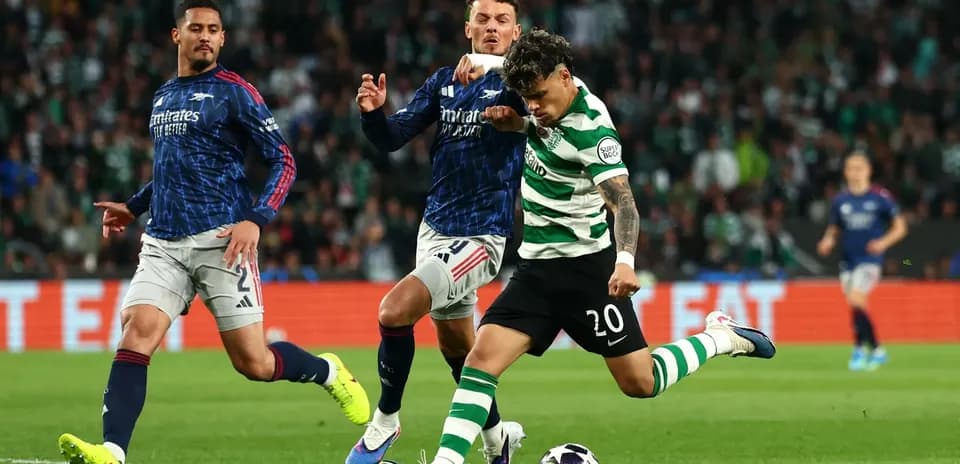
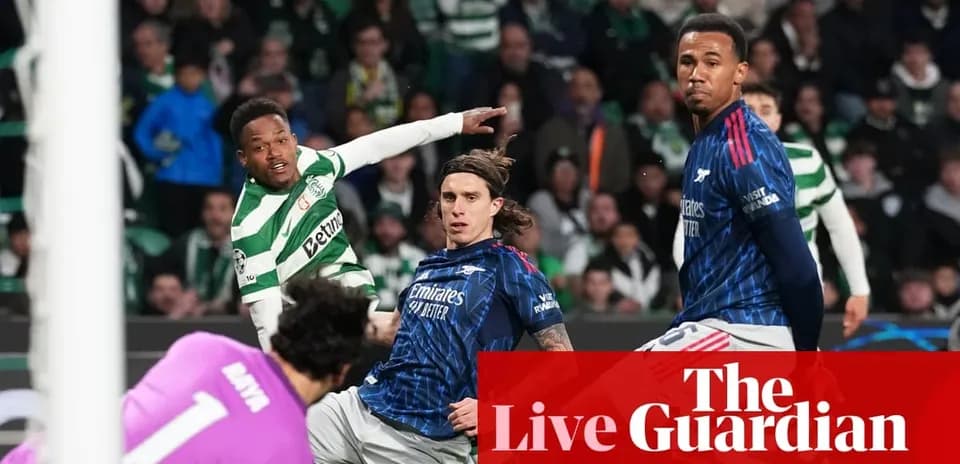
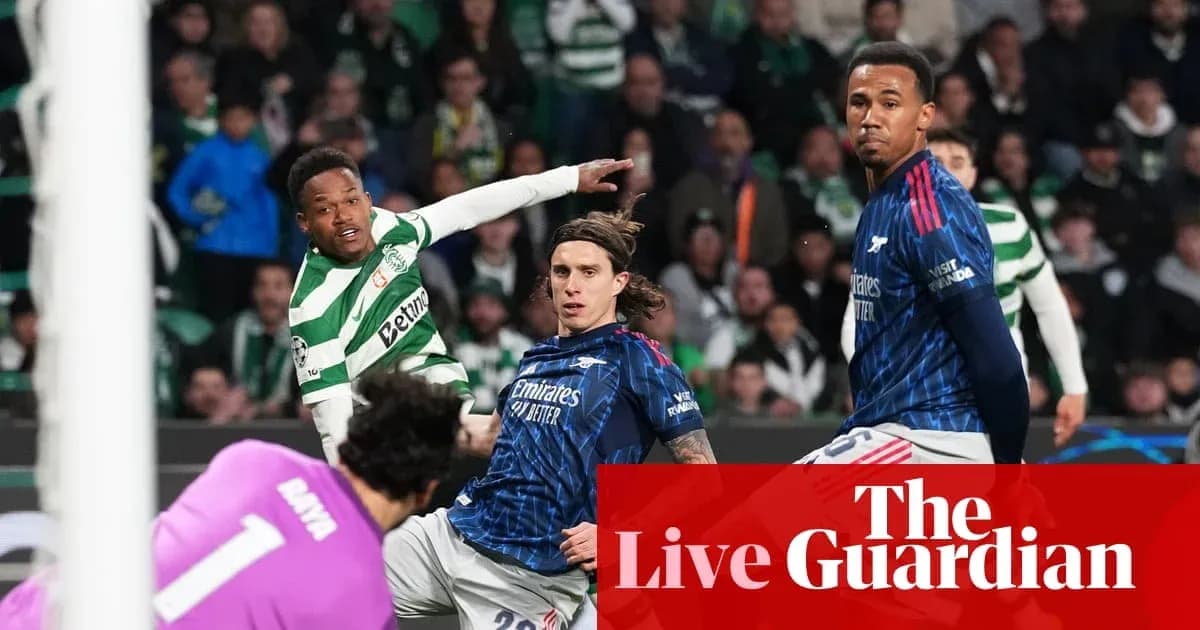
The first real warning came on six minutes, and it was a loud one. Ousmane Diomande, stepping out of defence, shaped his body and carved a stunning outside-of-the-boot pass through Arsenal’s line. Araújo timed his run, beat the offside trap and tore in behind. He lashed his shot high, and the ball crashed against the crossbar. Only replays revealed the slightest of touches from Raya, fingertips turning a goal into a near miss. A huge save, disguised in the chaos.
Sporting smelled vulnerability. The referee gave them a dangerous free-kick soon after, but the Arsenal wall stood firm, and Araújo’s follow-up effort from distance sailed over. Still, the home side had landed the first blows. Arsenal, for all their possession, had yet to settle in the final third.
Mikel Arteta’s team selection underlined the stakes. Declan Rice returned to the XI. So did Leandro Trossard and Gabriel. Martin Ødegaard floated between the lines. New signing Martín Zubimendi anchored midfield. Up front, Noni Madueke and Viktor Gyökeres flanked Trossard, with Bukayo Saka and Eberechi Eze absent through injury and Jurriën Timber still missing at right-back, where White started.
Sporting had their own twist. With captain Morten Hjulmand suspended, Rui Borges turned to 19-year-old João Simões in midfield. It was a bold call, but one he defended pre-match: Simões, he said, brought “something different” to the table. Around him, the usual structure: a 4-2-3-1 out of possession, morphing into a more aggressive shape when they squeezed high.
Gyökeres, back on familiar turf, had to wait until the 11th minute for his first touch in the Sporting box. He tried to hold it up and look for runners, but Araújo, relentless in both directions, sprinted back and nicked the ball off him. The Swede’s reunion with Lisbon was not going to be a sentimental stroll.
Arsenal’s first real surge came down their right. Madueke drew a foul from Araújo just outside the box. Ødegaard whipped in the free-kick and Sporting goalkeeper Franco Israel Silva misjudged it badly, charging out and getting nowhere near the ball. It bounced awkwardly and spun behind for a corner. The home crowd groaned. A hint of nerves from the man between the posts.
Those nerves grew a couple of minutes later. Madueke took his time over the corner, whistles raining down as he waited. When he finally delivered, the ball curled viciously and smacked the crossbar, Silva stranded. The rebound dropped to Ødegaard, who swung at it and mistimed his shot. It rolled out to Trossard on the edge, and his low drive skidded wide. A scramble, a half-chance, and another uncertain moment for the Sporting keeper, who had already fumbled a routine free-kick.
For a spell, the game turned into exactly what Arsenal needed: quieter, slower, more structured. Rice and Zubimendi started to get on the ball, recycling possession, forcing Sporting to shuffle side to side. The tempo dropped. The whistles dulled. Arteta’s side were trying to drag the match into their rhythm.
But Sporting never completely backed off. When Inácio gifted possession to Madueke in his own half, Arsenal looked poised to punish the mistake. Madueke hesitated. Araújo, again, recovered and shut the move down. That summed up the opening half-hour: Arsenal glimpsing space, Sporting’s energy slamming the door.
At the back, Saliba had to tidy up more than once near the touchline, though one clearance ended with Raya slicing a poor ball straight into Silva’s path. The Spaniard threw up a hand in apology. It was a reminder that, despite his early heroics, Arsenal’s build-up could still be rattled by Sporting’s press.
When Arsenal did break Sporting’s lines, it often came from unexpected angles. Riccardo Calafiori, nominally the left-back, popped up on the right side of the box on 31 minutes. Ødegaard had drifted, the shape had rotated, and suddenly the Italian found himself in unfamiliar territory. His cross, though, found nothing but an empty patch of grass. The move fizzled out, emblematic of an Arsenal attack that had not yet clicked.
Sporting, for their part, were not just about raw running. Borges had spoken before kick-off about his side’s set-piece threat, proudly noting that only Arsenal, Dortmund and Inter ranked above them in Europe. That belief in their own identity showed in how they approached each dead ball, each press, each counter. They were not overawed by the Premier League leaders. They were intent on matching them.
Madueke took more punishment as the half wore on. Araújo, already heavily involved, fouled him repeatedly, sometimes high up the pitch, sometimes deeper. Arsenal tried one short free-kick routine, working the ball across the field before Ødegaard attempted to whip in a cross, but he failed to get the necessary height and it was blocked. Promising positions, wasted.
Suárez, the Colombian leading the line for Sporting, offered a different kind of threat to the man he replaced in this stadium. Where Gyökeres once bullied defenders and attacked space, Suárez dropped off, linked play and dictated movements in the final third. His teammates looked for him early, trusting his touch, even if he did not yet find a clear sight of goal.
Around all this, the subplots hummed. Arsenal fans had spent the week arguing over players withdrawn from international duty only to start here. Supporters debated whether the Premier League was already “more or less secured” and whether this competition would define the season. Arteta, for his part, had insisted there would be no panic, that the key lay in rediscovering “identity” rather than tearing up the script.
On the touchline, he cut a familiar figure: animated, demanding, urging his team to stay brave on the ball. Across from him, Borges watched a Sporting side that had won 17 straight at home, five of those in this Champions League run, including that extraordinary 5-0 demolition in the last 16 after overturning a 3-0 first-leg deficit at Bodø/Glimt.
By the time the half-hour mark ticked past, the contest had settled into an uneasy balance. Sporting carried the sharper edge in transition, Arsenal the calmer structure in possession. The woodwork had been rattled at both ends. The goalkeepers had shown their extremes: Raya with a fingertip save of the highest class; Silva flapping under crosses and misjudging flight.
The noise never dipped. Every tackle on Rice, every surge from Araújo, every touch from Gyökeres drew a reaction. This was billed as the night Arsenal needed to steady themselves, to prove that the last fortnight was a stumble, not a slide. Sporting, undefeated here and brimming with belief, had other ideas.
The first leg still had a long way to run, but one question already hung over the tie: in a stadium that has become a fortress, could Arsenal truly impose their identity, or would Sporting’s fearless home form drag this quarter-final into a very different kind of fight?