Sunderland's Struggles: A Season on the Brink
On the eve of war, Sunderland’s season was supposed to be starting again.
Bill Murray, barely five months into the job after replacing Johnny Cochrane in March 1939, walked into August with cautious optimism. He knew Roker Park. He had played under Cochrane. He understood exactly what a club that had been league champions in 1936 and FA Cup winners in 1937 was supposed to look like. His mission was simple in theory, brutal in practice: restore Sunderland to that level after a dismal drop-off in Cochrane’s final year.
An opening-day win over Derby County hinted that the old swagger might be returning. Then Huddersfield Town arrived.
By the time they left, with both points and barely a complaint from the home crowd, the scale of Murray’s task had been laid bare.
Huddersfield expose Sunderland’s flaws
Huddersfield were not spectacular. They were organised. They were sharper, tidier, and more cohesive across the pitch, and that was enough.
Sunderland’s back line hesitated, failed to pick up runners, and never really settled. In attack, the gears ground and slipped. Moves broke down before they built up any real pressure. The sense from the stands was not anger so much as unease.
Newspaper reports the next morning did not spare the officials. Huddersfield, it was said, lived on the edge with a series of borderline fouls that went largely unchecked. But the real story sat closer to home. Raich Carter, the captain and creative heartbeat, took a knock and moved with nothing like his usual freedom. Once he was hampered, too many around him shrank instead of stepping up.
Only one Sunderland player escaped serious criticism. Goalkeeper Johnny Mapson was widely judged blameless for both Huddersfield goals and was praised as the one figure who looked fully up to the task.
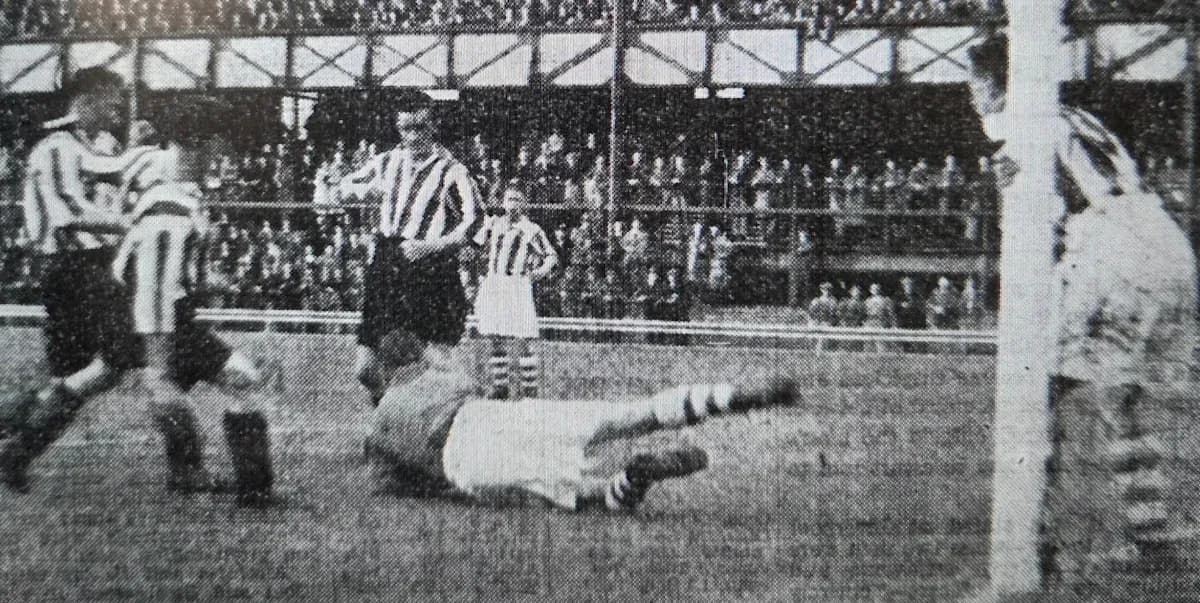
The first goal sparked argument. Some in the ground were adamant Billy Price’s early header crossed the line cleanly. The referee, though, recorded it as an own goal off Jimmy Gorman, who had challenged Price as the cross came in. Whether it was Price’s strike or Gorman’s misfortune, Sunderland were behind after just four minutes.
Carter briefly dragged his side back into it. On 33 minutes he levelled the scores, giving Roker Park a flicker of its old voice. For a while, belief returned. Huddersfield, though, never lost their shape.
The pressure finally told again late on. Price struck what proved to be the winner ten minutes from time, and this time there was no debate. The crowd drifted away in the closing minutes with little appetite to argue. The better side had won. The verdict was simple: Sunderland were a team in transition, and a long way from their peak.
Football under a darkening sky
Yet even that did not feel like the heaviest concern of the day.
Anyone who had bought a newspaper on the way to the ground would have seen it immediately: war, not football, dominated the front pages. Reports of mounting international tension and the looming prospect of a second global conflict filled the columns.
The Sunderland Echo and Shipping Gazette carried stories of French radio being handed over to military control and of frantic diplomatic talks across Europe. A stark photograph showed workmen stacking sandbags in front of the Royal Infirmary. It did not look like a country at peace.
Alongside that sat a chillingly practical notice for parents. Helmet and respirator arrangements were being finalised for Sunderland’s children, with demonstration and collection points listed at schools across the town: Redby, Hudson Road, Cowan Terrace, Thomas Street, Commercial Road, Hylton Road, Diamond Hall, High Southwick, James William Street and Barnes. Specially adapted versions were being prepared for infants.
It was the kind of detail that cuts through any pretence of normality. You could try to treat the match as an escape, but the world outside the turnstiles refused to be ignored.
Even inside Roker Park, the emergency was visible. Among the 16,315 in attendance were soldiers and sailors already called up, uniforms unmistakable in the stands. They were given half-price entry, so long as they were prepared to go in via what was usually the “boys gate”. It was a small gesture, and the performance on the pitch hardly lifted the mood.
Still, some must have suspected this might be their last game for a while. If the football was flat, the occasion carried its own weight.
The season that vanished
Within days, events off the pitch moved faster than anything on it.
By the time Sunderland travelled to Arsenal the following weekend, German forces had invaded Poland and a wider war was no longer a question of if, but when. The match at Highbury went ahead, but even that carried the mark of crisis. Kick-off was pushed back to 17:00 to ease pressure on emergency public transport timetables and to allow for a hurried evacuation of local children.
Football, in that moment, was little more than background noise.
Soon, the results that had seemed so important – the win over Derby, the defeat to Huddersfield, the trip to Arsenal – were wiped from official records. The season, in effect, disappeared.
Murray’s job changed almost overnight. Instead of building a new Sunderland side, he spent his time overseeing fitness training for troops stationed in County Durham. Roker Park, designated as an evacuation zone, stood largely idle for the next two years, its stands quiet, its pitch no longer a weekly stage.
On 30 August 1939, Sunderland 1 Huddersfield Town 2 looked like a worrying early setback in a manager’s rebuild. Within a week, it was something else entirely: a snapshot of English football on the brink, taken just before the lights went out.