Suso Retires at 32: Returns to Cádiz as Institutional Representative
Football rarely offers a neat final scene. For Suso, it comes with a kind of symmetry that the game doesn’t often allow: back in Cádiz, where it all started, and where it now ends.
The 32-year-old has retired from professional football after reaching an agreement with Cádiz, who confirmed he will stay on at the club as an institutional representative from October. The boots are going away. The badge remains.
It closes a career that took him from the south of Spain to Liverpool, to Milan and several stops in between, before the pull of home drew him back.
The Liverpool promise
Liverpool first saw Suso as part of a new wave.
He arrived from Cádiz in 2010 as a 16-year-old, a slight left-footed playmaker dropped into a club intent on hoovering up technical talent from across Europe. Two years in the academy and reserves sharpened his game and his reputation. Inside the club, coaches talked about his touch, his vision, his calm in tight spaces.
Brendan Rodgers was the manager who finally opened the door.
Suso’s senior debut came on 20 September 2012, in a Europa League win over Young Boys. Three days later, Anfield. Manchester United. Premier League. In the space of a long weekend, he went from prospect to first-team player.
There was a buzz around him then. He played between the lines, demanded the ball in crowded areas, always looking for the angle that others didn’t see. For a while, it felt like Liverpool had unearthed another long-term creative fulcrum.
A fleeting Anfield chapter
The breakthrough never hardened into permanence.
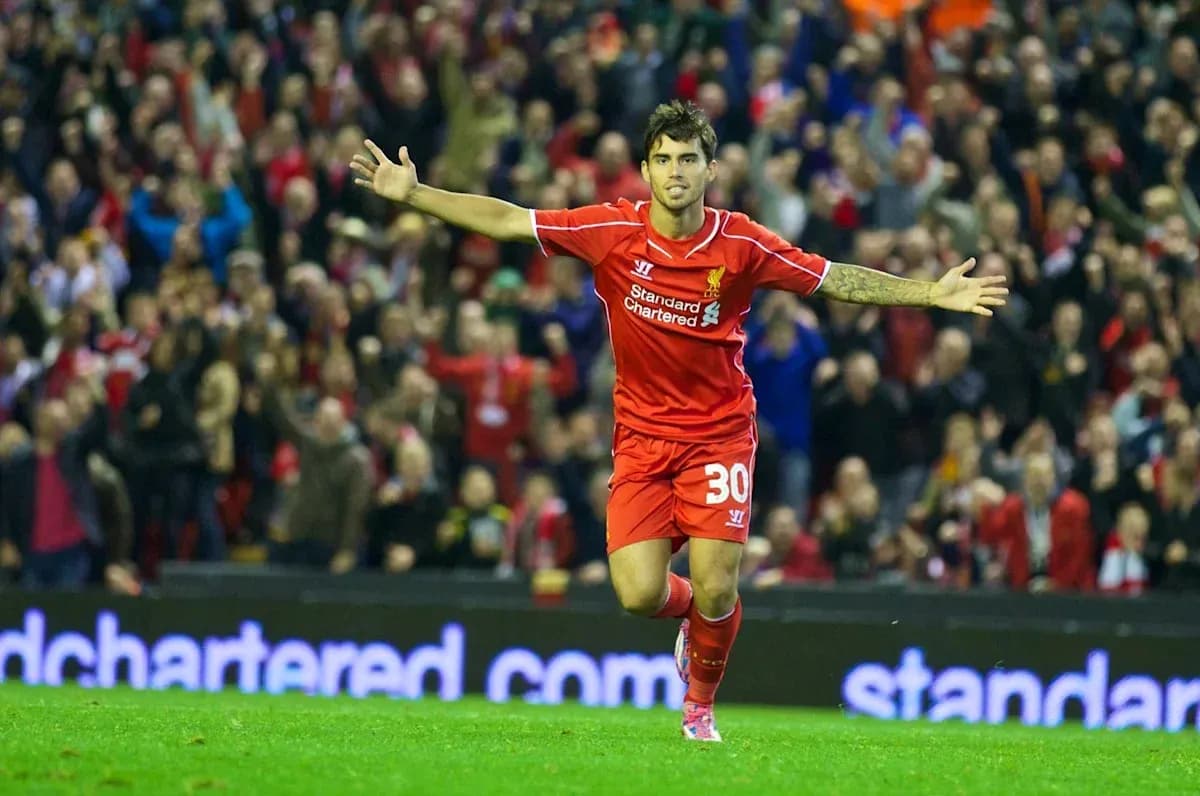
Competition for places and the churn of a club in transition limited his chances. Across his time at Liverpool, Suso made 21 appearances and scored once, his only goal coming against Middlesbrough in a League Cup tie in the first half of the 2014-15 season.
The year before that, he had gone on loan to Almería. Thirty-five games, three goals, and his first full season of top-flight football in Spain. It was a valuable education, proof he could handle senior football week after week, but it didn’t shift his status at Anfield.
By January 2015, the path was clear. A permanent move to AC Milan offered the stability and responsibility he couldn’t quite secure on Merseyside. Italy became the setting for the most substantial spell of his career.
Liverpool, in the end, occupies only a small slice of his professional record. Yet those early appearances sit inside a fascinating period at Anfield, when Rodgers tried to reshape the side with younger, technically bold players. Suso was one of the early symbols of that experiment, even if his story ultimately unfolded elsewhere.
Cádiz, captaincy and closure
Last summer, the circle finally closed.
Suso returned to Cádiz, the club where he had first pulled on a shirt as a boy. The club later revealed he had made a personal effort to come back, driven by the idea of helping his hometown team climb back to the top tier of Spanish football.
That dream stayed out of reach. Circumstances over the past year meant promotion never materialised. But his influence ran deeper than results and league tables.
He became captain of his boyhood club, carrying not just the armband but the weight of representing a place that shaped him. For local supporters, this was not a star passing through; it was one of their own coming home, taking on the responsibility of leading the team he once watched from the stands.
Now the role changes, not the allegiance.
From October, Suso will serve as an institutional representative for Cádiz, stepping into a position that keeps him inside the organisation and places him among the public faces of the club. The setting stays the same; the job description shifts from creator on the pitch to ambassador off it.
For many former Liverpool players, retirement brings a mix of “what if” and “look what happened anyway.” Suso leaves the game at 32 having travelled far beyond anything that 16-year-old from Cádiz could have imagined when he first arrived on Merseyside in 2010.
The next chapter won’t be written in minutes played or goals scored. It will be measured in how deeply he can now shape the club that has always felt like home.