Tony Popovic's Decision for the Socceroos: Asian Cup Focus Over Long-Term Contract
Tony Popovic could have signed on to lead the Socceroos all the way to the 2030 World Cup. Instead, he chose the exit ramp.
Offered a four-year deal by Football Australia, the national team coach has revealed he pushed it back across the table and asked for something far shorter: an extension only until the end of January’s Asian Cup in Saudi Arabia. After that, he’s prepared to walk away.
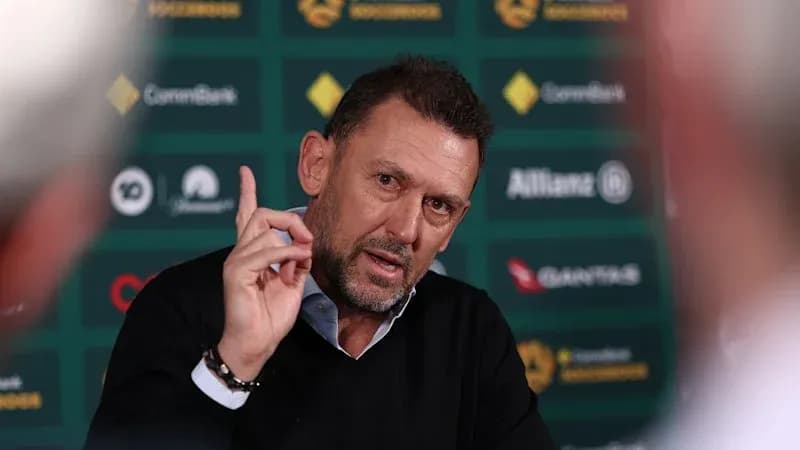
“I love coaching the Socceroos,” Popovic said in his first press conference since Australia’s contentious World Cup elimination. “It was my choice to go until the Asian Cup. Although I was offered a four-year deal, I decided to go to the Asian Cup. That’s something I think is good, and it also gives the FA an opportunity; if they want to go in a different direction, they can.”
He sounded utterly at peace with it.
“I’m very comfortable with the decision that’s been made. I’m very comfortable with how I’ve always worked for the future … if I leave a week later, I’ll still be comfortable with that.”
A coach betting on legacy, not job security
Popovic’s extension was quietly locked in on the eve of the World Cup. Only now is it clear just how much faith FA had in him: a full cycle on the table before a ball was kicked in the United States.
He declined it.
Job security, he insisted, has never driven his decisions. If it had, his World Cup squad would have looked very different. He wouldn’t have rolled out four of the eight youngest starting XIs at the tournament. He wouldn’t have cut so deep into the old guard.
Fourteen players who featured in the crucial June 2025 qualifiers against Japan and Saudi Arabia were nowhere to be seen in his World Cup squad. That brutal turnover was deliberate. It cleared the way for Lucas Herrington, Nestory Irankunda, Paul Okon-Engstler and Mohamed Toure to feel the heat of the game’s highest level years before their peak.
“That needs to happen,” Popovic said. “We need to create a pool of players that in four years, if we are fortunate enough to be at a World Cup … then you want to be in a better position with the starting players and the players that can come on and make a difference.”
He knows he may never coach that future team. He is building it anyway.
The approach won’t soften now his contract has an expiry date. Popovic flagged “a few fresh faces” for this month’s friendlies against Brazil in Queensland and another youthful squad for the Asian Cup, where he has set a clear minimum: reach the semi-finals.
World Cup scars and one big regret
The anger after the round-of-32 exit to Egypt has been fierce. Pundits lined up. Fans vented. Popovic said he understood the emotion but pushed back hard on the idea that his selections or tactics betrayed the team.
Across an hour at the microphone, he offered only one genuine regret from the tournament.
It wasn’t the penalty shootout against Egypt. He would not change a thing there. Maty Ryan still comes on late for Patrick Beach. Harry Souttar and Herrington still step up among the five takers, even though both missed.
The moment that nags at him came earlier, in the group stage, against the USA.
Australia had stunned Turkey 2-0 in their opener. Irankunda and Connor Metcalfe scored and instantly became the faces of the campaign. Then Popovic benched both of them for the clash with the co-hosts, turning instead to Mathew Leckie and Nishan Veliupillay. The Socceroos were, in his own blunt assessment, “outrun, outfought, out-duelled … whatever you want to call it.”
Looking back, he thinks he went only halfway.
“Part of me thinks I should have made more changes to the line-up, because I could sense the euphoria [from the Turkey win] and what it took out of a young group leading into the game,” he said. “We looked really fatigued in training. Maybe that’s the one I thought, I should have made more, and I felt that in the first half, after about five or 10 minutes, that we looked flat.”
The response came in the next match against Paraguay. Irankunda and Metcalfe returned to the starting XI and performed strongly, their freshness underlining Popovic’s central dilemma: a young squad with legs, but not yet the engine to go every three days at full throttle.
A brutal truth about depth and endurance
For Popovic, the World Cup didn’t just expose tactical questions. It laid bare the physical reality of his attacking options.
Across the six months leading into the tournament, he said, all of Australia’s forwards and attacking midfielders combined managed only 23 full 90-minute matches at club level. Ten of those belonged to one player, Ajdin Hrustic.
The numbers told him what was coming.
“When it gets to that 60th or 70th-minute mark ... they are fatigued, they are exhausted, they have nothing left,” he said. “That’s what we had. We knew that before the World Cup, and we knew we’d have to juggle those players through games to try and get the best out of them and to have an impact.”
The juggling act wasn’t enough. Australia fell short, not in talent or intent, but in endurance and depth.
Short contract, long view
All of that feeds into Popovic’s choice to keep his future open. A coach under pressure to protect his seat doesn’t throw kids into the fire, doesn’t rip up a qualifying squad, doesn’t turn down a four-year contract. Popovic has done all three.
He has staked his reputation on leaving something behind rather than clinging on in front.
Now comes Brazil in Queensland. Then the Asian Cup in Saudi Arabia, with a semi-final target and a squad that will again skew young, again be asked to grow up quickly on a major stage.
After that, the decision shifts to Football Australia.
Does the federation double down on a coach who has built for 2030 and 2034, even as he shrugs at his own tenure? Or does it hand his emerging core to someone else and start a new story with players he has pushed into the light?