Tottenham's Financial Growth Amidst On-Field Struggles
Tottenham’s season was a mess. Again.
Another manager gone. Key players in the treatment room. A final day spent glancing at phones and league tables as the ninth-richest club in world football flirted with relegation before scrambling over the line. Seventeenth place, for the second year running, is not a blip. It is a warning.
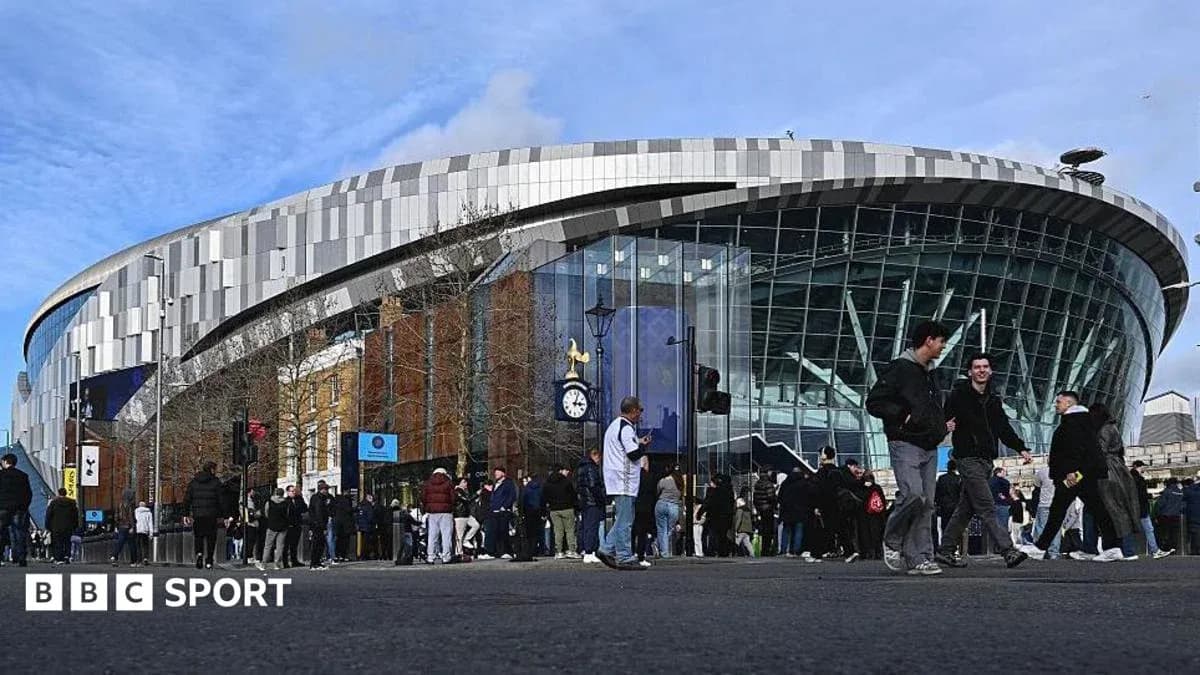
Yet step outside the dressing room and into the concourses of the Tottenham Hotspur Stadium and the picture flips. On the pitch, Spurs look fragile. Off it, they are a financial machine.
The stadium that prints money
The numbers are brutal and brilliant in equal measure.
“Spurs’ matchday income has increased from £45m in 2016-17, the season they left White Hart Lane, to £126m in 2024-25,” says football finance expert Kieran Maguire.
They have not even doubled the size of their old ground, but they have multiplied matchday revenue by two and a half. That is not an accident. That is design.
“What Spurs have done is they've created a welcoming environment,” Maguire explains. Fans don’t just rock up at 2.55pm and leave at the final whistle anymore. They arrive early, they linger, they drink, they eat, they shop.
“If people are spending an extra 40 to 50 minutes in the stadium itself they're not just spending time – more importantly they're spending money.”
The place never really sleeps. Spurs can stage up to 30 non-football events a year at full capacity. The pitch has flipped for NFL games. Anthony Joshua fought Oleksandr Usyk there for the heavyweight world title in 2021. Rugby union’s Saracens have turned it into their London derby stage against Harlequins since 2023. Concert rigs roll in and out.
Every show, every game, every corporate package swells the commercial column of the accounts. That figure has leapt from £73m in 2016-17 to £277m in 2024-25.
That cash doesn’t just sit in a vault. It goes back onto the grass. This summer Spurs pushed out a club-record deal for Sandro Tonali, a fee that could reach £100m. A club fighting for survival in the table is spending like a Champions League regular because its stadium behaves like one.
New rules, old loophole
All of this lands just as the Premier League rewrites its financial rulebook.
The old Profitability and Sustainability Rules are being replaced by a new framework built around two pillars: squad-cost ratio (SCR) and sustainability and systemic resilience (SSR).
Strip away the jargon and SCR is simple enough. It caps what a club can spend on its playing squad as a percentage of its overall revenue. Wages, transfer amortisation – the way transfer fees are spread across contracts for accounting purposes – and agent fees all sit inside the calculation.
One thing does not: stadium infrastructure costs.
“In the case of Spurs, their infrastructure costs are around £70m a year – but those are excluded,” Maguire points out. “Any money that you invest in stadiums is completely ring-fenced and excluded from your ability to invest in players.
“There's a separate issue in that stadiums do cost a lot of money. But Spurs borrowed from banks at spectacularly cheap interest rates.”
So the equation is stark. Spend heavily on a stadium, and the bill doesn’t drag down your SCR. Grow your revenues through that same stadium, and your spending limit on players rises. For Spurs, the upside dwarfs the downside.
“In order to be competitive, you need to have a significant increase in matchday income,” Maguire says. There are only two levers: hike prices or put more people – and more high-spending people – through the turnstiles.
“You could only do that from either increasing prices, which isn't going to go down well, or increasing the size of the stadium with a greater proportion of the tickets going to the non-season ticket fanbase.”
Tottenham chose bricks, steel and glass. Others are wondering if they must follow.
The stadium dilemma: stay, stretch, or start again?
Everton and West Ham have already taken the plunge, leaving historic homes for gleaming new builds. The balance sheet likes it. The fanbase often does not.
Across the Premier League, boardrooms are wrestling with the same question: renovate or relocate?
Renovation is cheaper and keeps the club rooted, but it comes with a very practical headache: where do you play if your ground becomes a building site? A full rebuild, on a fresh footprint, dodges that problem but comes with eye-watering costs and the emotional wrench of leaving a place that has defined generations.
The fear is always the same – lose the stadium, lose a piece of the club’s soul.
At Manchester United, Sir Jim Ratcliffe has made his intentions clear. He wants a new stadium to stand as the physical symbol of his era. The plans unveiled in March 2025 talk of a 100,000-capacity arena, loaded with corporate areas. It would dwarf Old Trafford’s current matchday income.
The logic is ruthless. More seats, more boxes, more premium experiences. More money to drive revenues and, in turn, improve the senior squad.
But the grand design comes with hidden lines on the spreadsheet. The proposed huge canopy is not just an architectural flourish. It is a cost. The overhang and what sits beneath it would fall under United’s footprint – and under United’s responsibility.
Will the expense justify the visual impact and the commercial return? That is the gamble.
Club officials suggest construction could be done partly off-site and then shipped in, modular-style, which should trim costs compared with a full, in-situ rebuild of Old Trafford. Building the new ground just down the road also solves another thorny issue: where to play in the meantime.
None of Manchester City, Liverpool or Everton’s stadiums are ideal temporary homes. All have smaller capacities than Old Trafford. All would be expensive to hire, even if such a move were politically and logistically possible.
United’s current vision is clean. Finish the new stadium. Lock Old Trafford’s doors. Walk down the road and turn a new key.
Newcastle’s crossroads
If Tottenham are the poster club for stadium-led growth, Newcastle are the case study in what happens if you stand still.
This summer, Newcastle have effectively had to sell some of their best players simply to stay within financial rules. On Tyneside, the argument for a new, purpose-built stadium is no longer a theoretical debate. It is a financial strategy.
The numbers are unforgiving.
“For the 2024-25 season Newcastle's matchday income was £52m. Manchester United's was £160m, Arsenal's £154m, Spurs' was £126m,” Maguire sets out.
That is a £100m gap to the biggest earners before a ball is kicked. To close it, a club must either outthink everyone in recruitment and coaching or charge supporters more.
“How can Newcastle increase the yield per fan and still be loyal to the Gallowgate hardcore?” Maguire asks. The answer, he suggests, lies in changing the product, not the people.
“You need to be able to offer a different product and St James' Park wasn't built for a corporate audience.”
St James’ Park can host gigs, as Newcastle supporter Charlotte Robson points out, but not on the scale of Tottenham’s stadium or West Ham’s London Stadium. The infrastructure limits what can be done, and how often.
Robson captures the emotional fault line.
“I don't think it would be stupid to move from the ground,” she says, “but I think there is so much identity for Newcastle fans who are attached to St James' Park that it would break a lot of hearts to move the ground in any significant way.”
That is the tension at the heart of the modern game. The accountants can model the uplift in corporate revenue. They cannot model what happens when you uproot a community from the place where it has lived its footballing life.
Who can really copy Spurs?
Every club watching Tottenham’s balance sheet will be tempted to say: we want that.
But not every club is Tottenham.
“Spurs have got the advantage that they're in London – a huge tourist trap,” Maguire cautions. “They are also a club with a global fanbase, so it works there.”
Day-trippers, tourists, and international fans pour into the capital. They buy shirts, tours, and high-end hospitality. That model is harder to replicate in a city where the fanbase is overwhelmingly local and more resistant to ticket price rises.
“Is that going to work elsewhere in the country where you've got a more localised fanbase and where there is resistance to putting up prices for tickets? Then it becomes more challenging,” Maguire says.
Construction costs have surged. Steel, labour, logistics – every line item is heavier than it was when Spurs broke ground in north London. Yet the appetite has not gone away. Clubs still queue up architects and feasibility studies, still sketch out new skylines and naming rights deals.
The financial rules now reward those bold enough, and rich enough, to turn concrete into competitive advantage. The question is no longer whether a new stadium makes money.
It is which clubs are willing to risk everything that made them feel like home to chase it.