Tottenham's Survival: De Zerbi's Impact on Spurs
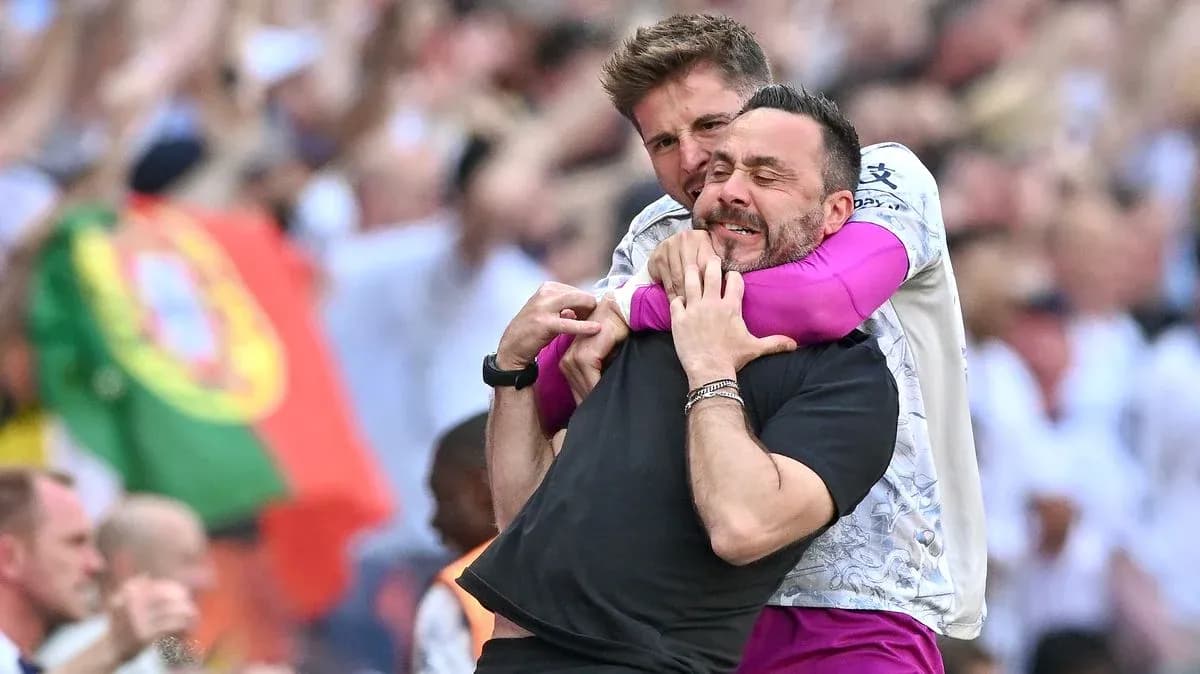
Guglielmo Vicario crossed the Goodison Park turf like a man released. Fresh from hernia surgery, not yet fully fit by his own admission, the Tottenham goalkeeper sprinted towards Roberto De Zerbi at the final whistle and almost wrestled his head coach to the ground in celebration.
Joao Palhinha’s goal against Everton had helped keep Spurs in the Premier League. The embrace said the rest: this was survival, and in Vicario’s eyes, it belonged to De Zerbi.
From freefall to survival
Tottenham had been drifting. Confidence drained, belief eroded, the club had slipped into a relegation fight few inside the stadium ever imagined possible. Vicario speaks openly about it now: a long, painful season, both for the team and for him personally.
“This club deserves at least to stay in the Premier League. This is the minimum you can get at this football club,” the 29-year-old said, reflecting on the ordeal. Spurs had lost focus, lost hope, lost “a lot of stuff”, as he put it. They were heading towards trouble.
Then De Zerbi walked through the door.
The Italian did not simply tinker with tactics. He rebuilt a dressing room that had forgotten how to breathe. He delivered 11 points from the final six matches and, with them, safety.
Vicario credits him entirely.
The goalkeeper talks about “a lot of patterns, a lot of football”, but insists that was not the foundation of the turnaround. De Zerbi’s first job was emotional. He poured belief back into a squad paralysed by fear, flooding the place with “good vibes, good feelings” and a clarity of purpose that had been missing for months.
Inside De Zerbi’s rescue act
Unable to help on the pitch after his operation, Vicario tried to help off it. He spent long spells in conversation with De Zerbi, watching the Italian methodically stitch the club back together.
“He had a lot of talks with the players. I spoke a lot with him,” Vicario explained. The message was simple but relentless: play for the badge, drag everyone into the fight, and pull the supporters with you.
That call was answered. On the final day, with everything on the line, the response from the stands was “unbelievable”. The players felt it, he said. A team that had been shrinking into itself now fed off the noise.
They came through the storm. They stayed up. And in Vicario’s mind, that changes the club’s starting point for next season entirely.
“From next season there will be a different Tottenham Hotspur for sure,” he said, without hesitation.
Kinsky’s redemption arc
If De Zerbi has been the architect of Spurs’ survival, Antonin Kinsky has been one of its most striking symbols.
The 23-year-old Czech goalkeeper endured a nightmare in Madrid earlier in the season. Hauled off after just 17 minutes against Atletico by interim boss Igor Tudor, he was left with a Champions League scar that could easily have defined him.
Instead, it hardened him.
When Vicario went under the knife, Kinsky stepped in and produced a run of performances that changed the narrative of his season – and Tottenham’s. He delivered crucial, often spectacular saves against Wolves, Leeds and Everton, helping to drag Spurs over the line.
Vicario was not surprised. When De Zerbi first arrived and asked about “Toni”, the senior keeper did not hesitate.
“I think he is fully recovered from what happened because in football it can happen,” Vicario told him. Kinsky proved him right.
“He has been incredible, impressive, he did unbelievably well,” Vicario said. “In every game it was not easy… I was sure of his mental strength and ability.”
The Italian describes Kinsky’s mentality as his greatest weapon. The young keeper “made some really important saves to keep us in the league and he deserved his moment”. After the humiliation in Madrid, he found his “ups” when Spurs needed them most, especially in those final two or three games.
One of those moments came at Goodison, where Tottenham conceded just a single shot on target – a late effort that Kinsky clawed away. It was a snapshot of what De Zerbi has built in a short space of time: a side suddenly hard to break down, organised and aggressive without the ball, and bold with it.
A different Spurs on the horizon
Vicario has been linked with a move back to Italy and Inter Milan, but for now his focus is recovery and the future under De Zerbi. He says he is “not 100 per cent fit but in a better place”, and confident that a proper break will leave him ready for next season.
What excites him is not just the footballing identity that De Zerbi is famous for, but the balance the coach has struck.
Spurs needed a way of playing again. They also needed to stop leaking chances. De Zerbi has given them both.
He is widely recognised for his attacking patterns and possession play, yet Vicario is keen to highlight the other side. Since the Italian’s arrival, the defensive phase has been “unbelievably good”, typified by that Everton match where Tottenham controlled the game so completely that Kinsky was only called into serious action once, deep into stoppage time.
On the training ground and in the dressing room, there has been total buy-in. Vicario stresses that “everyone who was playing or not playing followed him in a great way”. In a season where fractures could easily have widened, De Zerbi managed to pull the group together.
Vicario does not dress it up. “Without him this result would not have been possible,” he said. “I want to thank him from the bottom of my heart because we were suffering a lot and he gave us a lot of joy in every aspect.”
Spurs have stared at the drop and stepped back from the edge. The fear has been replaced by something else: a sense that this, finally, might be the start of a very different story in north London.