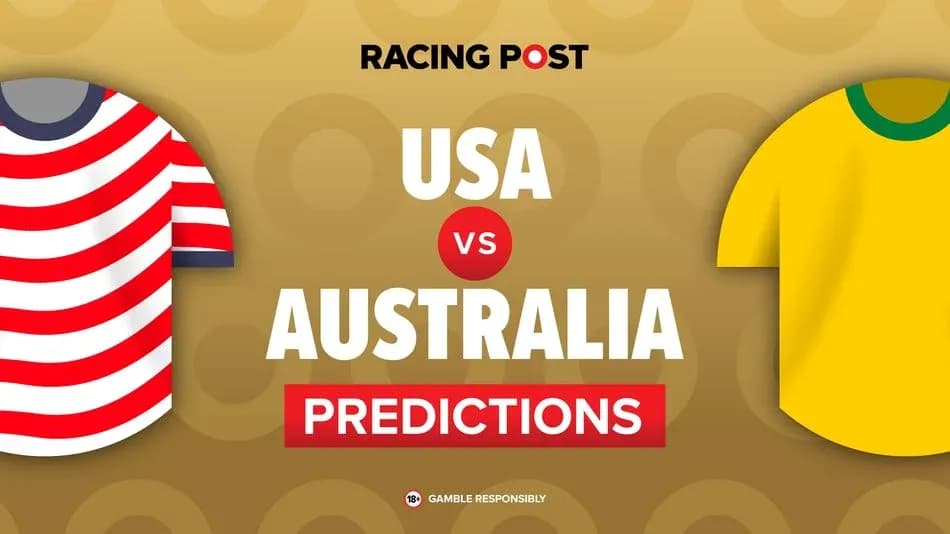
USA vs Australia: Hosts Seek Last-32 Spot at Lumen Field
Friday night in Seattle. A home World Cup, a full Lumen Field, and a USA side that has finally started to look like the version long promised but rarely delivered.
Beat Australia and they are in the round of 32. Simple on paper. It won’t be on the pitch.
USA’s new edge under Pochettino
The 4-1 dismantling of Paraguay felt different. Not just the scoreline, but the manner of it. USA hunted in packs, pressed with purpose and intelligence, and never really let go.
Mauricio Pochettino, questioned heavily since taking the job two years ago, watched his side force 16 high turnovers – a figure bettered only by Spain so far at this tournament. This was not a chaotic press, it was a coordinated assault. Paraguay could not breathe.
Down the left, Christian Pulisic, Malik Tillman and Antonee Robinson carved open space again and again. Folarin Balogun finished the job, striking twice with the kind of conviction USA have long craved from their No 9. For once, the “well-coached” tag didn’t feel like a diplomatic compliment. It felt accurate.
Now comes the test of consistency. Beat Australia in Seattle and the knockout place is wrapped up with minimal drama. Fail, and that Paraguay performance starts to look like another of those American false dawns.
Pulisic is a doubt after limping off with a calf issue, a potential blow not just in quality but in tempo. His aggression with and without the ball sets the tone. If he cannot start, the structure remains, but the spark changes.
Australia’s stubborn blueprint
Australia arrive with far less fanfare and absolutely no intention of playing along with the script.
Tony Popovic’s side stunned Turkey 2-0 in their opener, a result built on defensive discipline and sharp counter-attacks rather than long spells of control. A youthful XI sat deep, absorbed pressure and then struck through flashes of brilliance from Nestory Irankunda and Connor Metcalfe.
The numbers tell the story. Before Thursday’s fixtures, only Cape Verde had seen less of the ball than Australia’s 28.4 per cent possession. They are comfortable without it. They expect to be without it again.
That suits Popovic. His team will not hand USA the same space Paraguay did. Expect a compact 5-4-1, a low block, and long stretches where the ball barely crosses the halfway line in green and gold control. The job is to frustrate, to drag the tempo down, to turn a home World Cup group game into a grind.
Most of this squad is built on work-rate and structure rather than flair. There are exceptions – Irankunda’s electricity out wide, Metcalfe’s timing in transition – but this is a side that prides itself on industry. Eight of their last ten defeats have been by a single goal. They rarely collapse.
A different rematch from October
These teams know each other, at least on paper. They met in a friendly in October, USA winning 2-1 thanks to a Haji Wright brace after Jordy Bos had opened the scoring.
That game offers only limited clues. Just five starters from each side in that friendly began their World Cup openers. Personnel have shifted, roles have evolved, and the stakes are now entirely different.
The core dynamics, though, are likely to echo that meeting: USA on the front foot, Australia compact and opportunistic. The difference this time is the sharpened American press and the heightened pressure of a World Cup group where both have already banked three points.
Tactical fault lines
Pochettino’s USA prefer to build centrally, using Tillman and Weston McKennie between the lines with Sergiño Dest stepping in from the right. Australia will aim to clog those zones, forcing the hosts wide and into low-percentage crosses against a back line anchored by Harry Souttar.
The predicted USA shape remains a 4-2-3-1:
Freese; Freeman, Richards, Ream, A. Robinson; Adams, Tillman; Dest, McKennie, Pulisic; Balogun.
If Pulisic does not make it, the creative burden tilts further towards Tillman, who fired five shots against Paraguay and comes into this World Cup off an eight-goal season in 24 league starts for Bayer Leverkusen.
Australia’s likely 5-4-1 is designed for survival and sudden strikes:
Beach; Italiano, Circati, Souttar, Burgess, Bos; Metcalfe, O'Neill, Irvine, Irankunda; Yengi.
Patrick Beach, a surprise starter in the opener, is set to keep his place in goal, while Mo Toure races to recover from a calf injury. If he misses out, the burden up front falls heavier on Kusini Yengi to occupy centre-backs and buy time for runners from deep.
USA arrive on a seven-game winning streak at Lumen Field and have taken six wins from their last ten overall. Both teams have scored in eight of those last nine American outings, a reflection of their ambition and occasional defensive looseness.
Australia, by contrast, live in tight margins. Only one of their last nine matches has gone over 3.5 goals. When they lose, it is usually narrow.
Where this game tilts
The clash feels set along a clear fault line: can USA’s press and attacking patterns crack Australia’s defensive shell before frustration seeps in?
The hosts are backed to do just enough. A USA win with under 3.5 goals fits the profiles of both sides – pressure, territory and chances for the Stars and Stripes, resistance and the odd break from the Socceroos, but not a repeat of the 4-1 scoreline seen against Paraguay.
Australia’s midfield enforcer Aiden O’Neill will be central to that battle. The New York City man has committed 18 fouls in 11 MLS games this season and will spend the night trying to disrupt American rhythm in central areas. In a game where USA are likely to dominate the ball and probe through the middle, he stands out as a prime candidate for a card.
Expect Australia to make USA work for everything. Expect long spells of American pressure, perhaps a level score at half-time, and then the weight of territory and quality to begin to tell.
The hosts look ready to grind, not just glide. Nights like this decide whether that Paraguay performance was a statement of intent or just another fleeting high in a World Cup story still searching for its defining chapter.