Udinese vs Parma: Tactical Analysis of Serie A Defeat
Udinese’s 1–0 home defeat to Parma at the Bluenergy Stadium – Stadio Friuli unfolded as a study in contrasting efficiency. In this Serie A Regular Season - 33 fixture, Udinese controlled territory and tempo for long spells but were undone by Parma’s superior structure in both boxes. The visitors, set up in a compact 3-5-2, absorbed pressure, struck decisively through substitute Nesta Elphege early in the second half, and then managed the game with disciplined, low-foul defending. Udinese’s 3-4-1-2 generated volume but not clarity, and with Parma goalkeeper Zion Suzuki making all three saves required of him, the hosts’ statistical dominance never translated into a breakthrough.
The match’s lone goal arrived in the 51st minute, five minutes after Carlos Cuesta’s key adjustment. At 46', Nesta Elphege (IN) came on for Mateo Pellegrino (OUT), a like-for-like change on paper that subtly altered Parma’s forward dynamics. Elphege immediately offered deeper runs and better hold-up play, giving Parma a more reliable outlet when breaking Udinese’s first line.
On 51', that shift paid off. Parma constructed their best attacking sequence of the match, exploiting the half-space around Udinese’s central block. Gabriel Strefezza, starting as one of the two forwards, drifted into a wider pocket and received between the lines. His assist to Elphege was the product of Parma’s deliberate verticality: a quick progression that bypassed Udinese’s midfield four and isolated the back three. Elphege’s finish, classified as a normal goal, came from inside the box and aligned with Parma’s broader shot profile (eight of ten attempts from inside the area). With Maduka Okoye recording zero saves across the 90 minutes, this was not a night of heroic goalkeeping errors or interventions; Parma’s only shot on target found the net, reflecting a high degree of clinical edge rather than volume.
From that point, the game became about how each side managed the tactical state created by the 0–1 scoreline. Udinese, who had already leaned on their 3-4-1-2 structure, doubled down on width and central overloads. Kosta Runjaic’s back three of Oumar Solet, Christian Kabasele, and Thomas Kristensen provided a stable platform, allowing both wing-backs, Kingsley Ehizibue on the right and Hassane Kamara on the left, to push high and pin Parma’s wide midfielders, Enrico Delprato and Emanuele Valeri.
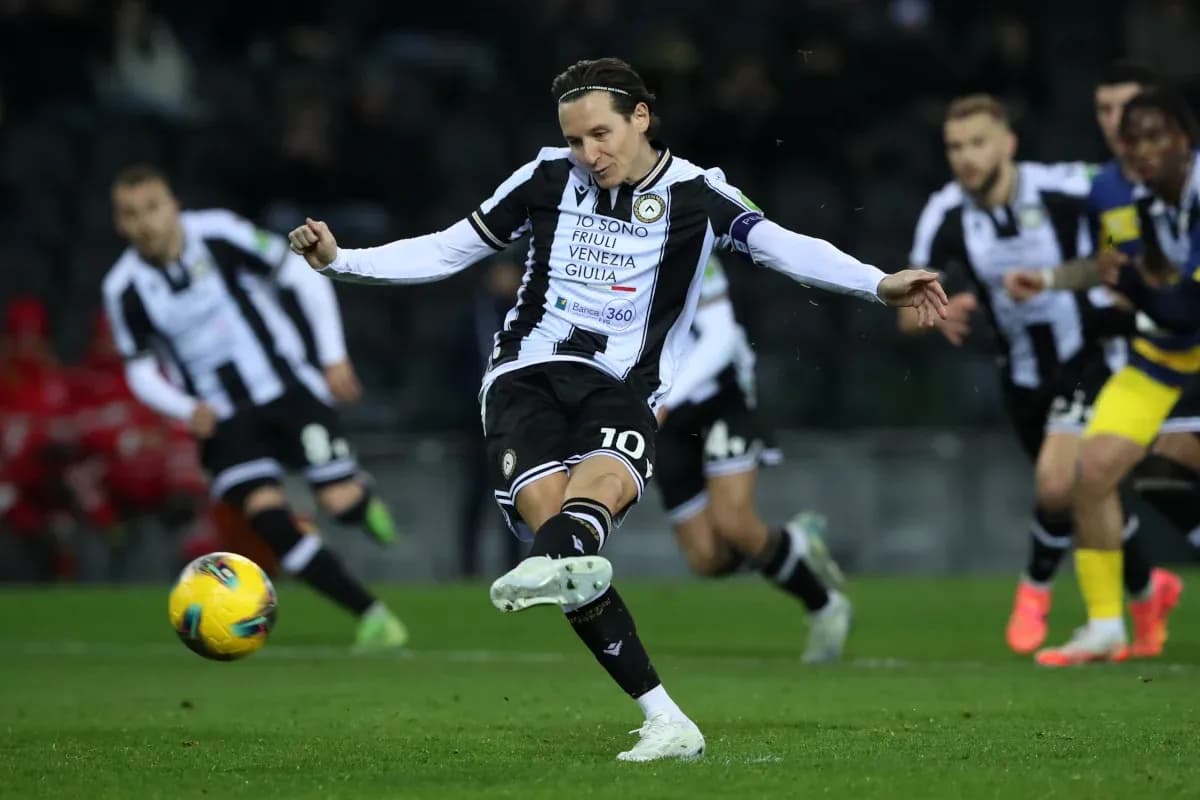
In possession, Udinese’s 57% share of the ball and 441 total passes (88% accuracy) underlined their territorial control. Jesper Karlstrom and Jakub Piotrowski formed the central pivot, tasked with recycling possession and feeding Nicolò Zaniolo in the advanced role behind the front two, Jürgen Ekkelenkamp and Arthur Atta. The structure produced 16 total shots, ten from inside the box, but the shot quality rarely dislocated Parma’s back three of Alessandro Circati, Mariano Troilo, and Abdoulaye Ndiaye. Udinese’s expected goals of 1.13, combined with just three shots on target, illustrated a pattern of half-chances and blocked efforts (four blocked shots) rather than repeated clear looks.
Parma, by contrast, accepted a lower-possession identity (43%, 349 passes at 83% accuracy) and built their threat on compactness and transitions. The midfield trio of Adrián Bernabé, Mandela Keita, and Hans Nicolussi Caviglia initially focused on screening central lanes, forcing Udinese wide and then defending crosses with their three centre-backs. With Parma generating an xG of 1.23 from only ten shots and one on target, their attacking approach was ruthlessly selective: fewer attempts, but better positions, mostly from inside the area.
The substitutions further sharpened these tactical trends. On 64', Runjaic attempted to inject energy and verticality: Juan Arizala (IN) came on for Hassane Kamara (OUT), and Idrissa Gueye (IN) replaced Jakub Piotrowski (OUT). Arizala offered more direct running from the left, while Gueye added forward thrust from deeper zones, aiming to attack the spaces between Parma’s lines. Yet Parma responded almost immediately: at 66', Jacob Ondrejka (IN) came on for Strefezza (OUT), and Christian Ordoñez (IN) replaced Bernabé (OUT), freshening both the forward line and the midfield screen.
Udinese’s later changes reinforced their attacking posture. At 73', Adam Buksa (IN) came on for Ekkelenkamp (OUT), giving Udinese a more traditional penalty-box reference, and Oier Zarraga (IN) replaced Ehizibue (OUT), adding an extra technical midfielder while reshaping the right flank. This tilted Udinese towards a de facto back four in many phases, with one of the centre-backs stepping wider to cover the vacated lane. Parma, anticipating the aerial threat, shored up their back line when Sascha Britschgi (IN) replaced Abdoulaye Ndiaye (OUT) at 75', effectively refreshing the defensive unit tasked with handling crosses and second balls.
The final Udinese substitution, Branimir Mlačić (IN) for Thomas Kristensen (OUT) at 81', was a late attempt to combine fresh legs in the back line with sustained pressure higher up. By then, however, Parma’s block had settled into a low-to-mid 5-3-2 without the ball, compressing central areas and forcing Udinese into wide deliveries and shots from less favourable angles.
Disciplinary management further revealed the tactical tone. Udinese collected both yellow cards in the match, each explicitly for fouls. At 70', Zaniolo’s booking reflected the growing frustration of a creative player repeatedly crowded out between Parma’s lines. At 84', Karlstrom’s caution came as Udinese committed more players forward and were increasingly vulnerable to transition, forcing tactical fouls to prevent counters. Parma, with eight fouls and no cards, maintained control of their defensive duels, rarely overcommitting in wide areas or allowing themselves to be drawn into reckless challenges.
In the statistical verdict, the match distilled into a contrast between structural possession and pragmatic control. Udinese outshot Parma 16–10, led in corners 10–5, and posted a slightly lower xG (1.13 to Parma’s 1.23) despite their volume, underscoring that Parma’s fewer chances were of higher quality. Okoye’s zero saves versus Suzuki’s three confirmed the asymmetry in shot effectiveness: Parma turned their only effort on target into the decisive goal, while Udinese’s attacking framework lacked the precision to translate their territorial and passing superiority into the scoreboard. Defensively, Parma’s low card count and compact 3-5-2, morphing into a 5-3-2, provided a stable platform for an away win built on efficiency rather than spectacle.