Bournemouth's Tactical Efficiency Secures 2–1 Win Over Newcastle
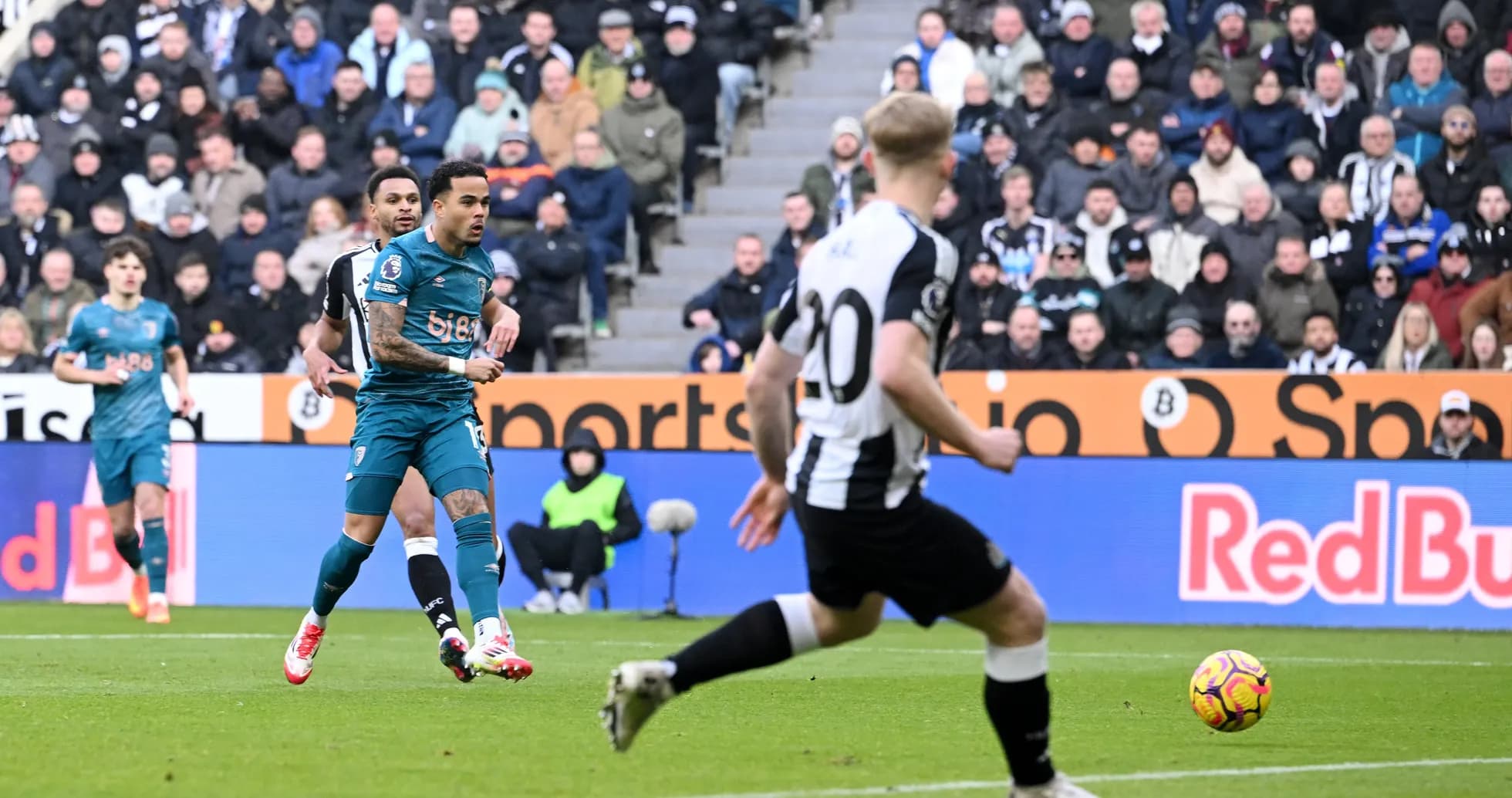
Newcastle’s 2–1 home defeat to Bournemouth at St. James’ Park unfolded as a structurally even contest in volume but one where the visitors executed their attacking plan with greater clarity and efficiency. In a Premier League Round 33 fixture, Eddie Howe’s 4-3-3 tried to dominate territory and possession (54%) but Andoni Iraola’s 4-2-3-1 was sharper in transition and chance creation, reflected in a significant xG edge (3.03 to 1.65) and ultimately on the scoreboard.
First Half
Bournemouth’s first-half control of key moments set the tone. With both sides trading early half-chances, the visitors struck on 32 minutes: Marcus Tavernier arrived from the left half-space to finish a move initiated by Rayan between the lines. The pattern was typical of Iraola’s setup – Alex Scott and Ryan Christie forming a double pivot in build-up, with Rayan and Eli Junior Kroupi narrowing inside to overload Newcastle’s midfield three. Tavernier’s goal gave Bournemouth a 1–0 lead that they protected to half-time, despite Newcastle edging possession and territory.
Newcastle’s 4-3-3 was built on a high starting position from full-backs Lewis Hall and Valentino Livramento, with Sandro Tonali and Lewis Miley tasked with progressing the ball through central lanes. However, Bournemouth’s mid-block was compact: Evanilson screened passes into Tonali, while Scott and Christie slid laterally to deny clean access into Jacob Ramsey between the lines. This forced Newcastle to funnel play wide, where Bournemouth’s back four – Álex Jiménez, James Hill, Marcos Senesi and Adrien Truffert – were comfortable defending crosses and front-foot duels.
Second Half
Howe’s adjustments after the break were aggressive and clear. At 46', Kieran Trippier (IN) came on for Lewis Hall (OUT), immediately raising the technical quality of Newcastle’s right side and improving delivery from deep. Trippier’s presence also allowed Livramento to invert more often, stepping into midfield to create temporary double-pivot structures with Tonali and giving Newcastle better rest defence against Bournemouth counters.
The game’s physical and emotional temperature rose after the interval, and Bournemouth’s discipline was tested first. Ryan Christie collected a yellow card for a foul on 52', a direct consequence of Newcastle’s quicker vertical passes into the half-spaces. Three minutes later, Tavernier was booked for argument at 55', a sign of Bournemouth’s frustration as Newcastle began to compress the game in the visitors’ half.
Howe doubled down on attacking intent on 62'. Bruno Guimarães (IN) came on for Jacob Ramsey (OUT), and Jacob Murphy (IN) replaced Anthony Elanga (OUT). The double change transformed Newcastle’s midfield dynamics: Guimarães dropped deeper to dictate tempo and draw Bournemouth’s first line out, while Murphy’s width and 1v1 threat on the right stretched Truffert and Senesi horizontally. This rebalancing finally yielded a breakthrough.
On 68', William Osula levelled the match with a normal goal, capitalising on Newcastle’s improved occupation of the penalty area. The move reflected the cumulative effect of Trippier’s delivery, Guimarães’ circulation and Murphy’s wide presence. The goal was checked and confirmed by VAR at 71', but the key tactical point was Osula’s positioning: constantly working the channels between Hill and Senesi, he gave Newcastle a vertical reference they had lacked in the first half.
Bournemouth’s response was measured rather than reactive. Iraola rotated his advanced midfielders to restore energy and pressing intensity. At 65', Tyler Adams (IN) came on for Ryan Christie (OUT), adding more defensive bite and ball-winning capacity in front of the back four. A minute later, David Brooks (IN) replaced Eli Junior Kroupi (OUT) at 66', offering more composure in possession and better decision-making in transition. On 78', Ben Gannon-Doak (IN) came on for Rayan (OUT), keeping Bournemouth’s right flank fresh for counters against a Newcastle side committing more numbers forward.
Newcastle continued to tweak their structure. At 74', Dan Burn (IN) replaced Valentino Livramento (OUT), shifting the left side into a more conservative, physically dominant profile and allowing Trippier to remain the primary attacking full-back. This also aimed to secure the back post against Bournemouth’s crosses. However, the hosts’ increasing risk exposure began to show in their disciplinary record: Sven Botman was booked for a foul on 77', a late challenge symptomatic of Newcastle defending larger spaces in transition. Jacob Murphy followed with a yellow card for a foul on 80', again linked to Bournemouth’s ability to break beyond Newcastle’s advanced full-backs.
Final Phase
Bournemouth’s midfield control reasserted itself in the final phase. Alex Scott’s yellow card for a foul on 82' underlined how often he was at the heart of duels, but he and Adams were now screening central zones effectively, forcing Newcastle into lower-quality shooting positions. Despite both sides finishing with 12 total shots and 3 on target each, Bournemouth’s shot profile was superior: 7 efforts inside the box to Newcastle’s 11, but with far higher xG (3.03 vs 1.65), reflecting clearer chances rather than volume.
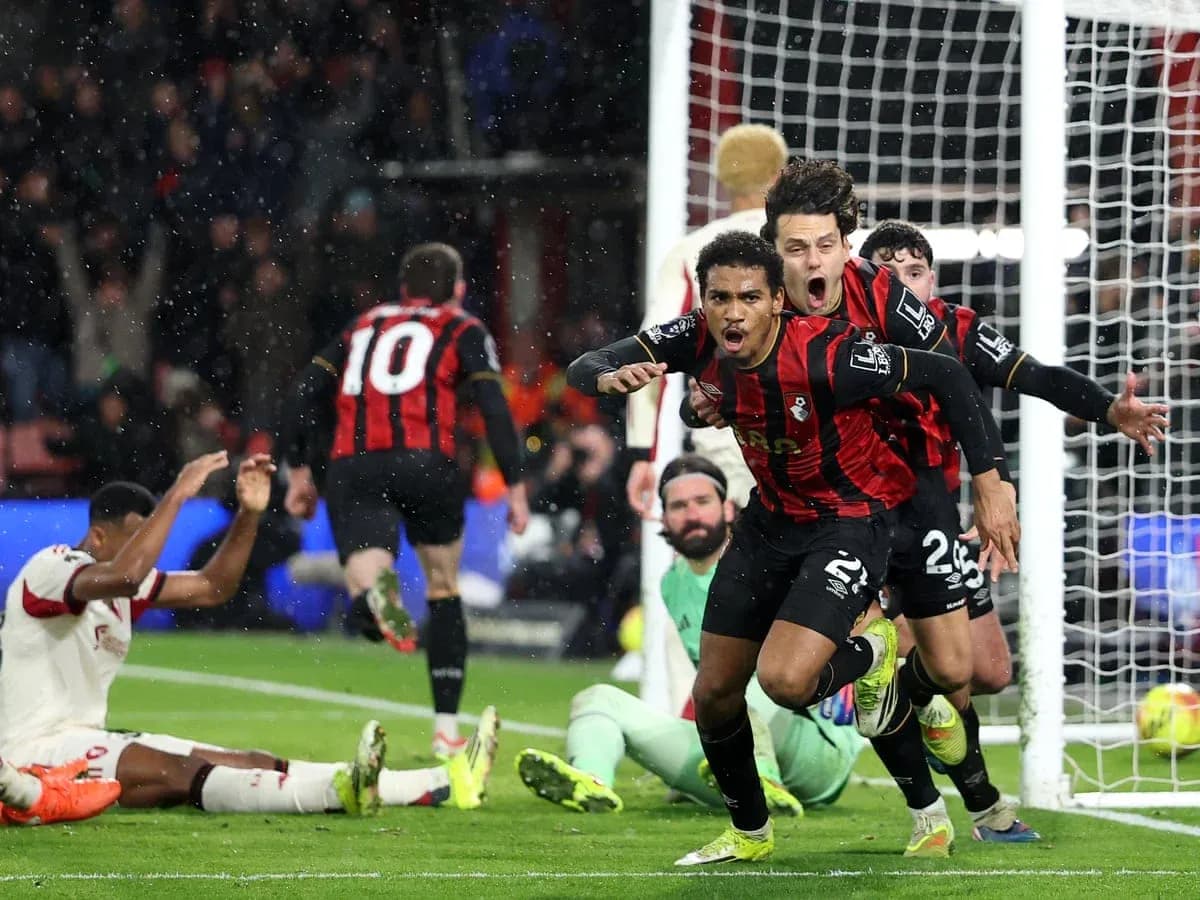
The decisive moment came on 85'. Adrien Truffert, who had largely been tasked with containing Murphy and supporting build-up down the left, stepped up with a normal goal to restore Bournemouth’s lead at 2–1. The sequence typified Bournemouth’s late-game strategy: absorbing pressure, then exploiting the vacated flanks as Newcastle pushed for a winner. Truffert’s advanced positioning was enabled by Adams’ and Scott’s coverage behind the ball and by the fresh legs of Gannon-Doak stretching Newcastle’s back line.
Howe’s final throw of the dice came on 86', when Nick Woltemade (IN) replaced Sandro Tonali (OUT), effectively turning Newcastle’s shape into a more direct, striker-heavy configuration. With Guimarães orchestrating from deep and multiple forwards occupying the last line, Newcastle chased second balls and crosses rather than structured combinations. Bournemouth, in turn, managed the closing stages with further substitutions at 89': Alex Tóth (IN) for Marcus Tavernier (OUT) and Enes Unal (IN) for Evanilson (OUT), adding fresh legs to press and hold the ball upfield.
Đorđe Petrović’s yellow card for time wasting at 90+4' illustrated Bournemouth’s game-state management. The goalkeeper made 2 saves to Aaron Ramsdale’s 1, but the underlying story was different: Bournemouth’s defensive block forced Newcastle into lower-quality efforts, while their own attacks generated significantly higher expected goals. Newcastle completed more passes (433 to 380) at a slightly better accuracy (79% vs 75%) and held more of the ball, yet Bournemouth’s defensive index – compact shape, timely fouls, and effective substitutions – translated possession concession into controlled risk rather than vulnerability.
Overall, the statistical verdict is clear. Newcastle’s overall form on the day was one of territorial dominance without incision: 54% possession, 12 shots, 3 on target, xG 1.65, and only 1 save required from Ramsdale, showing that Bournemouth’s attacks, though fewer in volume, were far more dangerous. Bournemouth’s overall form was defined by verticality and efficiency: matching Newcastle’s 12 shots, equalling their 3 on target, but posting xG 3.03 and generating the higher-value chances that justified their 2–1 away win. Disciplinary totals – 2 yellows for Newcastle (Botman, Murphy) and 4 for Bournemouth (Christie, Tavernier, Scott, Petrović) – underline a contest where Bournemouth accepted tactical fouling as the cost of protecting a structurally sound and ultimately decisive game plan.