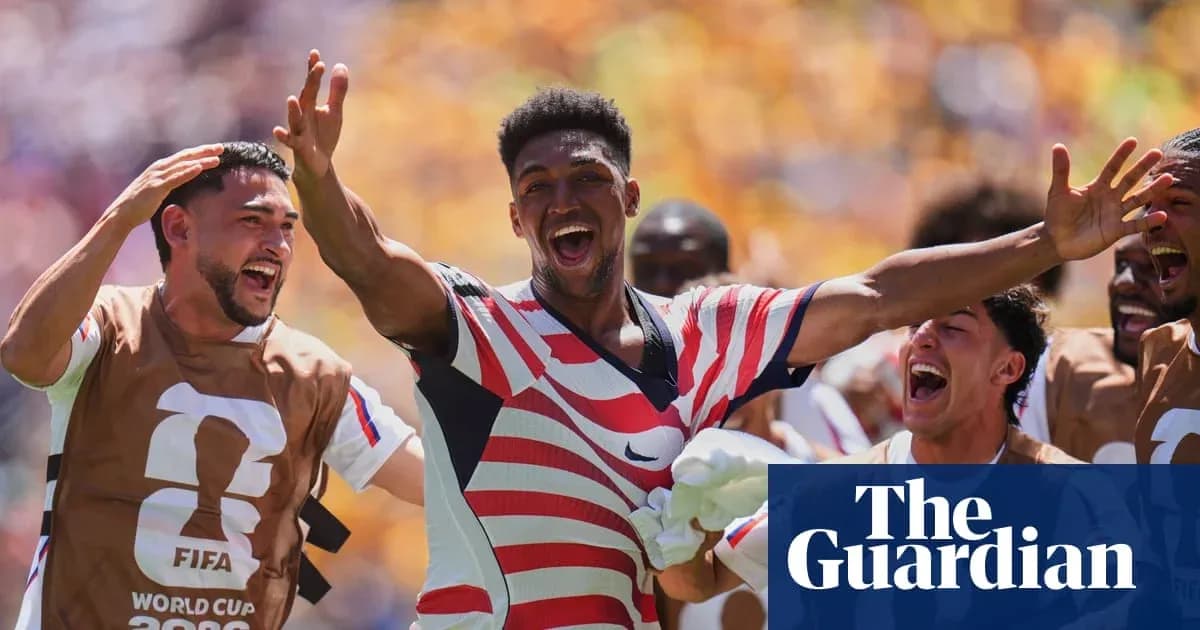
US Soccer Dominates Australia with 2-0 Victory
Soccer was always going to win here. The arguments about what to call it could wait. On a bright, easy Friday in the Pacific northwest, the sport took over Seattle, and the United States took care of Australia.
A 2-0 victory, a place in the knockout round secured, and a serious claim laid on top spot in Group D, pending Turkey v Paraguay later in the day. The numbers were simple. The occasion was not.
A stage built for a statement
Seattle Stadium throbbed long before kick-off. Of the 66,925 inside, three loud pockets of yellow fought to be heard, Australian fans bunched behind the south end, defiant and noisy. They never really had a chance.
This was a US crowd in one of the sport’s strongholds in the country, and it sounded like it. The flyover – four military helicopters skimming the roofline as the anthem ended – turned a World Cup group game into something heavier. Not subtle, but brutally effective. The volume never really dipped.
Both nations arrived with the usual burden. Every World Cup, the US and Australia carry the same question: can this tournament push soccer further up the national sporting food chain? That pressure sat underneath everything. In a group as even as this one, with both sides fresh off impressive opening wins, the stakes were obvious.
No Pulisic, no problem
The build-up had revolved around one calf. Christian Pulisic’s. The US captain limped out of the opener at half-time, trained apart all week, and never made it to the team sheet. Mauricio Pochettino confirmed his absence shortly before kick-off, and the doubt arrived right on cue. Could this team, without its star, break down a disciplined Australian back line?
Australia had heard plenty in the days before. US pundits had dismissed the Socceroos as a “layup,” a soft touch at this level. Inside the US camp, the tone was very different. Players and coach repeated the same line: respect the opponent, expect a fight. It sounded like media training. It turned out to be accurate.
Australia landed the first jab. Inside a minute, Alex Freeman’s loose pass invited trouble, Mohamed Touré pouncing and driving at the heart of the US defence. Chris Richards held his ground, forcing Touré wide, and Matt Freese swallowed the low shot at his near post. A scare, nothing more, but a reminder that this would not be a stroll.
The US response was sharp. They took the ball, pushed Australia back, and began to pry at both flanks, dragging that five-man back line from side to side, looking for seams.
Balogun forces the breakthrough
The opening goal came from the space where Pulisic would usually live.
Antonee Robinson stepped into midfield and slid a pass into Folarin Balogun, stationed wide on the left. Balogun simply went. He burned past Jacob Italiano and whipped a low cross into the six-yard box. Defender Burgess, caught between clearing and reacting, could only divert the ball into his own net.
Another early own goal for the US at this World Cup, another early lead. Paraguay had crumbled in similar circumstances. Australia did not.
Two minutes later, Touré held off his marker and laid the ball back for Mathew Leckie at the edge of the box. Leckie tried to bend an outside-of-the-boot effort around Richards, but the shot sailed high and wide. It was ambitious, but it carried intent.
The game settled into what both coaches had predicted: tight, physical, competitive. Tackles began to bite. Nishan Velupillay clattered Tyler Adams in front of the US bench, sparking anger on the touchline. Jordan Bos collected the first yellow card for a hand to Weston McKennie’s face. Alessandro Circati joined him in the book for clipping Malik Tillman as the American surged toward the area. The free-kick was cleared, but the tone had shifted. This was now a grind.
Freeman’s redemption and a crucial second
In the 39th minute, the stadium held its breath. Freeman and Paul Okon-Engstler clashed heads and both went down, medical staff sprinting on. After treatment, both continued. Moments later, Freeman’s afternoon turned from anxious to unforgettable.
The move began with Tillman, wrestling with Velupillay on the byline and somehow keeping the ball alive long enough to win a dangerous free-kick near the corner. Robinson rolled it short to the top of the box, where Sergiño Dest wound up and let fly. Harry Souttar launched himself into the shot, blocking it full stretch.
The ball dropped loose. Freeman reacted first, lunging in to force it over the line. The flag went up, then the check came. After a brief delay, the goal stood. The centre-back who had nearly gifted Australia an opener was now the man doubling the US lead.
Freeman, backpedalling into his usual position in the chaos, ended up celebrating at the opposite end of the field, mobbed by teammates streaming from the bench. A strange, scruffy goal, but a huge one. At 2-0, the US had a cushion. Australia had a mountain.
Popovic rolls the dice
Tony Popovic knew his side had been second-best in the first half. He did not wait to act. At the break, he threw on Jason Geria for Burgess and unleashed both of his previous match-winners, Nestory Irankunda and Connor Metcalfe, for Touré and Velupillay.
The shape shifted. Australia moved into a bolder 4-3-3 with the ball, still dropping into a five-man line without it. Risky, but necessary.
The risk nearly backfired seven minutes after the restart. McKennie snapped into a loose ball in midfield and immediately slid Balogun through the middle. Only Souttar chased. Balogun bore down on goal, but his shot was blocked, the defender recovering just in time. A warning, loud and clear.
Australia answered with pressure of their own. Robinson picked up the US’s first yellow card of the day in the 56th minute, forced to haul down a developing attack on his flank as the Socceroos finally found some rhythm.
Popovic kept pushing. Cristian Volpato replaced Leckie just after the hour, and almost made an instant impact. Irankunda tore down the right, cut the ball back, and Volpato arrived in stride inside the box, only to lash his shot over the bar. Minutes later, Metcalfe found space and shot, but Freese smothered comfortably.
The pattern had flipped. Australia were now the aggressors.
Hanging on, standing firm
Pochettino responded by tightening the screws. Robinson, Dest and Ricardo Pepi made way for Sebastian Berhalter, Auston Trusty and Joe Scally – fresh legs with a defensive mindset, designed to see the game out rather than stretch it.
The changes invited Australia forward. The Socceroos pressed higher, swung in crosses, and forced half-chances. Circati went close in a scramble, others flashed efforts wide. Nothing clean, but enough to keep the US back line under constant strain.
The physical edge sharpened again as the clock ticked down. Souttar, Balogun and Italiano all saw yellow in a chippy final spell, incidents on and off the ball feeding a crowd that roared “USA” at every collision. The match threatened to spill over without ever quite doing so.
Even the referee could not escape the chaos. Felix Zwayer suffered an odd injury late on, briefly pausing the game before continuing. It felt fitting. Nothing about this contest had been simple.
As the tension threatened to sag, Balogun turned to the stands and windmilled his arms, demanding more noise, more energy. The response was instant. For a night at least, this corner of Seattle became “Soccer City, USA” in more than name.
The US had done enough. No Pulisic, no problem, not this time. The knockout rounds await, and with them a bigger question: is this just another step, or the start of something far larger for a team still learning how to carry the weight of a sport’s future on its shoulders?