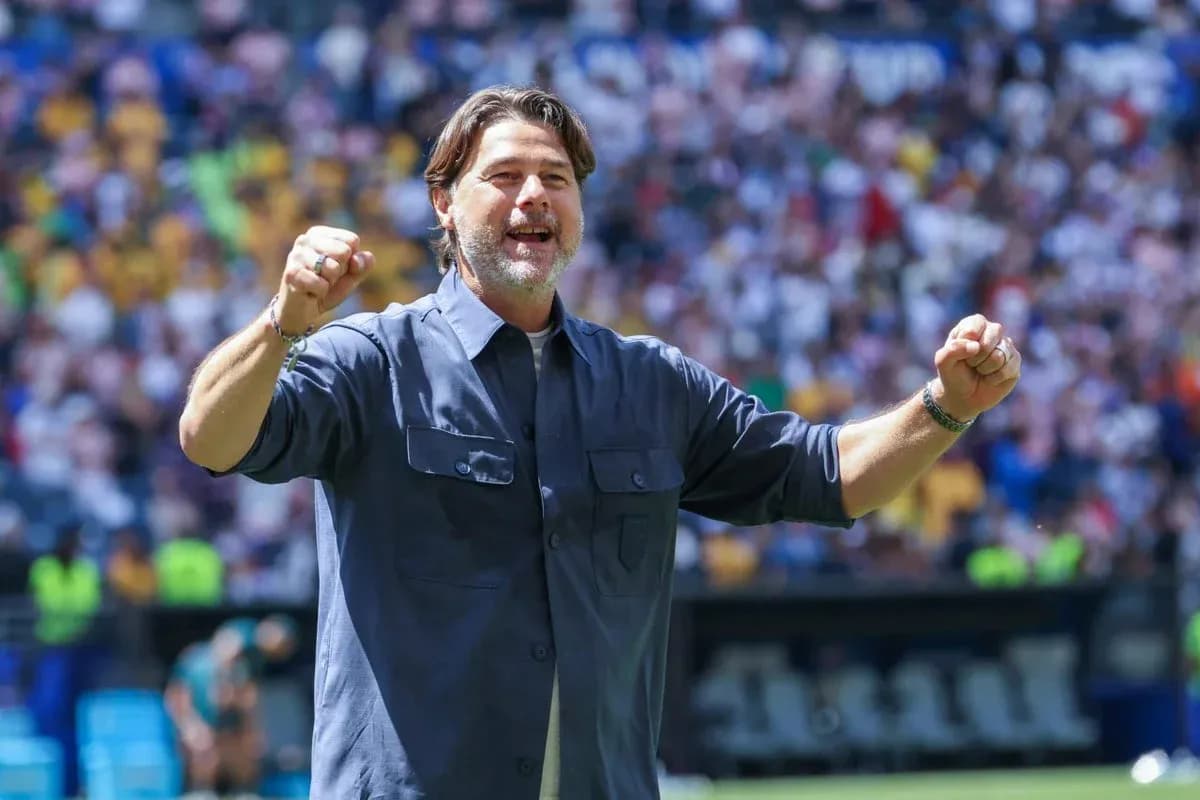
US Soccer's Proposal to Keep Pochettino Until 2030
The United States Soccer Federation has made its move. Mauricio Pochettino has a proposal on the table to stay with the USMNT through a second World Cup cycle, running to 2030. Nobody is rushing to sign it.
The offer is there, formally presented before a ball was kicked at this home World Cup. The decision can wait. Both sides agreed long ago that nothing would be finalized until after 2026, when the dust settles on a tournament that could redefine the sport in the country.
For now, Pochettino’s contract still ends when this World Cup does. Behind that simple line sits months of quiet conversations between U.S. Soccer and the 54-year-old Argentine, with sources confirming an offer to extend his deal by four more years.
The message from Chicago was clear: they want him to stay.
A coach in demand, a federation on alert
USMNT’s performances have only sharpened that desire. Wins over Paraguay and Australia secured a place in the round of 32 with a game to spare, turning Thursday night’s defeat to Turkey into a footnote rather than a crisis. The draw looks inviting. The mood in the country is shifting from curiosity to genuine belief.
That kind of momentum changes the stakes. It also changes Pochettino’s market.
U.S. Soccer knows he could be a free agent within weeks. It also knows the assumption in much of Europe has long been that Pochettino would return to club football as soon as this World Cup ended. That belief only grew when sporting director Matt Crocker — the man who worked with Pochettino at Southampton and later brought him to the U.S. job — abruptly left for a role in Saudi Arabia in April.
The coach has never been short of admirers. He spoke with AC Milan in late May, talks U.S. Soccer chief executive JT Batson framed as the reality of “the big leagues” when you employ a manager with a CV that includes Chelsea, Tottenham Hotspur and Paris Saint-Germain. Those calls will not dry up if he keeps navigating this World Cup as impressively as he has started.
Over the past year, several clubs have shown interest. U.S. Soccer, though, has been unwavering in its stance: they want Pochettino beyond the home World Cup, not just for it.
A four-year project that’s bigger than one tournament
The next cycle offers more than another shot at the World Cup. It is a rare alignment of events that could tempt any elite coach.
There is a home Olympic Games in Los Angeles in 2028. Copa America is expected to land on U.S. soil that same year, with the USMNT again in the thick of it. A new $250 million national training center is rising in Atlanta, designed as both a statement of intent and a practical tool to elevate every level of the program.
For Pochettino, that package is about power and influence as much as prestige. An extension would give him greater scope to shape the pathway from youth national teams to the senior side and to lean into coach education — an area where he has long shown interest. It is the kind of structural imprint club jobs rarely allow.
U.S. Soccer is banking on that broader vision. It is also making sure the financial side matches the ambition.
Big money, big donors, big expectations
Pochettino’s deal is already among the most lucrative in international football. A historical tax filing covering April 1, 2024 to March 31, 2025 projected his pro-rated base salary at around $4 million, with bonuses and incentives lifting the total to somewhere between $5 million and $6 million in a non-World Cup year.
An extension would keep him in line with the world’s highest-paid national team coaches and competitive with top-end European club offers — if still short of the eye-watering salaries at the very richest clubs.
That level of compensation does not come from federation coffers alone. When U.S. Soccer hired Pochettino in September 2024, it did so with the help of what it called a “philanthropic leadership gift” from Ken Griffin, the billionaire founder and CEO of hedge fund Citadel. Additional backing came from Scott Goodwin of Diameter Capital and several commercial partners.
Those conversations have not stopped. With Pochettino’s future again in play, the federation has been in regular contact with wealthy donors and sponsors, determined to stay in the financial bracket required to attract and retain the game’s elite coaches. Their pursuit of Jürgen Klopp before appointing Pochettino was not a one-off headline; it was a marker of where they intend to shop.
Pochettino weighs legacy against the lure of Europe
For all the planning and positioning, the decision rests with one man.
Pochettino has not closed the door on staying. This week, he spoke candidly about his connection to the country and the uncertainty of what comes next.
“It’s difficult to describe or know your future,” he said. “But when you are here, I think it’s difficult now to see yourself living in another place, because for sure, we will miss it if one day we don’t stay here in this country.”
He stressed that he and his staff have told the federation they are “open” to talks but do not want contract noise intruding on a World Cup campaign. “We don’t want to distract when all the energy needs to be with my players,” he said.
In another interview, he went deeper into what might keep him.
“If the American people start to show passion in our sport too, why not be here being part of something that can create a legacy?” he said. For him, that legacy is not simply lifting a trophy. “The legacy is not to win the World Cup. Of course, we want to win, but that [connection] is the legacy we need if one day we want to be very successful and be consistent. Why not be part of that?”
That is the choice in front of him: another charge at European club football, with its relentless week-to-week rhythm, or a long-term project in a country where the sport is still writing its story — with a World Cup, an Olympics and a Copa America all on home soil.
The offer is on his desk. The nation is at his feet. The answer will wait until the final whistle on 2026.