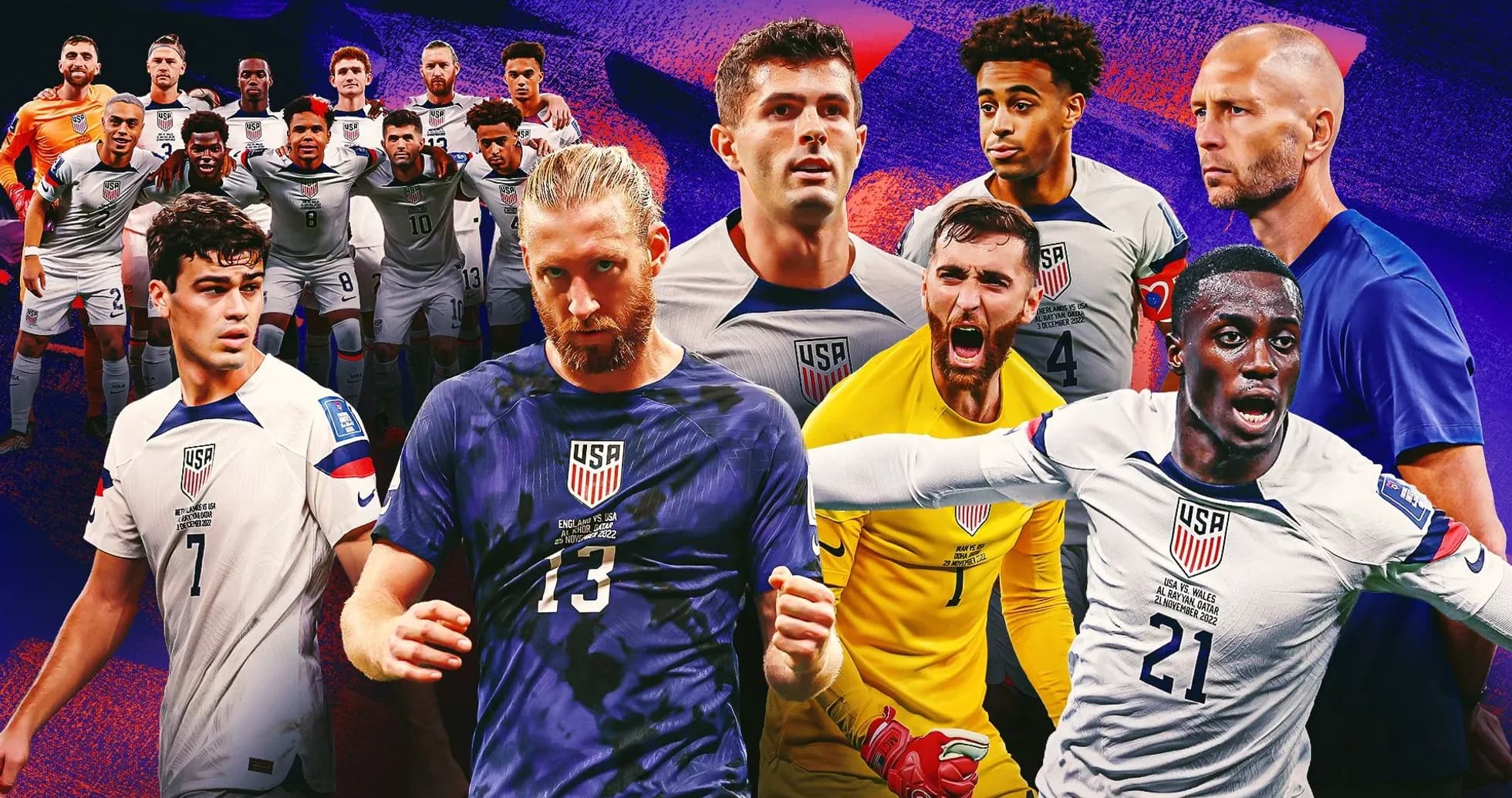
The Journey of U.S. Soccer: A World Cup Legacy
On the eve of Wales, Gregg Berhalter called them into a circle and gave them a number.
Not a formation. Not a tactical cue. A number.
Each player, he explained, was now part of a lineage: the running tally of Americans who had ever set foot in a World Cup match. Walker Zimmerman’s was 152.
“He said, ‘Each one of you guys has been assigned a number specific to you,’” Zimmerman recalls. “For me, it was 152. I was the 152nd player to represent the U.S. in a World Cup.”
Back in his room, Zimmerman found the jersey waiting. The number hit him harder than any pregame speech.
“One hundred fifty-two, that’s it? That’s all that has ever gotten to this,” he says. “Then you go by position… you realize you're in such an elite group.”
That was the point. Before a ball was kicked in Qatar, Berhalter wanted his young squad to understand that they were not just a team. They were a chapter.
A generation that grew up together
For Tyler Adams, Christian Pulisic, Weston McKennie and the rest of the core, that chapter had started long before Doha. They had come through the youth ranks together, inheriting the mess of 2018 and the responsibility of cleaning it up.
“Those are the best memories,” Adams says. “My memories with Weston are always going to be more valuable as a kid… It’s the memories of us getting to that stage, even more than where we are now.”
Tim Weah, Josh Sargent, Sergiño Dest — they had their own youth-team stories, the bus rides and hotel corridors that never make the highlight reels. By 2022, they weren’t just teammates. They were co-authors.
Then the tournament started, and everything sped up.
There were no extended camps, no long run-up friendlies. Players flew in from clubs, barely dropped their bags, and were thrown into the most intense environment of their careers.
“It’s so quick,” Tim Ream says. “It was a little more condensed than a regular World Cup… The games are late, you’re playing at 10 PM, so it switches our body clocks. We’re staying up until three in the morning… Breakfast at 12, lunch at four, then training.”
Some tried to fight the rush. Sargent leaned on a mental coach.
“It’s going to be a stressful time, you’re going to be nervous,” he says. “But make sure that, while you're there, take some deep breaths and be grateful and take it all in.”
Still, three group games in eight days — Wales, England, Iran — turned into a blur of recovery sessions, tactical meetings and sleepless nights inside a sealed-off World Cup bubble.
“Looking back now,” Haji Wright says, “the World Cup was like a fever dream. It went by so fast.”
For Joe Scally, it moved at a different pace. He never got on the field, one of five USMNT players who didn’t log a minute. Yet the pull of the tournament was no weaker from the bench.
“A World Cup is a World Cup,” Scally says. “To be there was an awesome experience… but it also lit a fire underneath me.”
He watched teammates walk out to the anthem, watched full stadiums rise, watched the world watching them.
“Of course, I was a part of it,” he says, “but not on the field.”
Three goals, three very different memories
Before Qatar, only 22 American men had ever scored in a World Cup. Three more joined that group in 2022, each in a wildly different frame of mind.
Weah went first.
Against Wales, with the U.S. back on the biggest stage after eight long years, Pulisic slipped him through and Weah slid his finish home — a clean, ruthless strike that felt like a statement.
“Leading up to that World Cup, I dreamt of scoring,” he says. “I literally always dreamt of that one moment… For it to become a reality, it was — man, it was amazing.”
Playing in a World Cup was the dream. Scoring in one? That was something else.
Then came Pulisic.
The stakes were sharper now. A scoreless draw with England meant the U.S. had to beat Iran to reach the knockouts. The game carried a political edge, a sense of occasion that went beyond sport. Pulisic answered it with a run that hurt to watch.
He crashed into goalkeeper Alireza Beiranvand as his shot crossed the line, injuring his pelvis. His World Cup “moment” arrived with pain, not celebration. No iconic knee slide, no choreographed pose. Just agony, a hospital trip, and a FaceTime call back to the dressing room after his teammates finished the job.
“It would have been, and it was, a huge moment,” Pulisic told GOAL in 2024. “Normally… I would have had a pretty cool celebration with the team… but I just didn’t have that.”
He shrugs it off now.
“I wouldn’t have changed it for the world,” he says. “Unfortunately, I just had to celebrate that one lying in the goal. I hope to have many big moments… I want to go in and I want to win these tournaments.”
Wright’s goal came wrapped in something darker.
His flicked finish against the Netherlands in the Round of 16 — an almost accidental, looping touch that dropped inside the far post — briefly dragged the U.S. back into a game that had been slipping away. For a few seconds, it felt like the tide might turn.
“It felt crazy,” he says. “I kind of felt like the momentum might change… felt we might get another opportunity. Obviously, that’s not how it went.”
The U.S. lost 3-1. The dream ended that night. Wright walked off the pitch a World Cup goalscorer, and yet that label barely registered.
“It was a happy and a sad moment,” he says. “Being a World Cup goalscorer is amazing. Being knocked out of that same game, though?… That’s what I remember.”
Time has softened the edges. Social media keeps the goals alive, looping them back into their timelines, tying those seconds on the pitch to living rooms and bars across the U.S.
“We were just seeing the reactions online,” Weah says. “Seeing the fans back home when I scored or when Christian scored… just to see the impact that we have and the representation that we have in our country.”
The goals are what the world remembers. For the players, the real tournament often lived somewhere else.
The quiet moments that stayed
DeAndre Yedlin knows both sides of a World Cup. In 2014, he was the kid. In 2022, he was the only holdover, the veteran shepherding a young group through a spotlight he understood far better than they did.
After every game in Qatar, Yedlin led a group of players back onto the field. No fans, no cameras, just the stadium, half-asleep, and a few minutes to breathe.
“It feels like adversity gets multiplied by 10 because there’s always a camera on you,” he told GOAL in 2024. “I think it’s important to find that space and peace… For me, it’s always just about keeping that perspective.”
He reminded teammates that they were, at some level, entertainers — tiny figures in the “grand scheme of it all,” as he put it, yet capable of playing a huge part in people’s lives.
Some players tried to bottle every second. Sargent stayed off his phone.
“I just tried to fully embrace it,” he says. “I feel like I can remember every single detail.”
Ream remembers the opposite.
“I can see glimpses of it,” he says. “I’m so insanely focused… It’s like tunnel vision. There’s a whole lot that you forget.”
The parts no one forgot? Qatar itself.
The call to prayer rolling over Doha. The old souqs beside brand-new arenas. A city reprogrammed to World Cup time, every street and restaurant bending toward the next kickoff.
“I enjoyed every bit of it,” Matt Turner says. “It was so cool to be in a culture I’ve never experienced before… It was special because we were in this foreign land all together… and we had just this rock solid bubble.”
Doha was a bubble. Their hotel was a bubble inside the bubble.
The U.S. stayed at the Marsa Malaz Kempinski in The Pearl, a man-made island that felt more like a movie set than a neighborhood. Unlike most tournaments, there were no internal flights, no new hotels. The Kempinski became home.
Yunus Musah went back the following summer just to feel it again.
“Everything was like a throwback,” he said in 2025. “The smell!… I would just walk around, and it felt like I was experiencing all of those moments from the World Cup all over again.”
At the heart of that world sat the Players’ Lounge — a simple room that became the emotional center of the U.S. campaign.
“We had so much downtime with one another that it really just allowed us to connect,” Adams says. “That Players’ Lounge… it was like our own little sanctuary.”
Gregg Berhalter had insisted on it. Camaraderie wasn’t a bonus; it was part of the plan. The players responded in the only way they know how: with competition.
Ping-pong. Pool. Video games. World Cup matches on TV. Movie nights. Hours of trash talk.
“Sean Johnson and DeAndre Yedlin had their crazy style of pool,” Zimmerman laughs. “It was basically snooker. They barely hit the ball and just tried to make you lose by scratching.”
Cristian Roldan avoided his room as if it were a trap.
“I remember being around the boys in the Players’ Lounge and making sure I didn’t spend any time in my room and didn’t take any moment for granted,” he says.
The family section that told the real story
Walk back to that first game against Wales, to the anthem, to the moment the noise swelled and the cameras panned the stands. Zimmerman remembers where he looked.
Not at the tifo. Not at the opposing bench. At the family section.
“Everyone’s story is tied up with what that group of supporters has done to get us into this spot,” he says. “All of the sacrifices that those people made… That, for me, was a special moment.”
Mothers, fathers, siblings, partners, kids — the people who drove them to training, paid the fees, carried the disappointments. In that corner of the stadium, you could see the cost of every career.
For Ream, the best moments away from the pitch were the rare ones when families could come to the hotel.
“Those were the only moments where you felt you could actually sit back and breathe,” he says. “My wife and kids and I, we’re all here in this place together.”
The families bonded, too. Years of seeing each other briefly in mixed zones and parking lots turned into weeks of shared meals and shared nerves.
“We were all really close already,” Weah says, “but having that period of time to connect and meet everyone’s family… that was amazing.”
For some, life has moved on quickly since. Kids have been born. Others have grown up and now understand a little more of what “Dad’s job” really is. Some players have married. Some have changed clubs, countries, roles.
Roldan’s life changed most of all.
He’s now the father of a nearly two-year-old daughter, and the thought of sharing a World Cup with her has become a driving force.
“I’ve had this late surge because I’ve had my daughter around,” he says. “Part of my motivation… is that I want her to watch me play. I want her to watch daddy play.”
In 2022, he was a squad player, a presence more than a protagonist. He wants the next one to look different.
The ones who watched from afar
Not everyone’s World Cup story unfolded on Qatari grass.
Sebastian Berhalter lived it as a son, not a player, watching his father coach the national team on the sport’s biggest stage.
“It’s the one time I got to feel like an ultra,” he says with a laugh. “Seeing your dad coach against some of the best teams in the world was something I’ll never forget.”
For Gio Reyna, the story was far more complicated.
He arrived in Qatar battling injuries and expectations, then saw his role shrink dramatically. The frustration spilled over. His limited minutes, his reaction in training, and the fallout that followed — including the Reyna family informing U.S. Soccer of a decades-old domestic violence incident involving Berhalter — turned into one of the ugliest sagas in modern USMNT history.
The episode went well beyond tactics or team selection. It fractured relationships, dominated headlines and, for a time, left the program in limbo.
Berhalter returned in 2023, then departed after Copa América 2024. Mauricio Pochettino is now in charge. Reyna remains in the pool, and he is trying to frame 2022 as painful education rather than permanent scar tissue.
“I think… we were all very, very young and maybe a little bit inexperienced at the time,” he says. The Netherlands, he notes, were “a little bit more experienced, a little bit better, a little bit more savvy.”
He talks now about the collective.
“You learn that it’s about just trying to do whatever you can to help the team,” he says. “This is your whole country that’s fighting something… This one is in our home country, too, so it would be a dream come true just to be there.”
Reyna’s lesson was harsh: a World Cup can expose as much as it rewards.
He’s not alone in feeling that Qatar left unfinished business.
Miles Robinson was a lock for the 2022 squad until his Achilles tore in May. There was no miracle recovery, no race against time. Just a hard stop.
When the tournament finally kicked off, he had a choice: look away, or lean in.
“Man, I was outside watching that sh*t,” he told GOAL with a smile. “We were partying, watching, cheering on my guys. I really wanted to experience that real-life energy because that’s who I am.”
Chris Richards never got that kind of closure. A hamstring injury with Crystal Palace ended his World Cup dream weeks before the roster announcement. He rehabbed in London while his club and country teammates lived the moment he’d spent his life chasing.
“I was so, so happy for them,” he says. “But for myself, it was lonely… I didn’t want anything to do with soccer.”
Mark McKenzie’s absence came down to selection, not injury. That made it cut deeper.
“Missing out on the 22 World Cup? It ripped me apart, bro,” he says. “When you get that call that you're not going, that you weren't selected, it’s a punch to the stomach.”
He now sees a hard lesson in it.
“Maybe I put too much onus on this,” he says. “So much that I lost who I was.”
From prelude to main event
So much has shifted since that winter. Berhalter is gone. Pochettino is in. Careers have risen, stalled, revived. The U.S. is no longer just trying to reintroduce itself to the World Cup. It’s about to host one.
For Adams, the impact of 2022 didn’t fully land until he got home.
“From a notoriety standpoint, people all of a sudden knew who I was walking back home in the streets of New York City,” he says. “It’s a city that I never imagined I’d get recognized in.”
He was also preparing to become a father, juggling a new level of public scrutiny with a new level of private responsibility.
Now the entire squad faces a different kind of scrutiny. Qatar was the dress rehearsal. 2026, on home soil, is the main event.
This time, they’re not guests. They’re hosts. In a country where soccer is still growing, not fully grown, that carries a particular weight.
“It’s an amazing feeling, but also a responsibility at the same time,” McKennie says. He talks about the pathway, about kids who will watch them and see possibility.
“Hopefully, people see that there is a pathway out there for them,” he says. “The ultimate thing is to believe in yourself and bet on yourself always.”
Soon, 26 more players will bet on themselves in a World Cup. Some will return with Qatar’s “fever dream” still fresh in their minds. Others will arrive wide-eyed. Some will play every minute; some will never leave the bench. All of them will leave changed.
For the 2022 squad, that winter will always be a bond — a shared memory of late-night training sessions, of hotel lounges and rooftop views, of family sections and flicked finishes and one long, surreal month that felt like it ended too soon.
“I can understand how people call it emotionally draining,” Wright says. “After it was over, it felt like soccer had changed me… It’s hard to get that feeling again outside of a World Cup.”
Matt Turner feels the same pull.
“I had some amazing experiences,” he says. “That’s why I need to get back there, because I really want that feeling again.”
The next chance is almost here. The numbers on the jerseys will be different. The stakes will be higher. The bubble will move from Doha to home.
The question is simple, and brutal: when this World Cup fever breaks, who will be left chasing that feeling for the rest of their lives?