VAR Chaos in Manchester Derby: The Cost of Speed
“Quick, quick, quick, quick! Go, go, go, go, go!”
Those frantic words from video assistant referee Matt Donohue, beamed out from the VAR hub at Stockley Park, now frame one of the most damaging officiating errors the Premier League has seen.
He was trying to be efficient. Instead, he helped create chaos.
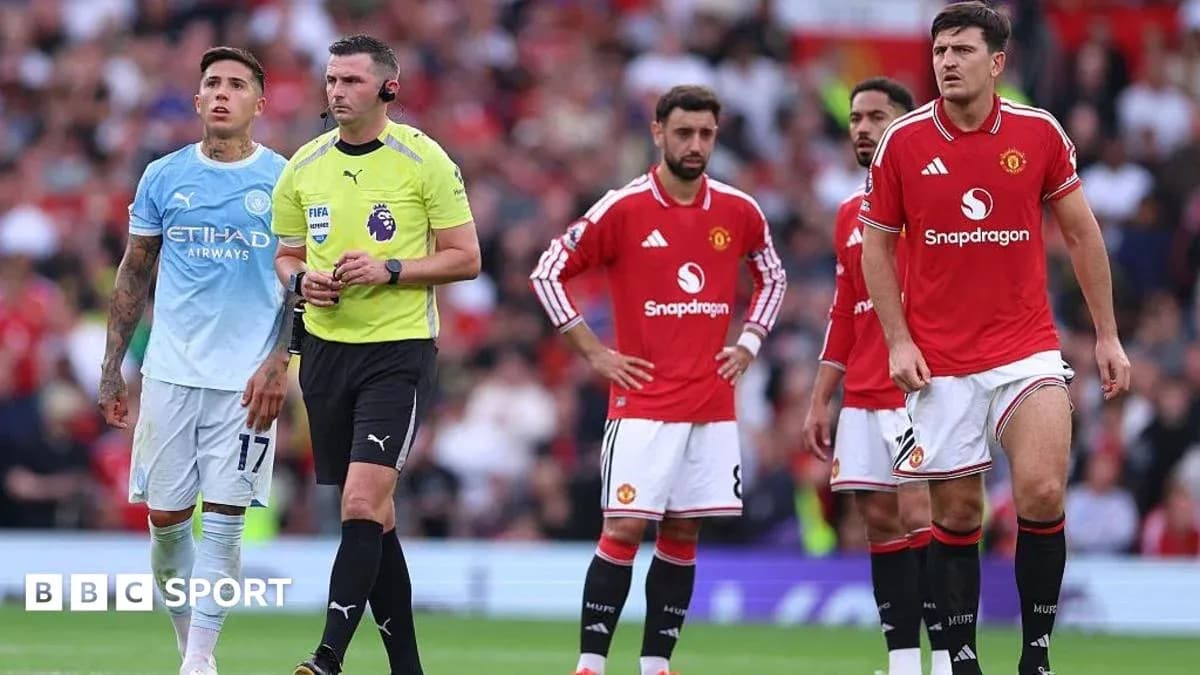
Erling Haaland’s winner in the Manchester derby stood. Manchester City 1-0 Manchester United. Yet Enzo Fernandez had been three yards offside before attacking the ball. Somehow, nobody in the booth noticed.
Speed over sense
Refereeing has always been a pressure job, a goldfish bowl. VAR has turned up the heat. Every frame, every angle, every delay dissected in real time.
This season the Premier League doubled down on a key principle: “more efficient application of VAR to reduce delays.” Less waiting. Quicker decisions. A slicker product.
But at what cost?
The audio from Sunday is uncomfortable listening. Donohue pushes the replay operator on, his voice tight with urgency.
“Let’s go, let’s go, let’s go, let’s go!”
It doesn’t sound like a calm official walking through a process. It sounds like someone racing a clock. Rushed. Chaotic. The very opposite of what VAR is supposed to be.
Referees are constantly told VAR must be quicker. Fans groan at delays. Pundits hammer the time taken. Phone-ins rage about stoppages. The Premier League’s own stakeholders’ survey – managers, coaches, supporters – flagged speed of decisions as the main area for improvement.
That pressure seeps into the booth. It doesn’t excuse what happened.
City head coach Enzo Maresca, who benefited directly from the blunder, still offered a hint of understanding on Wednesday.
“To make a decision in 10, 20 seconds is not easy for them,” he said. “Sometimes they make mistakes. I make mistakes, players make mistakes. It’s part of our job.”
Referees’ chief Howard Webb has tried to respond to the demand for faster calls without losing accuracy. On the numbers, it has worked. Average VAR delays, including the referee’s stadium announcement, have dropped from 46 seconds per game to 36.
But the only other acknowledged VAR error this season – the failure to give Arsenal a penalty at Aston Villa – also came from an incident that was waved through too quickly.
The pattern is hard to ignore.
The moment it went wrong
The critical failure in the derby didn’t actually come when Donohue began to rush the attacking phase. The damage was done even earlier.
On the first replay of Josko Gvardiol crossing the ball into the area, Donohue asked the operator to freeze the frame at the point of contact. He then went straight into semi-automated offside mode.
That step should never have come so soon.
The VAR team should first have watched the entire sequence: Gvardiol’s cross, Fernandez’s movement, Haaland’s finish. Only then do you understand the full picture – where Fernandez is, what he does, how he affects play.
They didn’t. The penalty area traffic went unexamined until the attacking phase check, and by then Donohue and his assistant VAR, Blake Antrobus, were locked onto a single question: did Fernandez touch the ball?
If he had, it would have created a new phase and put Haaland offside. That became their tunnel vision.
The rest – including the glaring fact Fernandez was offside when the cross came in – slipped through.
Donohue has taken most of the public heat, but Antrobus’ role, or lack of one, was just as significant. The AVAR is there to challenge, to spot what the main VAR might have missed, to act as a second pair of eyes.
Across the whole review, Antrobus’ only contribution on the key incident was a brief “no, yeah” on whether Fernandez had made contact with the ball. One second later, Donohue said: “final decision is goal, check complete.”
That is not a system of checks and balances. It’s a rubber stamp.
A long shadow from Brentford–Sunderland?
This isn’t the first time Antrobus has been at the centre of a VAR storm this season.
The only truly lengthy delay so far came in Brentford v Sunderland, when a Dan Ballard goal was ruled out for a subjective offside against Kevin Danso. That review dragged on for more than four minutes and drew fierce criticism in some corners of the media.
Antrobus was AVAR that day as well. He played a crucial part in guiding VAR Tim Wood towards the correct offside call against Danso.
Did the backlash over that long check play on his mind on Sunday? Did it make him more reluctant to slow things down and speak up?
We simply don’t know. But the contrast is striking: from painstakingly thorough to painfully rushed.
There was also a support VAR in play – an official in the operations room next to the match hub, empowered to intervene on protocol. That role exists for exactly this kind of moment, when process starts to fray.
They watched it unfold. No intervention came.
Even then, the situation was not beyond repair. Between Haaland scoring and the restart, there was still a window to pull the decision back. That chance was missed too.
The VAR “specialist” question
Pro Ref has poured time, money and training into VAR, trying to make it both efficient and accurate. This is not a system built on a whim.
There have been loud calls to appoint dedicated VAR specialists. On paper, that’s exactly what Donohue is.
Three seasons ago, Pro Ref invited referees to apply to become video officials. Candidates went through aptitude tests; around 15 reached the final training phase, with 10 going on to work Premier League matches.
Donohue was one of them. Sunday was his 65th match as the video official. His development has been strong enough that he now sits on the international list and has handled Uefa club competition qualifiers.
He has made errors before – almost all VARs have – which underlines how demanding the role is. Over the last two seasons, only Nick Hopton and Neil Davies, both graduates of the same accelerated programme, have a clean VAR record.
Convincing experienced referees to give up the whistle and spend their careers in a dark room is not straightforward. Nor does it guarantee perfection. Lee Mason and Mike Dean, the Premier League’s only full‑time VARs appointed after retiring from on‑field duties, were both removed by Webb just months into his tenure after a string of mistakes.
Spain offers a stark comparison. La Liga and its second tier use a full team of officials who operate only as VARs and never referee on the pitch. Yet the controversies there are just as fierce. At the start of last season, VAR completely missed that a goalscorer was offside when the ball was played.
Specialists alone do not solve the human element.
A football problem, not just a VAR problem
Pro Ref now faces serious questions. How does a VAR end up racing through one of the biggest calls in one of the biggest games of the season? Why is “quick, quick, quick” echoing around the room instead of “check, check, check”?
That caution did exist last season. When West Ham’s stoppage-time equaliser against Arsenal was chalked off, the review took more than four minutes. It was laboured. It was criticised. But it was right.
The derby decision was the opposite: rapid, applauded by no one, and wrong.
The drive for speed is starting to undercut the very purpose of VAR. That obsession doesn’t come only from the officials’ room. It comes from clubs, broadcasters, fans, surveys, and the league itself.
And until football decides what it really wants from VAR – instant answers or correct ones – the system will keep walking this same tightrope, one high‑profile fall at a time.