Villarreal vs Sevilla: Tactical Analysis of a Thrilling 3-2 Clash
Under the floodlights of Estadio de la Cerámica, Villarreal’s Champions League charge was supposed to gather more speed. Heading into this game, they sat 3rd in La Liga with 69 points, built on an expansive attacking identity: 67 goals in total this campaign, with a fearsome 2.4 goals per game at home and a total goal difference of 24 (67 scored, 43 conceded). Sevilla arrived as the unpredictable mid-table spoiler, 12th with 43 points, their season defined by volatility: 46 goals for and 58 against in total, a negative goal difference of -12 that spoke of defensive fragility, especially away where they conceded 34.
The contrast of styles was written on the teamsheets. Marcelino doubled down on Villarreal’s season-long template, rolling out the familiar 4-4-2: Á. Tenas behind a back four of A. Pedraza, Renato Veiga, P. Navarro and A. Freeman; a midfield band of A. Moleiro, P. Gueye, D. Parejo and N. Pepe supplying G. Moreno and G. Mikautadze. It was the same structure that had powered 14 home wins from 18 and five home clean sheets, a system designed to suffocate visitors with territory and tempo.
Luis Garcia Plaza responded with a fortified 5-3-2, a clear nod to Sevilla’s away numbers. With only 5 wins and 10 defeats on their travels, and an average of 1.9 goals conceded away from home, protection was non-negotiable. O. Vlachodimos was shielded by a line of five: Oso and G. Suazo as wing-backs flanking K. Salas, C. Azpilicueta and J. A. Carmona. In front, a combative midfield trio of D. Sow, L. Agoume and R. Vargas fed a mobile front two, A. Adams and N. Maupay, tasked with punishing any overcommitment from Villarreal’s full-backs.
By full time, the script had been flipped. Sevilla survived a breathless first half, went in level at 2-2, and then landed the decisive blow after the interval to win 3-2. Following this result, Villarreal’s home aura was dented, while Sevilla’s away form – previously marked by 22 goals scored and 34 conceded – gained a statement victory that belied their defensive averages.
Tactical Voids and Discipline
Both coaches had to navigate important absences. Villarreal were again without P. Cabanes (convalescence) and J. Foyth (Achilles tendon injury), removing a versatile defensive option and a natural right-sided stopper from Marcelino’s toolbox. The consequence was a back line where A. Freeman and Renato Veiga had to shoulder more responsibility in wide and central defensive zones. Veiga, a key figure in Villarreal’s season with 30 blocked shots and a red card on his record, was once more central to their build-up and last-ditch defending.
Sevilla’s list was longer and more disruptive: M. Bueno (knee injury), Marcao (wrist injury) and Isaac Romero (injury) all missing. The absence of Marcao and Isaac – who had contributed 4 league goals and carried a red card and a missed penalty in his profile – stripped Sevilla of both a left-sided enforcer and a direct attacking threat from the bench. It pushed Garcia Plaza toward a back five where K. Salas and Azpilicueta had to dominate the air, and where Oso’s inclusion as a left-sided defender added legs but less experience.
From a disciplinary standpoint, this was always likely to be a spiky affair. Heading into this game, Villarreal’s yellow-card distribution showed a late-game spike: 25.64% of their yellows arrived between 76-90 minutes, and a further 8.97% between 91-105. Sevilla, meanwhile, were even more combustible in the closing stages, with 18.63% of their yellows from 76-90 and a striking 20.59% between 91-105. The league’s leading yellow-card collector, J. A. Carmona with 13 bookings, and L. Agoume with 10, formed a combustible right-sided axis. It was no surprise that as the game stretched, Sevilla’s defensive line walked a disciplinary tightrope to protect their lead.
Key Matchups – Hunter vs Shield, Engine Room Wars
The headline duel was always going to be Villarreal’s front line against Sevilla’s shaky away defence. G. Mikautadze, with 12 goals and 6 assists in total this campaign, entered as one of La Liga’s most rounded forwards: 51 total shots, 29 on target, 65 dribbles attempted with 32 successful, and 45 fouls drawn. Alongside him, G. Moreno’s movement and N. Pepe’s creativity from the right – 8 goals, 6 assists, 55 key passes and 121 dribble attempts with 59 successes – created a three-pronged “hunter” unit.
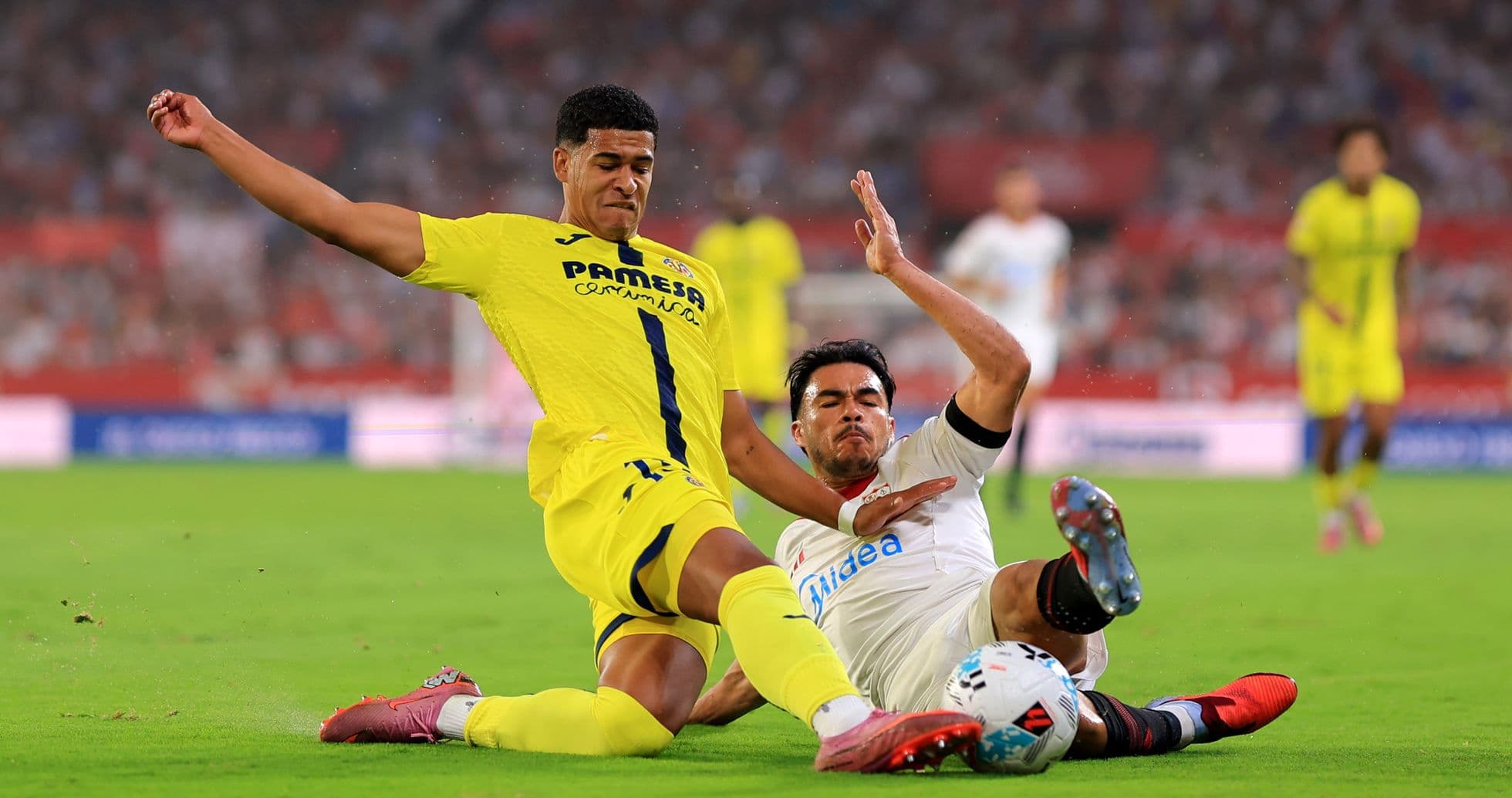
Their target was a “shield” that had leaked 34 away goals in 18 matches. Azpilicueta’s reading of the game, Salas’ aerial presence and Carmona’s aggression were tasked with compressing space between the lines. Carmona, who had committed 47 fouls and received 13 yellows, walked the fine line between intensity and recklessness; his duels with Mikautadze and Pepe were a running subplot, with the Georgian forward constantly trying to drag him into wide areas and 1v1s.
In midfield, the “engine room” confrontation was finely poised. D. Parejo’s role as metronome – supported by the vertical energy of P. Gueye and the line-breaking runs of A. Moleiro (10 goals, 5 assists, 36 key passes) – met the steel and structure of L. Agoume and D. Sow. Agoume’s season numbers told the story: 66 tackles, 47 interceptions, 281 duels with 145 won, but also 54 fouls committed and 10 yellows. He was Sevilla’s enforcer, tasked with stepping into Parejo’s passing lanes and clipping Villarreal’s transitions at source.
R. Vargas was the creative hinge in Sevilla’s 5-3-2. With 6 assists and 25 key passes in total this campaign, his job was to exploit the spaces left by Villarreal’s adventurous full-backs. Every time Pedraza or Freeman advanced, Vargas drifted into the half-spaces, looking to release A. Adams. Adams, with 10 goals, 3 assists and 3 penalties scored from 3 attempts, brought power and penalty-box instincts; his duels with P. Navarro and Renato Veiga were brutally physical, as he tried to pin one centre-back and attack the channel between them.
Statistical Prognosis and Tactical Verdict
On paper, the numbers pointed toward a high-event contest. Villarreal’s total averages of 1.9 goals for and 1.2 against per game, combined with Sevilla’s 1.3 for and 1.6 against, hinted at a match where both xG profiles would be healthy. Villarreal’s 5 failed-to-score games in total this campaign contrasted with Sevilla’s 8; the home side almost always create, especially at La Cerámica.
Defensively, Villarreal’s 8 clean sheets overall and Sevilla’s 6 suggested that neither side is built primarily to shut games down. Sevilla’s away concession rate of 1.9 goals per match, coupled with Villarreal’s 2.4 goals scored at home, made a multi-goal home xG outlook almost inevitable. Conversely, Villarreal’s tendency to open up – 25 goals conceded away but 18 at home – meant Sevilla’s counter-attacking 5-3-2 had a realistic path to chances, especially via Adams’ movement and Vargas’ service.
Following this result, the story is of Sevilla finally aligning their tactical plan with their underlying potential. They accepted suffering without the ball, trusted a back five that has often been porous on their travels, and leaned into the ruthlessness of Adams and Maupay. Villarreal, for all their attacking quality and the season-long excellence of Mikautadze, Moleiro and Pepe, were undone by the very openness that has made them so thrilling.
From an xG and defensive solidity perspective, this 3-2 away win feels like a classic case of efficiency beating volume: Villarreal likely accumulated the greater shot volume and territorial dominance, but Sevilla’s compact 5-3-2, anchored by Agoume’s interventions and Carmona’s edge, turned fewer, clearer chances into a season-defining scalp.