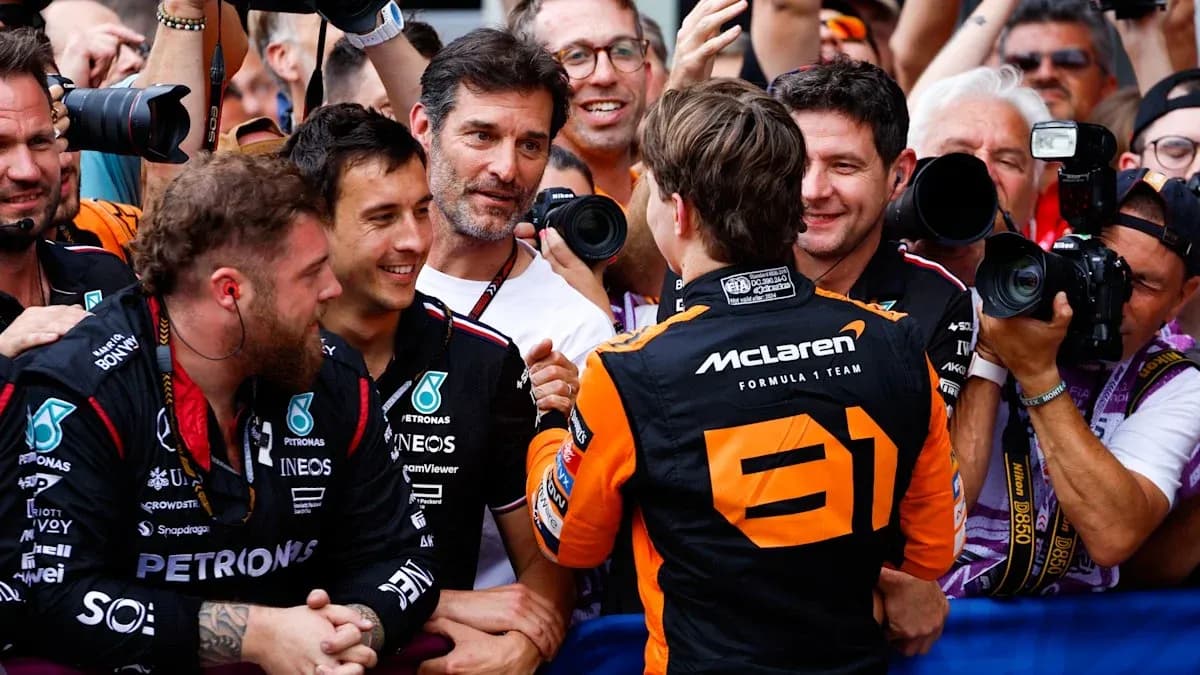
Webber and Piastri End Their Partnership: A New Chapter
For seven years, Mark Webber stood in Oscar Piastri’s corner – mentor, manager, shield and sounding board. Now, that partnership is over, and the timing could hardly be more intriguing.
The split from Webber’s JAM Sports Management, confirmed after a gradual scaling back of responsibilities this season, ends one of the most distinctive alliances in modern Formula 1. This wasn’t just a former driver offering the odd bit of advice. It was a full‑scale, hands-on project that helped turn a promising Australian junior into a multiple grand prix winner and genuine title contender.
That chapter has closed. The consequences will play out in public.
From Junior Prodigy to Grand Prix Winner
Piastri’s rise through the ranks was as clean and ruthless as any in recent memory. F3 champion in his rookie season. F2 champion in his rookie season. Straight into Formula 1 with a blueprint that had Webber’s fingerprints all over it.
Behind the scenes, JAM Sports Management – founded by Webber, his wife Ann Neal and administrator Jason Allen in 2019 – did far more than handle contracts and appearances. Webber’s voice carried the weight of experience from his own F1 career, while Neal, the architect of Webber’s path to the grid in 2002, brought a deep European network and a fiercely protective approach.
Piastri has often spoken about how much he leaned on Webber in those early F1 seasons. Not just for driving tips, but for how to survive – and thrive – in the political, relentless world of the paddock. Webber helped flatten some of the brutal learning curves that usually punish young drivers. Piastri skipped a few of those.
As his results came, the partnership looked like a masterstroke.
A Quiet Step Back Becomes a Full Break
The first signs of change surfaced at the start of this season. Webber, once a constant presence in the McLaren garage, eased away from regular trackside duties. He shifted his focus more towards Piastri’s commercial portfolio, leaving others to take on a bigger role around the car.
Into that space stepped familiar faces: Pedro Matos, Piastri’s race engineer from his Formula 2 days, and performance coach Emma Murray, a respected figure who has worked with some of Australia’s top athletes including Dustin Martin, Scott McLaughlin and Cate Campbell. They became more prominent voices in his race-weekend preparation.
In today’s paddock, most drivers sit under sprawling agencies that split responsibilities across commercial, legal, media and sporting departments. Webber and Neal were the exception – a tight, almost old‑school operation that handled almost everything with a personal touch. Neal’s involvement, in particular, made the model work: she’d already spent seven years grinding through Europe to get Webber to F1. She knew every lever to pull.
Now, that structure has been dismantled. The two camps have fully dissolved the partnership. For a driver still in the formative years of his F1 career, that’s a major reset.
A Dip in Form at the Worst Possible Time
The timing is impossible to ignore. Piastri’s trajectory had pointed one way: up. After breaking into championship contention in just his third season, the expectation was clear – this year he would go after Lando Norris for top billing at McLaren.
That hasn’t happened.
The 2026 campaign has turned into a grind. Since Webber reduced his trackside role, Piastri’s form has slipped, and the numbers are stark. He sits seventh in the drivers’ standings, under pressure from Red Bull’s Isack Hadjar, who is closing in behind.
His last win remains the 2025 Dutch Grand Prix. This year, he has climbed onto the podium only twice, and not at all since the Miami Grand Prix in May. For a driver tipped to make the final step into regular race‑winning territory, that’s a glaring stall.
Across the garage, Norris has surged back to life under the new engine regulations. His hard-fought victory in Brazil – his third of the season – has lifted him to sixth in the championship, just 33 points off Max Verstappen in second. On paper, the gap between the McLaren teammates is only one position. In reality, it’s far wider.
Norris leads Piastri by 94 points. His average finishing position in grands prix is 4.1; Piastri’s is 6.8. In all races this season, Norris holds a 16–4 advantage head-to-head.
For a driver who was supposed to be tightening the screw on his teammate, those are uncomfortable figures.
Life Without Webber’s Shield
The split from JAM doesn’t change Piastri’s contract security. He is locked in with McLaren until the end of 2028. There’s no immediate scramble over his seat or his future.
The real impact lies elsewhere.
Webber’s management style was famously protective of Piastri’s time and energy away from the circuit. In a calendar that stretches drivers to breaking point, that buffer matters. McLaren controls much of his race-weekend schedule, but Webber and Neal controlled what happened in the margins – the sponsor demands, the media obligations, the endless requests that can slowly drain a driver.
A new team around him will mean a new philosophy. Perhaps more exposure, perhaps a different commercial focus, certainly a different way of managing the noise that surrounds every front-running F1 driver.
On the sporting side, Piastri now leans more heavily on his in-garage circle. His understanding of F1 grows with every season; the need for Webber’s racecraft input naturally diminishes as he builds his own. That’s the normal evolution for any driver who graduates from prodigy to established contender.
But the safety net has gone. The dynamic that helped guide him through F3, F2 and the early F1 years is no longer there.
A New Phase for a Driver Under Pressure
Piastri has not yet revealed his new management structure. That silence is telling in its own way. With his long-term McLaren deal in place, there is no rush to negotiate fresh contracts, but there is a clear need to rebuild the framework around him.
Webber’s role in getting Piastri to this point is undisputed. The McLaren driver knows it, and has never shied away from acknowledging it. Yet elite sport moves quickly, and sentiment doesn’t protect you from the stopwatch.
A challenging season, a widening gap to Norris, a major off-track reshuffle: this is the first genuine stress test of Piastri’s F1 career.
The next question is simple and unforgiving: without Webber in his corner, can he turn this into the moment he truly stands on his own?