West Ham's Dominance Over Wolves: A Tactical Analysis
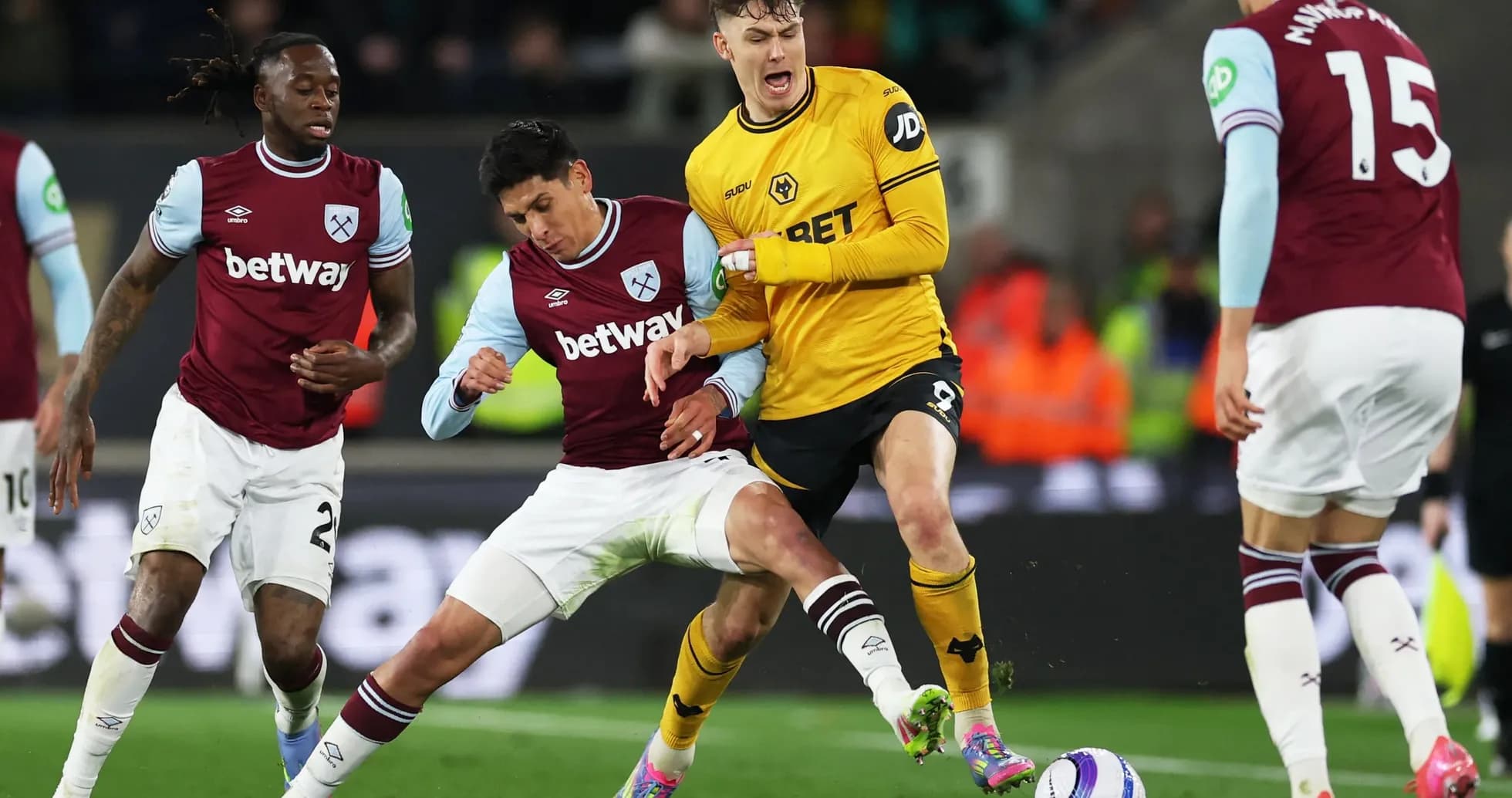
West Ham’s 4-0 dismantling of Wolves at the London Stadium was a textbook example of how to weaponise verticality and set-piece power against a possession-heavy opponent. In a Premier League Round 32 fixture, West Ham accepted a 44% share of the ball, but turned 18 shots and 2.35 xG into four unanswered goals, with centre-back Konstantinos Mavropanos and striker Valentín Castellanos each scoring twice. Wolves, despite 56% possession and cleaner passing (86% accuracy), produced only 0.59 xG and were repeatedly exposed in defensive transitions and dead-ball situations.
The disciplinary tone was set early. At 9', Jean-Ricner Bellegarde received a yellow card for a foul, a small but telling sign of Wolves’ difficulty containing West Ham’s midfield runs. At 20', Yerson Mosquera followed with a yellow for argument, reflecting growing frustration rather than tactical aggression. West Ham’s only first-half card came at 31', when Mateus Fernandes was booked for a foul, but the hosts managed their aggression better and rarely looked destabilised.
The breakthrough arrived at 42'. From another well-worked attacking pattern, K. Mavropanos surged into the box and finished a move assisted by J. Bowen, giving West Ham a 1-0 lead that accurately reflected their superior chance quality despite Wolves’ territorial edge. The halftime score stood at 1-0 to West Ham.
After the interval, West Ham’s forward line became more direct and combative. At 52', Valentín Castellanos went into the book for a foul, underlining his physical approach in duels with the Wolves back three. Wolves then sought to reset their attacking structure with a double change at 61': Rodrigo Gomes (IN) came on for A. Gomes (OUT), and Mateus Mané (IN) came on for J. Bellegarde (OUT). The intent was to refresh the half-spaces and add penetration behind Adam Armstrong.
Instead, West Ham ruthlessly exploited the transitional chaos. At 66', T. Castellanos converted from close range after a contribution from Pablo, doubling the lead at a key psychological moment. Two minutes later, at 68', Castellanos struck again, this time finishing another incisive move assisted by J. Bowen. The 3-0 scoreline effectively killed the contest and highlighted West Ham’s superior efficiency in the final third.
Wolves responded with more attacking substitutions at 71'. Hee-Chan Hwang (IN) came on for A. Armstrong (OUT), adding a more mobile threat, while Tolu Arokodare (IN) replaced Y. Mosquera (OUT), reshaping the forward line and back line simultaneously. Yet the structural issues in Wolves’ rest defence persisted.
West Ham then moved into game-management mode. At 78', Adama Traoré (IN) came on for C. Summerville (OUT), adding direct counter-attacking speed on the flank, while Freddie Potts (IN) replaced Pablo (OUT), bringing fresh legs into midfield to maintain compactness and pressing intensity. At 82', Callum Wilson (IN) came on for T. Castellanos (OUT), a like-for-like change to preserve vertical threat while rewarding Castellanos’ brace.
Any faint Wolves hopes were extinguished at 83', when K. Mavropanos scored again, this time unassisted, to make it 4-0. His second goal underlined West Ham’s aerial and set-piece dominance against a Wolves back three that never solved the physical mismatch. At 85', Soungoutou Magassa (IN) replaced M. Fernandes (OUT), further solidifying central areas. Wolves made a late change at the same minute, with T. Edozie (IN) entering for an unspecified outgoing player, a final roll of the dice that had no tactical impact on the outcome.
Tactical Overview
Tactically, West Ham’s 4-4-1-1 was built on a clear spine. Mads Hermansen made 4 saves, comfortably dealing with Wolves’ limited on-target attempts and benefitting from disciplined protection by the back four. The full-backs, Kyle Walker-Peters and El Hadji Malick Diouf, balanced conservative starting positions with selective overlaps, ensuring that Wolves’ wing-backs, Hugo Bueno and Jackson Tchatchoua, rarely found clean 2v1s wide.
The centre-back pairing of Axel Disasi and Konstantinos Mavropanos was decisive. Defensively, they dominated aerial duels and front-foot interceptions against Armstrong and later Hwang/Arokodare. Offensively, Mavropanos’ two goals were the clearest expression of West Ham’s set-piece and second-phase threat, turning Wolves’ zonal structures into liabilities.
In midfield, Tomáš Souček and Mateus Fernandes formed a robust double axis. Souček’s late runs and second-ball dominance underpinned West Ham’s ability to spring quick attacks, while Fernandes, despite his yellow card, balanced ball-winning with simple, forward-minded passing. Out wide, Jarrod Bowen and Crysencio Summerville stretched Wolves horizontally; Bowen’s two assists confirmed his role as the primary creative outlet, repeatedly exploiting the spaces around Wolves’ outside centre-backs.
Ahead of them, Pablo operated between the lines, linking midfield to Castellanos and creating the conditions for vertical combinations. Castellanos’ brace and yellow card encapsulated his performance: aggressive pressing, constant duelling, and ruthless finishing once chances arrived. The substitutes—Traoré, Potts, Wilson, and Magassa—were all integrated with clear roles: maintain counter-threat, secure central control, and protect the clean sheet.
Wolves’ Structure
Wolves’ 3-5-1-1, by contrast, looked structurally sound in possession but fragile once the ball was lost. José Sá made 3 saves but had little protection on key moments, particularly against set-pieces and fast breaks. The back three of Mosquera, Santiago Bueno, and Ladislav Krejčí struggled to track late runs from deep and were repeatedly pulled into wide channels by Bowen and Summerville, opening central lanes for Castellanos and Pablo.
In midfield, André and João Gomes provided volume of passes but limited progression, reflected in Wolves’ 456 passes at 86% accuracy translating to just 0.59 xG. The wing-backs offered width but rarely delivered decisive final balls, and the advanced roles of Angel Gomes and Adam Armstrong never fully connected with the rest of the structure. The substitutions added energy but not clarity; Wolves finished with more forwards on the pitch but no coherent mechanism to break West Ham’s compact 4-4-1-1 block.
Statistically, the verdict aligns with the scoreline. West Ham generated higher xG (2.35 to 0.59), more shots (18 to 14), and more efforts on target (7 to 3), despite having less of the ball. Their 81% passing accuracy on 355 passes was sufficient given the vertical game plan, while Wolves’ superior possession and accuracy lacked penetration. Fouls (11 by West Ham, 7 by Wolves) and yellow cards (2 each: Bellegarde, Mosquera; Fernandes, Castellanos) were evenly spread, but West Ham’s Overall Form in this match—defined by efficiency, structure, and ruthlessness—was clearly superior. Defensively, West Ham’s Defensive Index was strong: a clean sheet, 4 saves from Hermansen, and almost no high-quality chances conceded, whereas Wolves’ defensive metrics reflected a side repeatedly undone by set-pieces and transitions.