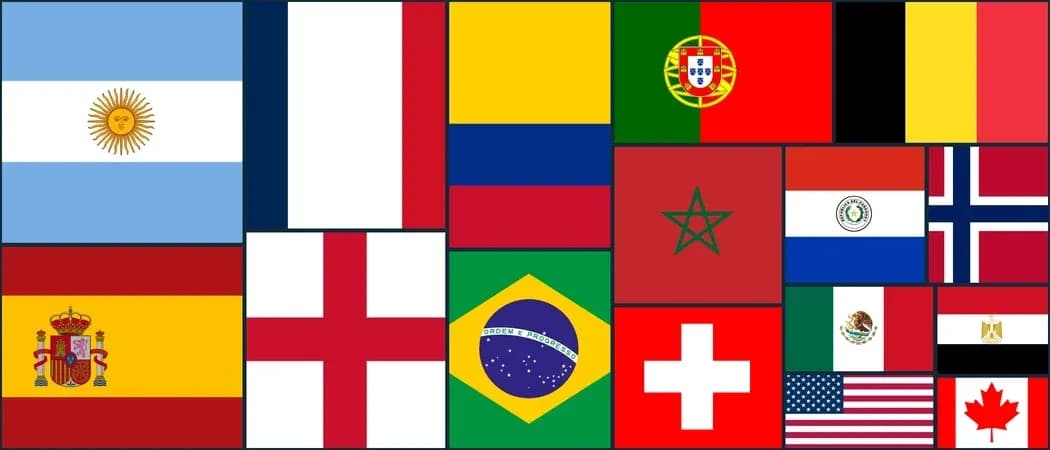
World Cup Last 16: Germany Out, England Faces Mexico
Six days, sixteen matches, and half the World Cup has been stripped away. The field of 32 has been cut to 16, and it took a genuine heavyweight to remind everyone that no favourite is safe.
Germany are out. On penalties. To Paraguay.
The numbers had them at roughly a 63% chance of going through, the kind of probability that usually sees the bigger nation walk on. Instead, the South Americans held their nerve in the shoot-out and detonated the biggest shock of the first knockout round. Had Senegal clung on against Belgium, that would have ranked right alongside it. They didn’t, and so Germany’s exit stands alone as the defining upset so far.
Morocco’s win over the Netherlands felt like a surprise to the naked eye, but the data had it closer to a coin toss. Elo ratings put the Dutch at only about 55% to progress – a marginal edge, not a mismatch. It was one of the round’s more balanced ties, and it played out that way.
Some of the supposedly one-sided contests produced the fiercest drama. Cape Verde, given only a 10% chance of knocking out holders Argentina, dragged Lionel Scaloni’s side all the way to extra time. Congo, rated at just 17% to upset England, led with a quarter of an hour to go before finally being reeled in. The pre-match probabilities said “routine.” The matches themselves refused to listen.
Familiar faces, long odds for the outsiders
The last 16 has a very familiar shape. All Asian teams are gone. All but two African sides have been eliminated. Once again, Europe and South America dominate the business end of the World Cup.
The outliers are clinging on: Canada, Egypt, Mexico, Morocco and the United States are the remaining nations from outside the traditional power base. Romance, yes. Likely winners, no. Between them, their combined chance of lifting the trophy is only around 3.5%, according to the simulations.
At the top of the tree, Argentina survived that scare against Cape Verde but paid for it in the model. Their overall probability of winning the World Cup has dipped slightly to 28%. Part of that is performance, part of it is the shifting landscape: France have quietly cashed in on Germany’s exit.
With the Germans gone, France’s route looks a touch clearer. Their title chances have jumped to 14%, Spain’s to 16%. Both cruised through their last‑16 ties: Spain dealt comfortably with Austria, France did the same to Sweden. One more hurdle cleared, one step closer to the trophy.
England sit just behind that leading pack, now rated at 12%. That rise says as much about the shrinking field as it does about Gareth Southgate’s team. Brazil and Argentina still loom in their half of the draw, even if England first have to deal with a different kind of challenge.
England, Mexico and the thin air of Mexico City
Next stop: Mexico City. England against hosts Mexico in the altitude and heat of one of football’s great stages.
On paper, England are clear favourites. Even after allowing for home advantage, the expected goals model has Mexico at 0.6 xG and England at 1.6 – effectively a goal’s worth of superiority. That translates to a 62% chance of England winning inside 90 minutes, 13% for Mexico, and a 25% likelihood of a draw and penalties.
The debate, of course, is not about paper. It is about air.
Altitude has dominated the build-up. Can England cope with the thinner air, the different ball flight, the fatigue? Or is the fear of altitude bigger than the effect itself?
The data suggests the myth is louder than the reality. Looking across thousands of international matches played at different heights above sea level, the broad pattern is clear. Around a third of all games take place within 250 metres of sea level, where home teams win roughly 55% of the time. Between 250 and 750 metres, a band that covers about 6% of matches (close to 4,000 games), the numbers barely shift.
Even at 2,000–2,250 metres – where Mexico City sits – the raw home‑win rate is about 52%, actually lower than at sea level.
Strip away the headline figure, though, and the picture sharpens. You have to control for who is playing there. The Economic Observatory’s Elo ratings, which track team strength and correlate closely with FIFA’s rankings, do that job. They assign a probability of a home win from 0 to 1, depending on the relative strength of the sides.
By comparing actual outcomes (home win coded as 1, anything else as 0) with those Elo expectations, you get a measure of how much home teams over‑ or under‑perform. Below around 1,750 metres, home sides win about as often as predicted. Above that, something starts to change.
Teams based at higher altitudes – Bolivia above 3,000 metres; Ecuador, Ethiopia and Mexico above 2,000 – tend not to be the global elite. Yet when they play at home in the thin air, they outperform their Elo‑based expectations. At the very highest levels, that over‑performance reaches about 20 percentage points.
Even then, the statisticians are cautious: that gap still sits within the margin of error. The evidence points to altitude offering an edge, but not an overwhelming one.
For England in Mexico City, that means no guaranteed disadvantage, no guaranteed immunity either. The hosts might get a nudge in their favour, especially with England having little time to acclimatise. If you assume altitude trims England’s expected goals by 0.25 and hands Mexico an extra 0.25, the picture tightens. England’s win probability drops to 48%, Mexico’s rises to 24%, with the rest left to the lottery of penalties.
Even under that harsher assumption, England remain the stronger side by every available metric: past results, Elo, even squad valuations from Transfermarkt. Altitude drags the contest towards the middle, but it does not flip it into a 50–50.
The rest of the last‑16 picture
Beyond Mexico City, the model draws a fairly clear map for the remaining ties.
- Argentina are rated 77% likely to beat Egypt.
- England, under the baseline assumptions, are 74% to progress past Mexico.
- Morocco are 70% favourites against Canada.
- Spain are given a 72% chance of knocking out Portugal.
- Colombia are 70% to go through against Switzerland.
- Brazil, at 69%, are expected to end Norway’s run.
- Belgium have a 64% edge over the United States.
- France, interestingly, are only at 62% to beat Paraguay.
That last figure jumps off the page. France have been free‑scoring, fluid and ruthless in front of goal. Paraguay have been the opposite: tight, disciplined, stubborn. Just as in the group‑stage preview of Group D, the South Americans’ defensive steel stands out.
The expected goals underline the tension. France are projected at only 1.1 xG in that match, Paraguay at 0.6. For a side that has cut through opponents with ease so far, that is a notable squeeze.
On paper, it is still France’s game to lose. On the pitch, it may be their hardest examination yet.