2026 World Cup Insights: Messi, Mbappe, and the Rising Stars
The 2026 World Cup is only just stretching its legs, but the tournament already feels like it’s in full sprint.
Lionel Messi is scoring in bunches at 39. Kylian Mbappe has slipped seamlessly back into his World Cup alter ego. Erling Haaland has arrived with the force everyone expected. And now Cristiano Ronaldo has thundered into the story with a ruthless display against Uzbekistan.
The expanded 48-team format? For now, the football has silenced the doubters. Cape Verde, Japan, Egypt and a clutch of lower-ranked sides have turned the group stage into a live audition for the sport’s future, proving this new shape can still deliver edge and jeopardy.
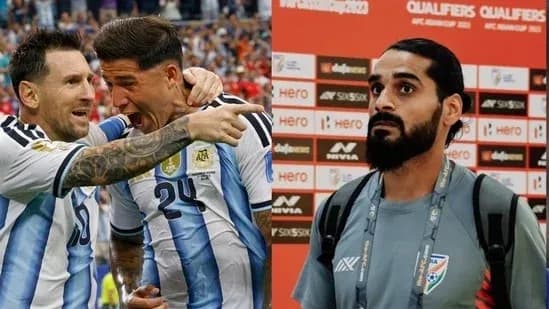
From his seat on the Zee5 expert panel, India defender Sandesh Jhingan has been watching it all unfold. Speaking to Hindustan Times Digital, he cut through the noise around the game’s biggest names and the tournament’s shifting power lines.
“He makes you feel like a kid again”
Messi is the obvious starting point. Five goals in two games, hat-tricks, braces, the whole thing looking suspiciously like a man refusing to let go of his stage.
“I think it’s incredible, first of all, to have that longevity and that consistency,” Jhingan said. For him, the real miracle is not a single night of genius, but the ability to repeat it, year after year. “The greatest talent you can have is to have that consistency, performing at such a high level… and having the longevity with it.”
He spoke like a fellow professional who understands the grind behind the magic, but his tone changed when he described the emotional pull. Jhingan recalled a visual from the Zee studio: a 100-year-old woman in the stands, utterly absorbed in Messi.
“When you watch Messi, it gives you that feeling of being a kid,” he said. In his mind, that centenarian must have felt “like a 10-year-old watching him play.” That, to him, is the essence of Messi: not just numbers, but pure, disarming joy.
The platform behind the genius
Messi’s fireworks tend to dominate the cameras, yet Jhingan’s eye went straight to the scaffolding behind the show. Argentina have not conceded a goal so far; they look like champions who remember exactly why they became champions.
“The reason Messi is doing so well is because the team’s shape and compactness are so good,” he explained, shifting the spotlight towards Lionel Scaloni and his staff. The praise was specific: this is a coaching group that adapts to its players, not the other way around.
Argentina, he noted, can drop deep, sit in a mid-block, or step higher, but the common thread is organisation. That structure pushes Messi higher up the pitch, frees him from the dirtiest defensive work and lets him live where it hurts opponents most.
The understanding is simple and ruthless. “The defenders and midfielders know their job is to win the ball back and get it to Messi because they trust that he can create something special.” That trust, Jhingan believes, feeds the entire squad’s confidence.
Reliant on Messi? “I wouldn’t mind”
Lautaro Martinez ran himself into the ground against Austria, pressing, tracking, linking play, stretching the back line. Still, the familiar criticism has surfaced: do Argentina lean too heavily on their No. 10?
Jhingan didn’t bother dressing it up. If he were an Argentina player or fan, he said, he “wouldn’t mind being called reliant on Messi as long as the team is winning.”
For him, the accusation misses the point. Argentina are not a one-man show; they are a hard, disciplined unit built to maximise their genius. Organisation, defensive discipline, compactness – these are not background details, they are the engine.
“They know when to sit back, how to hunt the ball together, and how to create the right conditions for Messi and the other attacking players to decide games,” he said. The evidence is on the table: they are winning, they are already through, and every player seems to understand his role. Jhingan reserved special credit for the coaching staff for designing that system.
Mbappe and the weight of history
If Messi is defending a crown, Mbappe is chasing a dynasty. At 27 or 28, with a World Cup already in his pocket and a mountain of goals, the Frenchman is being dragged into debates usually reserved for Messi and Ronaldo.
“With his goals and his numbers, it’s incredible,” Jhingan admitted. But he drew a clear line: to step into the true “greatest” bracket, Mbappe must sustain this level for a very long time.
“Everyone will have that judgment with Messi and Ronaldo now, because they are the pillars, or they are the standard,” he said. Mbappe, in his eyes, has “all the credentials” – the talent, the numbers, the big-game temperament. The question is not ability, but endurance: how motivated he stays, how fit he remains, how he handles the grind of years.
One thing already stands out to Jhingan: “Whenever the World Cup is there, that guy just brings an extra level.” From 2018 to 2022 and now again, Mbappe has treated the World Cup like his personal stage. “That’s the sign of a big player,” Jhingan said. On the biggest stage, the best don’t shrink. They sharpen.
Lamine Yamal and the defender’s dilemma
The World Cup has also thrown up a new kind of problem for defenders: Lamine Yamal, a teenager who seems to treat full-backs as invitations.
“If you’re in a one-on-one situation with Lamine, most of the time he’s going to get past you because that’s his biggest quality,” Jhingan admitted, with the candour of someone who has lived that nightmare on the pitch. Yamal, in his eyes, is one of those rare players “you pay to watch.”
From a defender’s perspective, the trap is obvious. If you frame the duel as a personal war – you versus him – you’ve already lost. “You can defend a striker or winger perfectly for 90 minutes, but one shot, one deflection, and the headlines say he won the battle.”
Jhingan’s approach is colder, more collective. The job is not to win every tackle; it is to shrink the game around the danger. Keep the team compact. Limit the spaces he receives in. Cut the supply at source. That means midfielders and forwards pressing, the back line holding high, the whole unit moving as one.
“Of course, he will get opportunities,” he said. The goal is not to erase them. It is to reduce them to a minimum and live with the rest.
Ronaldo, the spotlight and the armchair debate
No World Cup is complete without a Ronaldo argument. At 39, his every touch is dissected, his every miss rolled into a wider narrative about age and decline. Some voices have even called for him to be benched.
Jhingan didn’t tiptoe around that. “I’m going to give a bold statement,” he said, before delivering it: this debate, in his view, mostly comes “from the ones who never played professional football, or… never played much of it professionally.”
Opinions are inevitable, but the only one that counts is Roberto Martinez’s. “He’s the head coach. If he thinks he’s good enough, he will play.”
The scrutiny, Jhingan argued, is the price of being Cristiano Ronaldo – and, by extension, Messi. If the rival scores and you don’t, the conversation instantly turns to age, legs, mileage. The context – club form, qualifying goals, league scoring charts – gets pushed aside.
At club level, Jhingan pointed out, Ronaldo “scored a lot,” including finishing as top scorer in the Saudi league, and he “scored many goals in the qualifiers, also.” Those numbers tend to vanish from the discourse when the spotlight narrows to a single 90 minutes.
Golden Boot shootout
With the group stage still young, the Golden Boot race is already shaping into a heavyweight contest. Jhingan sees a familiar cast at the front of the pack.
“I think it could be between Messi and Mbappe,” he said, acknowledging that two games is a small sample, but also that Messi’s five-goal “healthy lead” counts for plenty. Haaland, he added, belongs firmly in that conversation as well – exactly the trio the world wanted to see firing.
And Ronaldo? Jhingan expects a response. He predicted the Portugal captain would “open his account… in a big way” once again, just as the noise around him swells. The pattern is familiar: doubt him loudly enough, and he tends to answer on the pitch.
“It’s going to be a tight race,” Jhingan said. Messi, Mbappe, Haaland, Ronaldo – four giants chasing one prize. For the rest of us, that means “more goals, more fun, more excitement.”
Heart with Japan, eyes on Argentina
When the conversation turned to potential champions, Jhingan didn’t pretend to be neutral.
“I’m going to be biased. I’m going to root for Japan,” he admitted with a smile. The Asian side have already been one of the tournament’s bright sparks, and for an Indian defender watching from the studio, their rise carries extra resonance. “I want them to go as high as they can.”
He knows the established powers are looming – “of course, Argentina and all are there” – but he is unapologetic about backing an Asian team to crash the party.
In a World Cup lit by Messi’s late-career brilliance, Mbappe’s relentless surge, Haaland’s raw power and Ronaldo’s refusal to leave quietly, Jhingan’s hope for Japan adds another strand to a tournament already bursting with storylines.
The giants are awake. The outsiders are fearless. How long before one of them tears up the script?