AC Milan W vs Parma W: Serie A Women's Match Analysis
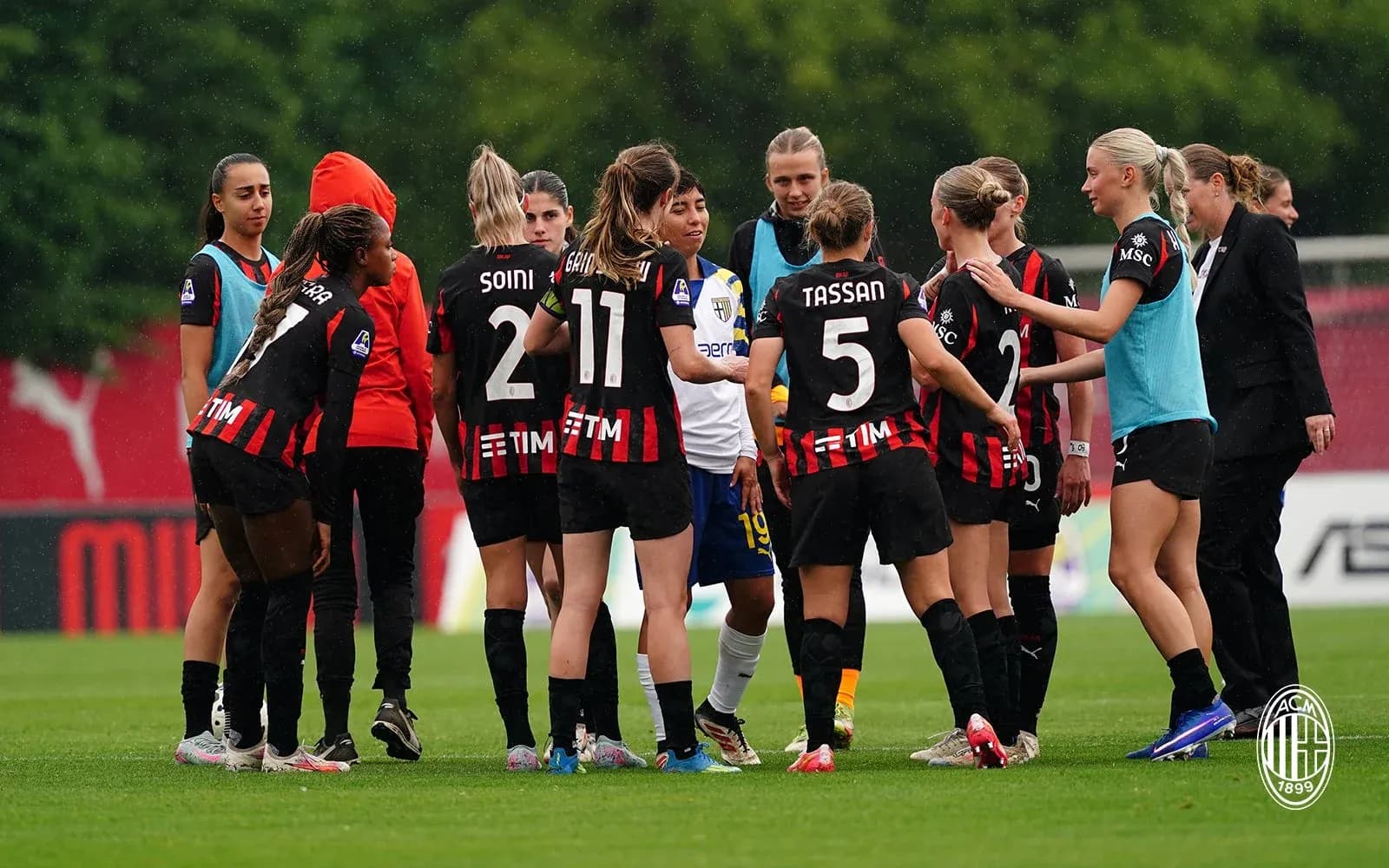
The Centro Sportivo Peppino Vismara felt like a pressure valve finally hissing open. Following this result, a 3–1 home win for AC Milan W over Parma W in Serie A Women’s Regular Season - 21, the league table and the season’s underlying numbers both seemed to click into place. Sixth-placed Milan, on 32 points with a goal difference of +6 overall (31 scored, 25 conceded), looked exactly like the side their metrics have hinted at: flawed but forceful, especially in front of their own fans. Tenth-placed Parma, stranded on 16 points with a goal difference of -13 overall (15 scored, 28 conceded), again played their familiar role: organised, combative, but ultimately too blunt and too fragile late on.
I. The Big Picture – Milan lean into their DNA
Across the season, Milan’s attacking profile has been clear. Overall they average 1.5 goals per game, rising to 1.6 at home, powered by a striking late-game surge: 35.48% of their league goals arrive between 76-90 minutes. Even before this match, that pattern framed them as a side that grows into contests, wearing opponents down rather than blowing them away early.
Defensively, they have been solid rather than watertight, conceding 1.2 goals per game overall, 1.4 at home. The vulnerability is again back-loaded: 32.00% of their goals against come in that same 76-90 window. Milan live on a knife edge in the closing stages – but they also thrive there.
Parma came into the fixture with a very different attacking DNA. Overall they score just 0.7 goals per game, and on their travels that falls dramatically to 0.2 goals per match: 2 away goals in 11 games. Their minute distribution suggests they can strike in bursts – 21.43% of their goals come in each of the 0-15, 46-60, and 76-90 ranges – but the volume simply is not there. The defensive record, 1.3 goals conceded per game overall and 1.3 away, is respectable for a side in 10th, but again the late-game pattern is damning: 37.93% of goals against arrive in the 76-90 period.
This match, then, was always likely to be decided in the final quarter-hour, where Milan’s attacking peak collides directly with Parma’s defensive weakness.
II. Tactical Voids and Discipline – Edges in the margins
There were no listed absences in the data, so both coaches could lean into their preferred identities. Suzanne Bakker’s Milan have mostly lined up in a 4-3-3 this season (10 league games in that shape), with occasional detours into 4-1-4-1 and 4-2-3-1. Even without a formation graphic for this specific fixture, the starting cast tells its own story: L. Giuliani in goal, a back line anchored by M. Keijzer, E. Koivisto and A. Soffia, and a midfield platform featuring G. Arrigoni and M. Mascarello, with C. Grimshaw pushing on from the middle.
Giovanni Valenti’s Parma, by contrast, are wedded to back-three structures. Across the season they have used variations like 3-4-2-1, 3-4-3 and 3-5-1-1, seeking compactness and counter-attacking width. The presence of C. Ambrosi, D. Cox and M. Gueguen among the starters, flanked by players such as C. Minuscoli and I. Rabot, fits that template.
Discipline is a crucial subplot for both. Milan’s season-long yellow-card distribution shows a late spike: 31.58% of their bookings come between 76-90 minutes, mirroring the emotional intensity of their late surges. Red cards are scattered across 46-90 minutes, with one dismissal in each of the 46-60, 61-75 and 76-90 ranges. C. Dompig and K. van Dooren both carry season reds, and defender M. Keijzer has also seen one; this is an aggressive, front-foot side that flirts with the line.
Parma’s disciplinary profile is even more telling. M. Uffren leads the league charts for yellow cards with 7, the heartbeat of a midfield that tackles hard (32 tackles, 34 interceptions, 3 blocked shots) and accepts the consequences. As a team, Parma’s yellow cards spike at 76-90 minutes (29.17%), and their only red card of the campaign also arrives in that window. Uffren has even missed a penalty this season, underlining how fine their margins are in key moments.
In a game that finished 3-1, those margins – the late bookings, the tired legs, the willingness to foul – inevitably shaped the rhythm of the second half, even if the data does not list individual cautions for this specific fixture.
III. Key Matchups – Hunter vs Shield, Engine Room vs Enforcer
The clearest “Hunter vs Shield” narrative belongs to Milan’s top scorer K. van Dooren against Parma’s defensive structure. Van Dooren’s league line – 5 goals from 18 shots (12 on target), with 242 passes at 78% accuracy and 8 key passes – paints her as a hybrid between goal threat and advanced playmaker. Her presence on the bench here gave Bakker a potent in-game lever: a late injection of shooting quality and vertical passing against a Parma side that concedes heavily just when she tends to come alive.
That dovetails perfectly with Milan’s late scoring surge and Parma’s late defensive collapse. When a side that scores 35.48% of its goals from 76-90 can turn to a finisher with van Dooren’s numbers against a defence that ships 37.93% of its goals in that same period, the matchup is brutally tilted. The 3-1 scoreline feels like the logical expression of that imbalance.
In the “Engine Room” duel, Milan’s C. Grimshaw and M. Mascarello squared off against Parma’s M. Uffren and C. Prugna. Grimshaw’s season profile – 1 goal, 2 assists, 11 key passes, 81 duels with 35 won – shows a midfielder who connects lines and arrives in advanced pockets. She also defends with bite, with 11 tackles and 4 blocked shots. Mascarello, meanwhile, is Milan’s metronome: 368 passes at 77% accuracy, 15 key passes and 4 yellow cards, a player who dictates tempo but is not shy about tactical fouls.
Uffren, on the other side, is Parma’s enforcer and organiser. Her 512 passes at 82% accuracy and 11 key passes show that she is more than just a destroyer, but the 24 fouls committed and 7 yellows tell you she is happy to break play when required. Her missed penalty this season is a painful footnote: even when she advances into decisive zones, Parma’s execution often deserts them.
In this match, Milan’s midfield trio had the advantage of structure and momentum. With Grimshaw and Mascarello supported by G. Arrigoni, they could circulate the ball, drag Parma’s three centre-backs wide and open channels for runners like S. Stokic, T. Kyvag and Dompig. Parma’s 3-4-x shapes, reliant on wing-backs such as Minuscoli and Rabot to cover huge distances, were always at risk of being stretched once the game broke open.
IV. Statistical Prognosis – Why 3-1 fits the numbers
Even without explicit xG values, the season data allows a clear prognosis of what this 3-1 means. Milan’s overall goal difference of +6 (31 for, 25 against) after 21 games is the profile of a side whose underlying chance creation and prevention are broadly positive. Their 7 clean sheets and 7 games failed to score suggest volatility, but when they do click, the ceiling is high – as shown by biggest wins of 3-0 at home and 0-3 away.
Parma’s -13 goal difference (15 for, 28 against), combined with 11 games failed to score and only 2 away goals all season, points to a chronic attacking shortfall. Their four away clean sheets show that on some days their defensive block and goalkeeper can hold up, but their biggest away defeat, 4-0, hints at what happens when that block is repeatedly asked to bend.
Overlay that with the late-game distributions and disciplinary tendencies, and a 3-1 Milan win looks like a textbook outcome. Milan, with their 1.6 home goals per game and heavy 76-90 scoring bias, are built to overwhelm a side like Parma once fatigue and pressure accumulate. Parma, conceding heavily late and relying on a midfield that fouls often and already carries cards, are structurally vulnerable to exactly the kind of surge that Bakker’s side delivered.
Following this result, the table hardens around a familiar story: Milan as upwardly mobile disruptors in sixth, Parma as survival scrappers in tenth. The match at Peppino Vismara did not rewrite anyone’s identity; it simply amplified what the numbers have been whispering all season.