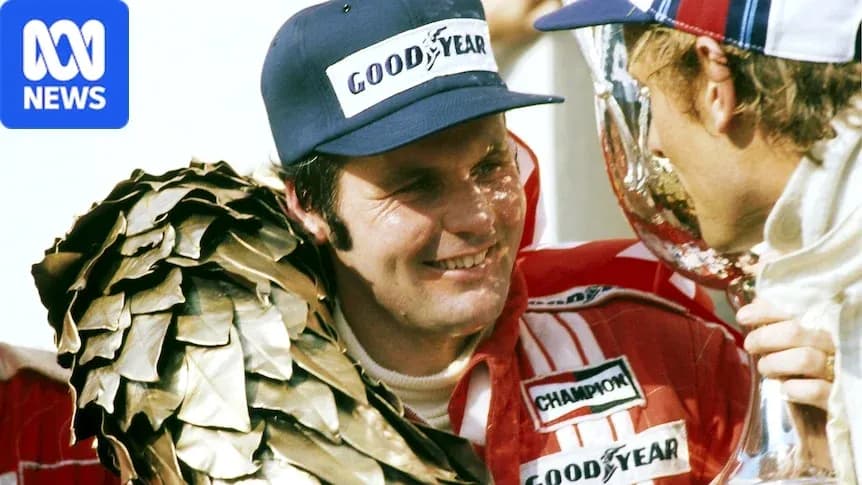
Alan Jones' Historic Win at the 1977 Austrian Grand Prix
The engines howled on the grid at the 1977 Austrian Grand Prix, 24 cars straining against the brakes, the mountains echoing with noise and expectation.
On pole sat Niki Lauda, the iron-willed hometown hero, barely a year removed from the inferno at the Nürburgring that had burned his face and very nearly taken his life. Beside that scarred, implacable figure on the front row lurked James Hunt, all swagger and glamour, the charismatic Brit Lauda once admitted was the only man he ever envied.
Third was Mario Andretti, the American giant whose career would sprawl across motorsport history: an F1 world title, four IndyCar crowns, a Daytona 500. A grid loaded with star power, a script seemingly written for the big names.
Eleven places further back, barely noticed, sat Alan Jones.
He was 30, a Victorian who had joined the F1 season only months earlier, drafted in at Shadow after the death of Tom Pryce in South Africa. No aura, no mystique. Compared with Hunt’s rock-star magnetism and Lauda’s monastic focus, Jones looked almost out of place.
Overweight, some said. Laconic. Underprepared.
What he truly carried was something harder to package: unvarnished, unpretentious talent.
On that grey August afternoon in the Styrian hills, the bloke who once sold Holdens for his father at a suburban Melbourne dealership would detonate the established order with a drive that stunned Formula One.
The rain had passed but left a treacherous surface. Strategy split the grid in two: those gambling on slicks and those clinging to wet tyres. Lauda’s Ferrari floundered, struggling for grip as the field surged away. Andretti pounced, slicing past both Lauda and Hunt after a minor clash between the two title heavyweights.
Eyes followed the American as he powered clear. They also tracked Gunnar Nilsson, the Swede carving his way from 16th to second on wets, a charge that lit up the early laps.
Somewhere in that chaos, almost unnoticed, Jones crept forward.
From 11th to fourth, he threaded his Shadow through the spray and traffic on slick tyres, a bold call that many others had agonised over. He didn’t posture. He didn’t wave. He just drove, sharp and uncompromising.
As the clouds broke and the circuit dried, the early heroes paid the price. Nilsson’s wet tyres shredded and forced him to pit. Andretti’s Lotus gave up in spectacular fashion, its engine detonating along with his hopes of victory. That left Hunt at the front, Jones now looming in his mirrors.
Lauda, rearmed with fresh rubber and a car finally biting into the asphalt, began his familiar, relentless charge. He carved back through the field, up into third, turning the race into a three-way story: Lauda, Hunt, and the stocky Australian wedged between them.
Two global icons, the eventual leads in the Hollywood film Rush, were suddenly sharing the stage with a man who looked more like a suburban clerk than a future world champion. Jones didn’t care. He let the lap times do the talking.
Then the race flipped on a single, brutal moment.
Hunt’s McLaren erupted in sparks and flame, his car limping to a halt at the side of the track. Marshals dived in with extinguishers, swallowing the stricken machine in a cloud of white dust. From that haze emerged a new leader: Alan Jones, Shadow’s unfashionable outsider, now out front with Lauda hunting him down.
Jones did not flinch. He held his nerve, managed his tyres, and kept the Austrian at bay to take the chequered flag. It was his first grand prix victory. It was also the only win Shadow would ever taste in its eight-year F1 existence.
The team spilled onto the circuit, disbelieving, arms aloft. In the commentary box and over the PA, there was a scramble to put history into words. The announcer told the crowd, hesitantly, that this was Australia’s first Formula One victory in seven years.
“The first Grand Prix win for Alan Jones, and the first Grand Prix win for the hard-working Shadow team,” came the call.
“And, we think, the first Grand Prix win for Australia in seven years.”
Down in pit lane, the unassuming Australian suddenly stood at the centre of a storm of congratulations. With his then-wife Beverley tucked under one arm and a bottle of champagne in the other, Jones planted a big kiss on her, then – urged on by Bev – popped the cork and drank deep.
He was still grinning when he was hustled to the podium, draped in a golden wreath as a band struck up behind him. Out of that soundtrack came one of the most enduring – and ultimately inaccurate – tales Jones loved to tell about that day.
“[The win] was a bit of a surprise to everybody,” he later told Wide World of Sports co-host Daryl Eastlake.
“In fact they had trouble finding the Australian national anthem, so some drunk played Happy Birthday on a trumpet.
“That’ll give you an idea how prepared they were for me to win.”
The audio from Zeltweg tells a slightly different story. Trumpeters can be heard in the distance, belting out La Cucaracha and other tunes before finally launching into Advance Australia Fair as Jones accepted his trophy.
The official anthem of Australia at the time was still God Save the Queen, reinstated in 1976 after Gough Whitlam had introduced Advance Australia Fair in 1974. That imperial anthem never played.
Maybe, in the blur of champagne and disbelief, Jones mistook Advance Australia Fair for Happy Birthday. Maybe all he could recall were the snatches of La Cucaracha and the general brass-band chaos before he climbed onto the top step. Maybe he didn’t even recognise the tune that had briefly been the new anthem, then the old one, and would eventually become the new one again.
What cannot be disputed is what followed. Over the next few years, Formula One organisers would become intimately familiar with Australia’s anthem as Jones turned that Austrian bolt from the blue into a sustained, era-defining presence.
In the golden age of F1, when the sport revolved around larger-than-life figures and cinematic rivalries, Australia’s standard-bearer was a man who looked less like a movie idol and more like the bloke behind the counter at the local bank.
That, in the end, is the power of his legacy: understated, unpolished, unmistakably real – and enough to fill generations of Australian motorsport fans with a quiet, enduring pride.