Argentina Edges England in World Cup Semi-Final Showdown
Under the closed roof of Mercedes-Benz Stadium, the semi-final between England and Argentina unfolded as a collision of carefully constructed systems and individual genius. By the final whistle, the scoreboard read England 1–2 Argentina, a narrow margin that told only part of the tactical story.
I. The Big Picture: Two Perfect Runs Collide
Heading into this game, both sides had carved near-perfect paths through the World Cup. England arrived as Group L winners with 7 points and a goal difference of 4, built on 6 goals scored and 2 conceded in the group stage. Across the whole tournament, they had played 7 matches, winning 5, drawing 1 and losing just 1, with 14 goals for and 8 against overall. Their attacking profile was balanced: at home they averaged 1.8 goals scored and 1.3 conceded, while on their travels they produced 2.3 goals for and 1.0 against, for an overall scoring rate of 2.0 and 1.1 conceded.
Argentina’s numbers were even more ruthless. Group J was swept aside with 9 points, 8 goals for and 1 against, giving them a group-stage goal difference of 7. Overall, they had been flawless: 7 wins from 7, with 19 goals scored and 7 conceded. At home they averaged 2.8 goals for and 1.0 against; away they were scarcely less lethal with 2.5 scored and 1.0 conceded, for an overall attacking output of 2.7 and 1.0 conceded per match. It was a meeting of an efficient, evolving England with a relentless, battle-hardened Argentina.
The semi-final scoreline – 1–2 – fit the broader pattern: England again found the net, Argentina again found a way to score more.
II. Tactical Voids and Discipline: England’s Thin Margins
The first structural absence for England was not on the teamsheet but in the disciplinary column. J. Quansah, who had already collected both a yellow and a red card in just 117 tournament minutes, was suspended through a sports court decision. Thomas Tuchel responded by leaning into control rather than raw aggression, trusting a back four of R. James, J. Stones, M. Guehi and D. Spence in front of J. Pickford.
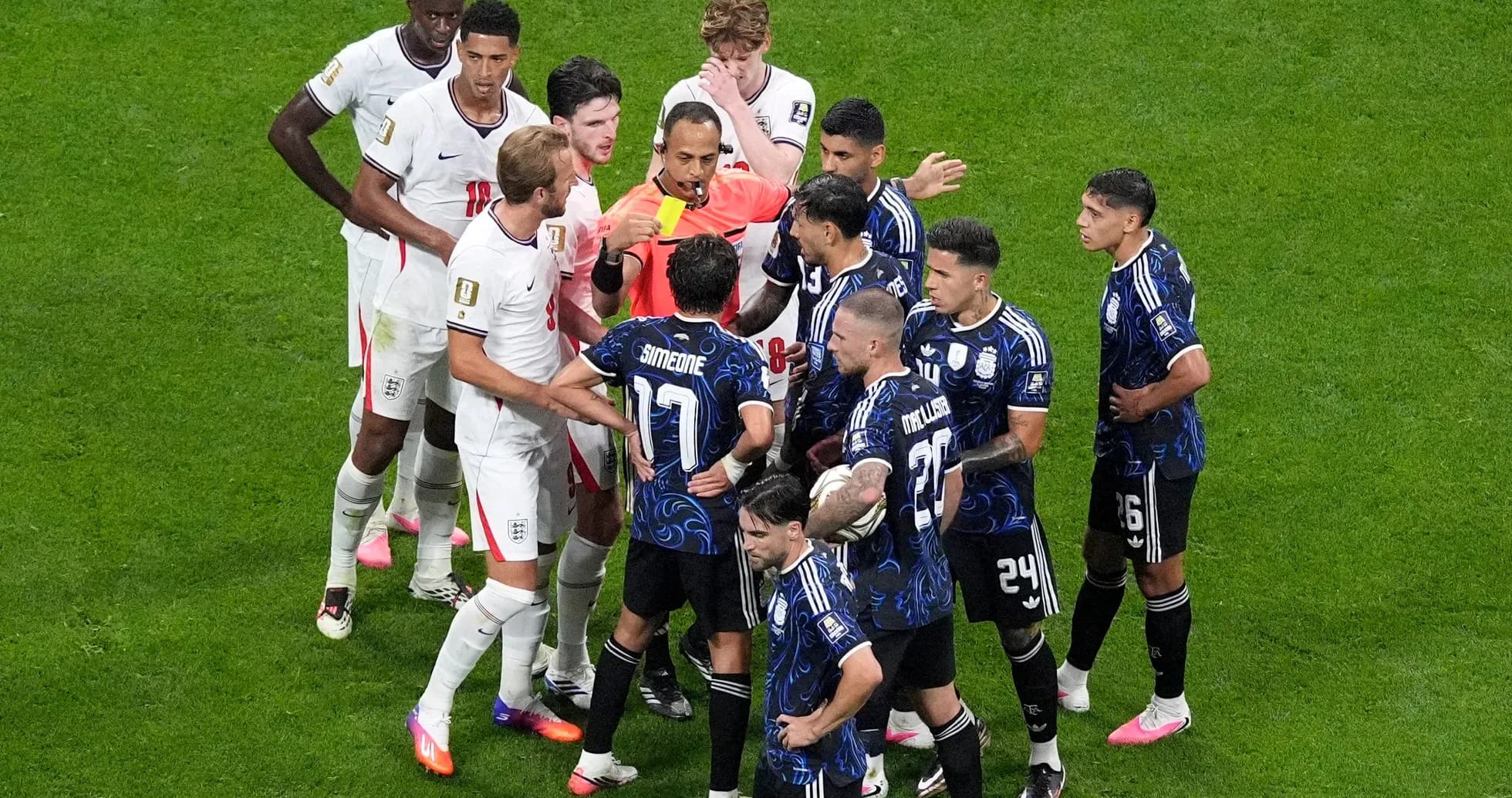
Declan Rice, already a central figure in the tournament’s disciplinary charts with 2 yellow cards, again walked the fine line between enforcement and exposure. England’s season-long card profile had shown a tendency to collect yellows in the 31–45 and 61–75 minute windows, each accounting for 25.00% of their bookings. That pattern spoke to a side that often raised the intensity – and the risk – just before and just after half-time. In a semi-final of this magnitude, every tactical foul, every delayed transition risked tipping the balance.
Argentina, by contrast, came in with a more erratic card timeline. Their yellows peaked dramatically in extra-time phases: 44.44% of their cautions arrived between 91–105 minutes, and 22.22% between 106–120. In regulation, they tended to stay relatively clean, with only scattered bookings in the 31–45, 46–60 and 76–90 windows. Lionel Scaloni’s side, in other words, usually kept their discipline during normal time and only flirted with chaos when matches stretched beyond 90 minutes. In this semi-final, settled in regular time, that tendency helped them preserve structural integrity when it mattered most.
III. Key Matchups: Hunter vs Shield, Engine Room vs Orchestrator
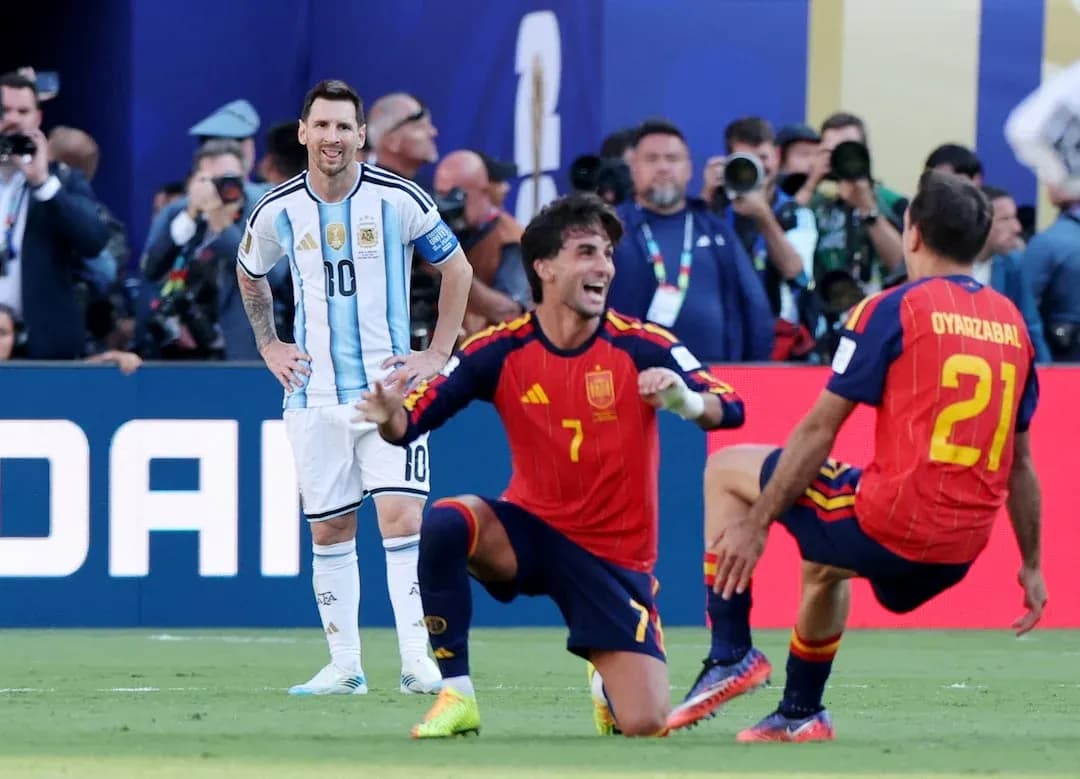
The headline duel was never going to be anything but L. Messi against the England back line. Messi arrived as the World Cup’s leading scorer and creator: 8 goals and 4 assists in 7 appearances, with a 9.07 average rating, 28 shots (18 on target) and 26 key passes from 314 total passes at 81% accuracy. He had also attempted 35 dribbles, completing 24, and won 51 of 90 duels. Those numbers framed him not just as a finisher, but as the entire attacking architecture.
The “shield” England raised was a composite: Stones and Guehi’s positioning, Rice’s screening, and the full-backs’ judgement on when to engage. Rice’s tournament passing – 240 completed at 91% accuracy with 15 key passes – underlined that he was not simply a destroyer. But his 4 tackles, 2 blocks and 2 interceptions, coupled with a history of cards, meant his timing against Messi’s drifting movements was always going to be decisive.
Further forward, the English “engine room” was built around J. Bellingham. With 6 goals and 1 assist in 7 matches, plus 223 passes at 82% accuracy and 8 key passes, he functioned as the side’s tempo-setter and late-arriving threat. His 14 tackles and 3 interceptions showed a two-way profile, while 84 duels contested and 44 won illustrated his willingness to engage physically between the lines.
Opposite him, Argentina deployed a multi-layered midfield. L. Paredes anchored, while E. Fernandez and A. Mac Allister operated as shuttlers and connectors, and G. Simeone added vertical running. Behind them, the back four of N. Molina, C. Romero, L. Martinez and N. Tagliafico had been part of a unit that, overall, conceded just 1.0 goal per match both at home and away. Their job was to compress the pockets Bellingham loves to exploit and to deny H. Kane the space to turn.
Kane, for his part, entered with 6 goals and 1 assist from 7 appearances, 18 shots (12 on target) and a 7.19 rating. He had already scored 2 penalties in the tournament, with no misses. His role in Tuchel’s 4-2-3-1 was dual: final finisher and dropping pivot. Around him, A. Gordon and M. Rogers offered width and pressing, while Gordon’s 3 assists and 6 key passes in 412 minutes made him a subtle but significant creative source. On the opposite flank or off the bench, B. Saka’s 3 assists and 5 key passes in just 267 minutes gave England another line-breaking option.
For Argentina, J. Alvarez’s deployment as a nominal midfielder in the 4-1-4-1 spoke to Scaloni’s intention: defend in a compact 4-1-4-1, then spring into a 4-2-3-1 or 4-3-3 with Messi as the free forward and Alvarez attacking the half-spaces. The interplay between Messi, Alvarez and Mac Allister against England’s double pivot was the game’s most delicate chessboard.
IV. Statistical Prognosis and Tactical Verdict
From a statistical standpoint, Argentina’s edge lay in their attacking ceiling and their ability to win without clean sheets. With 19 goals in 7 matches and an overall concession rate of 1.0, they were comfortable in games where both sides scored. England, while also positive overall (14 for, 8 against), leaned more heavily on structure and control, with only 2 clean sheets in 7 outings and one match where they failed to score.
Penalties formed a subtle subplot. England’s record from the spot this campaign was perfect: 2 penalties taken, 2 scored, 0 missed. Argentina’s was the opposite: 3 penalties, only 1 scored and 2 missed, with Messi himself having missed twice in the tournament. In a semi-final where marginal gains often come from set pieces, England could reasonably trust their composure from 12 yards, while Argentina had to rely more on open-play superiority.
Following this result, the narrative aligned with the numbers. Argentina’s habit of finding multiple routes to goal, powered by Messi’s all-encompassing influence, overcame England’s structured 4-2-3-1. Tuchel’s side, built on Bellingham’s surges, Kane’s gravity and Gordon’s incision, pushed a near-perfect Argentine machine to the brink but could not quite bend its statistical destiny.
In the end, the semi-final felt less like an upset and more like an inevitable convergence: a team averaging 2.7 goals per match overall, unbeaten in 7, guided by the tournament’s most decisive player, found just enough to edge an England side that had grown into a formidable, if slightly less explosive, contender. The 2–1 scoreline was a tactical verdict as much as a numerical one – Argentina’s higher ceiling, England’s admirable but ultimately insufficient control.