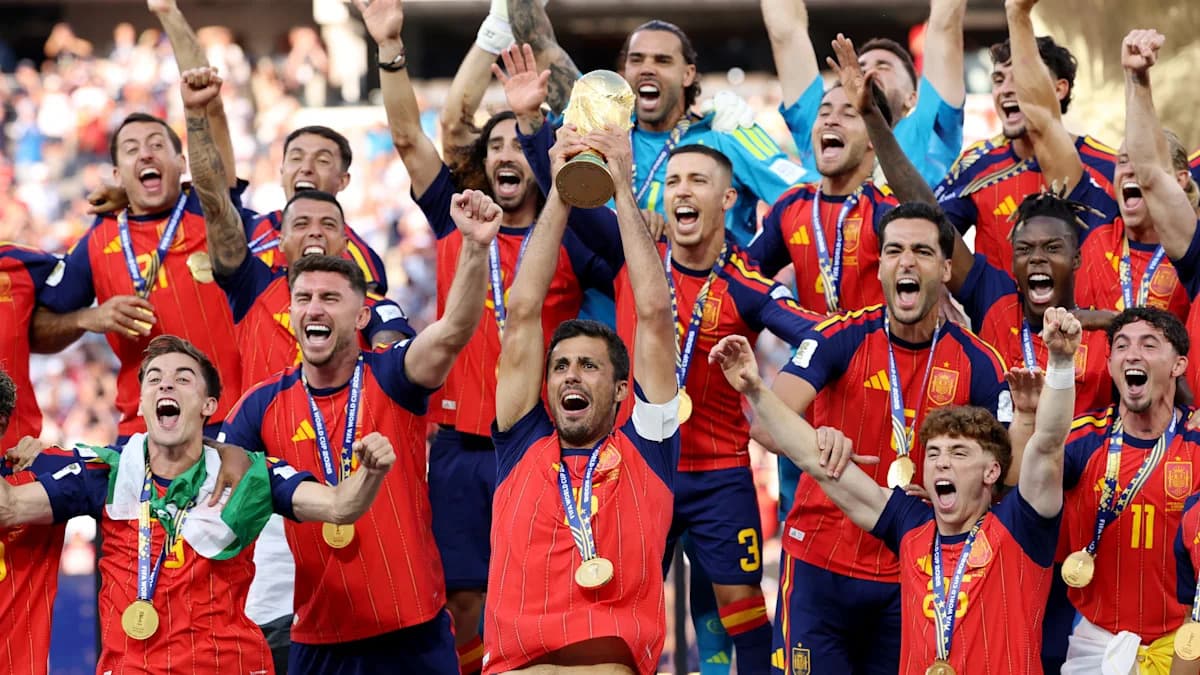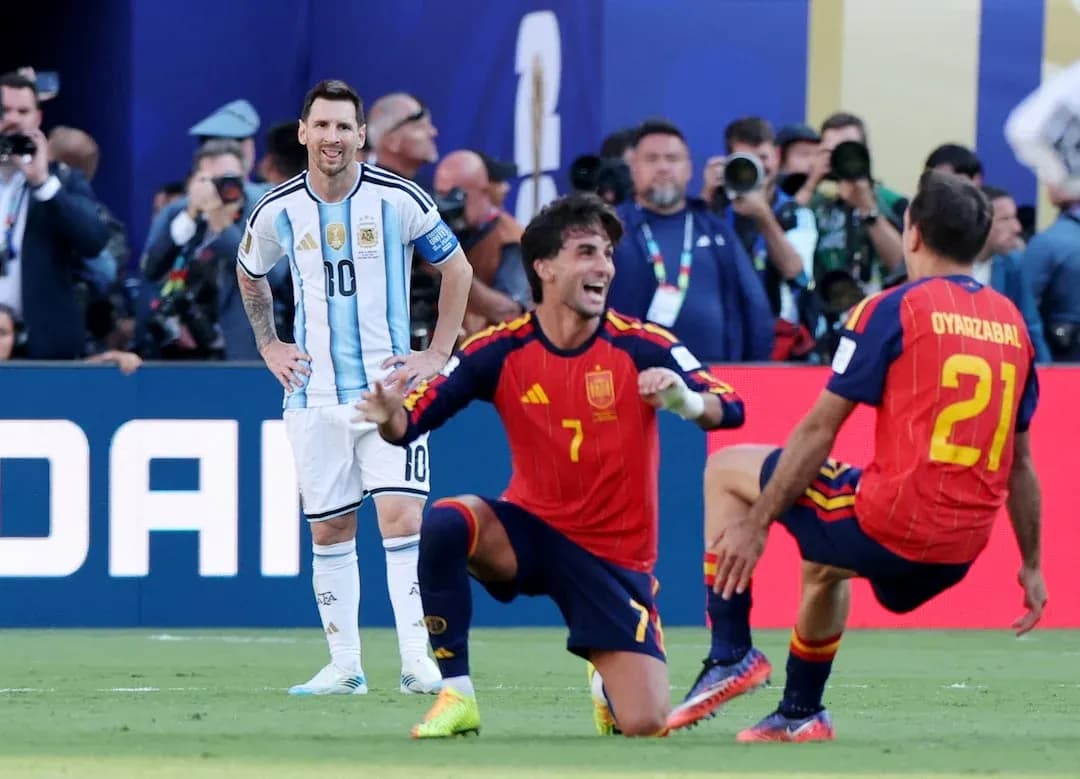
Spain Triumphs Over Argentina in World Cup Final
MetLife Stadium, East Rutherford. A World Cup Final that needed 120 minutes, not penalties, to separate Spain and Argentina. Spain’s 1–0 extra‑time win is the culmination of two sharply defined footballing identities that had been converging on this night from the opening group games.
I. The Big Picture – Two Perfect Arcs Collide
Heading into this game, Spain and Argentina had carved near‑perfect paths through the tournament. Spain topped Group H with 7 points, a goal difference of 5 built on 5 goals scored and none conceded in 3 matches. Overall this campaign, Spain played 8 fixtures, winning 7 and drawing 1, with no defeats. They scored 14 goals in total and conceded just 1, an overall average of 1.8 goals scored and 0.1 conceded per match. Their defensive line was almost hermetic: 7 clean sheets in 8 games.
Argentina arrived as the other heavyweight. They dominated Group J with 9 points, 8 goals scored and 1 conceded, for a group‑stage goal difference of 7. Over the full campaign they also played 8 fixtures, winning 7 and losing only once. Their attack was the most explosive of the two: 19 goals in total, averaging 2.4 per match, but they were more open at the back, conceding 8 (an average of 1.0 per game).
On the tactical board, Luis de la Fuente trusted his familiar 4‑2‑3‑1 for Spain. Unai Simón behind a back four of Pedro Porro, Pau Cubarsí, Aymeric Laporte and Marc Cucurella, with Rodri and Fabián Ruiz anchoring the midfield. Ahead of them, a fluid line of Lamine Yamal, Dani Olmo and Álex Baena supported Mikel Oyarzabal as the lone forward.
Lionel Scaloni answered with Argentina’s staple 4‑4‑2. Emiliano Martínez in goal, Gonzalo Montiel, Cristian Romero, Lisandro Martínez and Nicolás Tagliafico in defence. In midfield, Rodrigo de Paul, Enzo Fernández, Alexis Mac Allister and Nicolás González formed a compact band behind Lionel Messi and Julián Álvarez.
II. Tactical Voids – Discipline and Margins
Neither side entered with notable absences; the squads listed were fully available. The real voids were tactical and psychological: who would bend their identity first in a Final that demanded perfection?
Spain’s season‑long card profile hinted at a side that picks its battles. Their yellow cards clustered late: 33.33% between 31–45 minutes, 16.67% from 46–60, then a striking 50.00% between 91–105. They rarely lost their heads, with no red cards across the campaign. Argentina’s path was more combustible. Their yellow cards were spread, but the real red‑zone came in extra time: 33.33% of their yellows between 91–105 and 20.00% from 106–120. Crucially, they had already seen a red in this tournament between 91–105 minutes, a warning about how fine their emotional margins were when games stretched beyond regulation.
Enzo Fernández embodied that edge. Across the World Cup he combined 2 goals with high‑volume passing and duels, but his disciplinary line included a yellow and a yellow‑red, underlining how his aggression can tip either way. Leandro Paredes and Cristian Romero each collected 2 yellows in the competition, and both defenders and midfielders had shown a readiness to step into the line of fire.
III. Key Matchups – Hunter vs Shield, Engine Room vs Enforcer
The Final’s central duel was always going to be Lionel Messi against Spain’s defensive structure. Messi came in as the competition’s standout attacker: 8 goals and 4 assists, 28 shots (18 on target), and 38 dribble attempts with 27 successful. He was both hunter and architect, leading the assist charts as well. Yet even a star of that magnitude carried scars into this Final: from the spot, he had missed 2 penalties in this tournament and had not scored any, a rare vulnerability for a player of his stature.
Spain’s answer was collective rather than individual. Overall, they had allowed just 1 goal in 8 matches, with the only concessions arriving in the 31–45 and 46–60 minute bands. Pau Cubarsí and Aymeric Laporte, shielded by Rodri, formed a triangle designed less to win duels spectacularly and more to suffocate passing lanes into Messi’s feet. Spain’s defensive minute distribution showed no late‑game collapses; after 60 minutes they had not conceded at all, a perfect platform for extra time.
Upfield, Mikel Oyarzabal was Spain’s cutting edge. With 5 goals and 1 assist in the tournament, plus 21 shots (12 on target), he was the one Spanish attacker who consistently turned control into end product. Behind him, Dani Olmo and Lamine Yamal offered different threats: Olmo as the half‑space schemer, Yamal as the wide dribbler tasked with stretching Argentina’s compact 4‑4‑2.
On the other side, Messi was not alone. Lautaro Martínez matched his 8‑goal tally in the scoring charts, also adding 4 assists. Scaloni had the option to unleash Lautaro from the bench or start him, as here, alongside Julián Álvarez, turning Argentina into a twin‑striker threat that could attack Spain’s centre‑backs with constant movement.
In midfield, the engine‑room confrontation was brutal and cerebral. Rodri and Fabián Ruiz, both secure in possession, faced an Argentine axis of Enzo Fernández and Alexis Mac Allister, flanked by the relentless running of Rodrigo de Paul. Enzo’s 512 passes at 93% accuracy and 11 tackles across the tournament framed him as the metronome‑enforcer hybrid; Rodri’s role was similar, but within a system that had conceded far fewer chances.
IV. Statistical Prognosis – Control vs Chaos
The deeper numbers framed this Final as a clash between Spain’s control and Argentina’s chaos‑late surge. Spain’s goals‑for distribution showed a multi‑phase threat: 30.77% of their goals between 16–30 minutes, 23.08% from 76–90, and a further 7.69% in the 106–120 band. They were capable of striking early, then again late, and even in extra time. Defensively, once they navigated the brief vulnerability around half‑time, they were almost unbreachable.
Argentina, by contrast, were the masters of the late storm. A remarkable 44.44% of their goals arrived between 76–90 minutes, with another 11.11% in the 106–120 window. They lived for the closing quarter‑hour, turning games with surges of pressure. But their goals‑against profile exposed soft underbelly zones: 33.33% conceded between 46–60, 22.22% from 61–75, and another 22.22% in the 106–120 band. When matches stretched, they opened up.
In a Final that went to extra time, those curves intersected decisively. Spain, with their almost flawless defensive record and proven ability to score in the 106–120 range, were built for a long game. Argentina, who had already conceded 2 goals in that same 106–120 band and carried a history of late cards and a prior red in extra time, were always at risk of fraying when the match extended beyond 90 minutes.
Following this result, the narrative is clear. Spain’s 1–0 extra‑time win is not an upset but the logical endpoint of a campaign defined by control, clean sheets and timely goals. Argentina’s brilliance, embodied by Messi and Lautaro Martínez, brought them to the brink, but their structural openness and emotional volatility in the deepest minutes of knockout football left just enough space for Spain’s patient, meticulous football to write the final line of the World Cup.