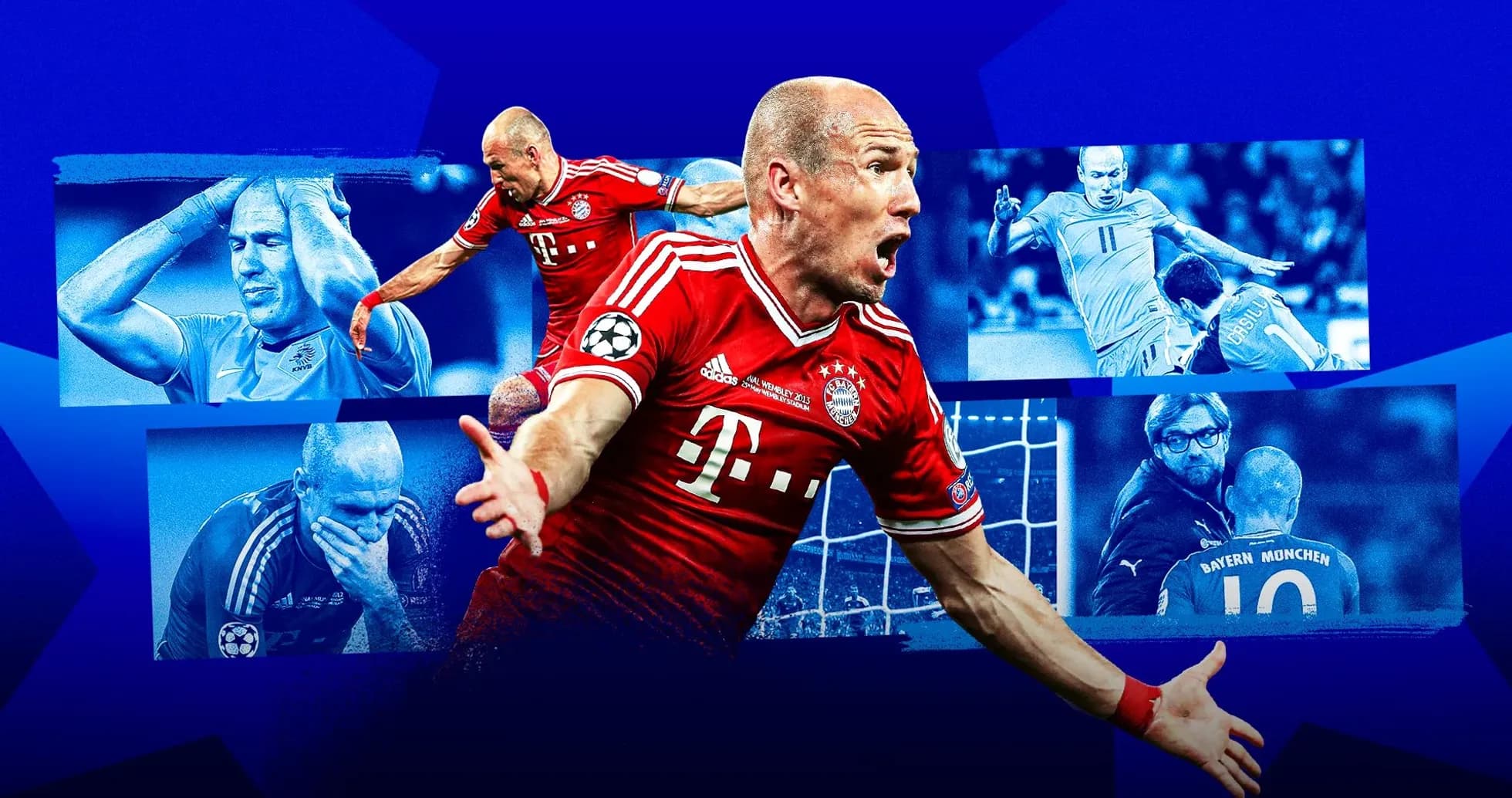
Arjen Robben: From ‘Man of Glass’ to Game-Changer
Before the jokes, before the memes about cutting inside and missing in finals, Arjen Robben was something else entirely.
He was fear.
Every full-back in Europe knew what he was going to do. He’d hug the touchline, square you up, drive inside onto that left foot and bend the ball into the far corner. Everyone knew it. Nobody stopped it.
At PSV, Chelsea, Real Madrid and then Bayern Munich, he collected league titles like souvenirs. In the Champions League, he lit up nights against Manchester United, Barcelona, Borussia Dortmund. The stage never looked too big. Not at first.
The one-man rescue act
By 2010, Bayern Munich were building around him. Louis van Gaal had Mario Gomez, Thomas Müller, Franck Ribéry, Bastian Schweinsteiger and a squad that looked ready to climb Europe’s highest peak. They did the domestic double in 2009-10, yet their Champions League campaign began with a stumble.
Robben dragged them through it.
Against Fiorentina in the last 16, Bayern carried a 2-1 lead from the first leg, Robben having scored from the spot. In Florence, though, they sank to 3-1 down. The tie was slipping away.
Then, in the 65th minute, Robben picked up the ball in the middle of Fiorentina’s half. One touch, a glide into space, and then that familiar whip of the left foot. The shot arced into the top corner, one of the most beautiful goals of his career.
At 4-4 on aggregate, Bayern advanced on away goals.
The script repeated itself in the quarter-finals. Manchester United escaped him in the first leg through injury, but still lost 2-1 in Munich. At Old Trafford, United surged to a 3-1 lead. Bayern looked done.
Robben refused.
From a Ribéry corner, he peeled away to the edge of the box and met the ball with a volley of such precision that even he seemed stunned, standing almost in disbelief as he celebrated. Again, Bayern went through on away goals.
In the semi-final against Lyon, he struck from distance at the Stade de Gerland, another long-range effort that left Hugo Lloris frozen in a 1-0 win. Robben wasn’t just decisive. He was dragging Bayern by the scruff of the neck.
Then came the final at the Santiago Bernabéu.
Against José Mourinho’s Inter, Bayern went with Ivica Olić and Thomas Müller up front, Ribéry suspended. Robben was isolated, Inter were ruthless, and Bayern meekly lost 2-0. Robben, so electric in the run, suddenly looked human.
Johannesburg: the toe that changed everything
That summer, another stage, another defining moment.
Robben arrived at the 2010 World Cup already branded the “Man of Glass”, his tournament delayed by more hamstring trouble. Once fit, he transformed the Netherlands.
He opened the scoring in a tight last-16 win over Slovakia. Against Brazil in the quarter-final, he set up a crucial goal in a 2-1 comeback. In the semi-final against Uruguay, he headed what proved to be the winner. Oranje were in the final.
And there, in Johannesburg, the image that would haunt him.
The match against Spain turned nasty, nine Dutch players booked, Nigel de Jong’s chest-high kick on Xabi Alonso burned into football’s collective memory. But the pivotal moment belonged to Robben and Iker Casillas just after the hour.
Wesley Sneijder threaded a quick pass through the middle. Robben burst clear, alone, galloping towards history. He waited, measured, perhaps overthought it. As he tried to roll the ball to his left, Casillas flung out a leg and diverted it wide with the slightest touch.
Dutch media named it “The toe of Casillas”. One touch, one toe, and a dream evaporated.
Casillas later admitted that as Robben closed in, his only thought was to stay on his feet for as long as possible. When he finally dived, he assumed Robben would go past him. “Of all the options he had, Robben chose exactly the wrong one,” the goalkeeper reflected. “If he had scored there, that final would probably have ended very differently.”
It never did for the Netherlands. Andrés Iniesta struck in extra time, and the World Cup slipped away.
“It hurts to miss such a chance,” Robben said four years later. “It’s part of sport, just a moment, a snapshot. But it will be part of me and part of my career for all of my life.”
That snapshot would not be the last.
Penalties, pressure and a brutal narrative
Back in Munich, Robben’s body again betrayed him in 2010-11. He barely played, but when he did he was devastating: 12 goals and eight assists in just 14 Bundesliga matches. The following season he stayed fitter, Bayern surged, and he helped them back to the Champions League final.
On the way, he revisited the Bernabéu, this time in a Bayern shirt against his former club Real Madrid.
The second leg of the semi-final looked lost early. Bayern fell 2-0 behind on the night and 3-2 down on aggregate within 14 minutes. Then, in the 27th minute, came another Robben penalty, another collision with Casillas.
With Munich’s hopes on his shoulders, he stepped up, two years on from Johannesburg. Casillas got a fingertip to it but couldn’t keep it out. Level on aggregate, Bayern survived and won the shootout.
It felt like a personal exorcism. It was really only the rehearsal.
At the Allianz Arena, in the 2012 final against Chelsea, Robben’s season came down to one more spot kick. Bayern had dominated but were pegged back to 1-1. In extra time, Didier Drogba tripped Ribéry in the box. Again, Robben took responsibility.
He went low to the corner. Petr Cech read it, smothered it, and the stadium fell silent.
Chelsea went on to win on penalties. Bayern’s dream of lifting the trophy at home died on the spot. For Robben, it was a double blow: he had already missed a title-deciding penalty against Borussia Dortmund in the Bundesliga weeks earlier. The label was now brutally clear.
He was no longer just the “Man of Glass”. He was the man who missed when it mattered.
“I can't describe how I feel with words, but it's been a terrible night,” he admitted. “Two or three times, you feel you have the cup in your hands but at the end you stand with nothing.”
He did not spare himself either. “It wasn't a good penalty. I wanted to shoot the ball hard and high in the goal, but the ball didn't go high enough. It was a terrible penalty kick. After that, I still played well but you have to change your mindset at that point.”
The injuries continued. The doubts deepened. Many wondered if the 2012-13 season would pass him by altogether.
The rebirth: Barcelona crushed, Dortmund broken
Robben played only 16 Bundesliga games in 2012-13. Bayern didn’t seem to need him domestically; they ripped the league apart anyway. But when the Champions League knockout rounds arrived, he was there. And he was ruthless.
Against Barcelona in the semi-final, Bayern produced a 7-0 aggregate demolition, with Robben at the heart of it.
In Munich, he tortured Jordi Alba, constantly cutting inside, constantly threatening. He scored Bayern’s third in a 4-0 first-leg win, a composed finish in a performance he would later call his best at the Allianz Arena.
The second leg at Camp Nou brought the quintessential Robben moment.
Early in the second half, he took down a long pass on the right wing. One razor-sharp touch, a cut inside past Adriano, and then that familiar, devastating curl into the top corner. Barcelona were carved open by a move everyone knew was coming and still couldn’t stop.
“That 4-0 was my best game at the Allianz Arena,” he told Sport Bild years later. “Against such a great team. With an uncharacteristic Robben goal. I broke through on the right wing with a stepover and had time to curl the ball into the far corner from a tight angle.”
He wasn’t finished.
The final at Wembley, against Jürgen Klopp’s Borussia Dortmund, turned into a test of nerve as much as talent. Dortmund’s pressing and intensity gave them the edge in the first half. Bayern bent but did not break.
After the break, Robben slipped a pass across goal for Mario Mandžukić to tap in. Bayern led. Eight minutes later, Dortmund equalised from the spot. Soon after, Neven Subotić somehow hooked the ball away from Robben with the goal gaping, and the old fears resurfaced. Was this another cruel chapter?
Not this time.
In the 89th minute, a long ball dropped towards the edge of the Dortmund area. Ribéry fought for it and flicked a delicate backheel into the chaos of yellow shirts. Robben anticipated it, darted into the gap and seized his moment.
Roman Weidenfeller rushed out, Mats Hummels and Subotić closed in. Johannesburg, Munich, all of it hung in the air.
Robben didn’t lash at the ball. He glided past the defenders, nudged it past the keeper with a touch so light it almost defied the stakes, and watched as it rolled slowly, almost teasingly, over the line.
“When I got the ball, I was free,” he said afterwards. “I anticipated Franck’s movement. The only thought was: 'I hope he puts the ball there' because I saw the space. I took it well. My first choice was actually to go past [Weidenfeller] on the left side but then he made a move and I could put it to the other side. He was on the wrong leg.”
Bayern were champions of Europe again. For Robben, it was something deeper.
“To finally win this Champions League, that's a dream come true,” he said. “You can't describe it – so many emotions go through your head, especially because you know what it is like to lose. I think you can enjoy it even more when you win the title.”
He knew exactly what he had shaken off. “After the disappointment of last year, and to a [lesser extent] 2010, and the World Cup for me – that's three finals and you don't want the stamp of a loser. At last we did it today, and we can forget about the other things a bit. It was a sense of 'finally'.”
In 2025, Bayern fans voted that goal the greatest in the club’s 125-year history. Second place? Robben’s volley at Old Trafford. The same player once whistled by his own crowd had given them their most cherished memories.
Brazil 2014: the legend rewritten
With his final demons exorcised, Robben’s late career took on a different tone. The pressure didn’t vanish; he just seemed to play above it.
At the 2014 World Cup in Brazil, a 30-year-old Robben arrived as a man unburdened.
Netherlands opened against Spain in a rematch of the 2010 final. This time, Oranje destroyed La Roja 5-1, and Robben produced one of the great individual World Cup performances.
He scored his first by plucking a long pass out of the sky, shifting past Sergio Ramos and finishing coolly. The second was pure, raw athleticism and composure.
Starting deep, he sprinted away from Ramos at astonishing speed, took down another long ball, dragged Casillas to the turf and waited, just long enough, before lashing the ball into the net while the goalkeeper flailed on his knees.
That night, the story around Robben changed for good.
He drove a Netherlands side that many felt overachieved under Van Gaal all the way to the third-place play-off. He was no longer the man defined by a missed one-on-one in Johannesburg or a saved penalty in Munich. He was the phenomenon who had lived through those failures and come out sharper, colder, more decisive.
A legacy carved in scars and silverware
The trophies piled up in Bavaria. Eight Bundesliga titles. Five DFB-Pokals. Across 307 Bayern appearances, Robben delivered 144 goals and 101 assists.
After the 2013 Champions League win, Bayern reached four more semi-finals, but under Pep Guardiola the European crown eluded them. Robben’s relationship with the competition stayed complicated, but his status in Munich did not.
When he left Bayern in 2019, in tears, another league title in his hands, the same supporters who had once jeered him off the pitch sang his name as a legend.
He did not leave as the fragile winger who broke down in big moments. He left as the ferocious forward who had felt the heaviest kind of failure – personal, public, repeated – and still forced his way into football history.
The man who always cut inside. The man everyone thought they could read.
And the man who, when it mattered most in the end, finally wrote his own ending.